Stier Andreas V, McCreary Kathleen M, Jonker Berend T, Kono Junichiro, Crooker Scott A
National High Magnetic Field Laboratory, Los Alamos National Laboratory, Los Alamos, New Mexico 87545, USA.
Materials Science and Technology Division, Naval Research Laboratory, Washington, Washington DC 20375, USA.
Nat Commun. 2016 Feb 9;7:10643. doi: 10.1038/ncomms10643.
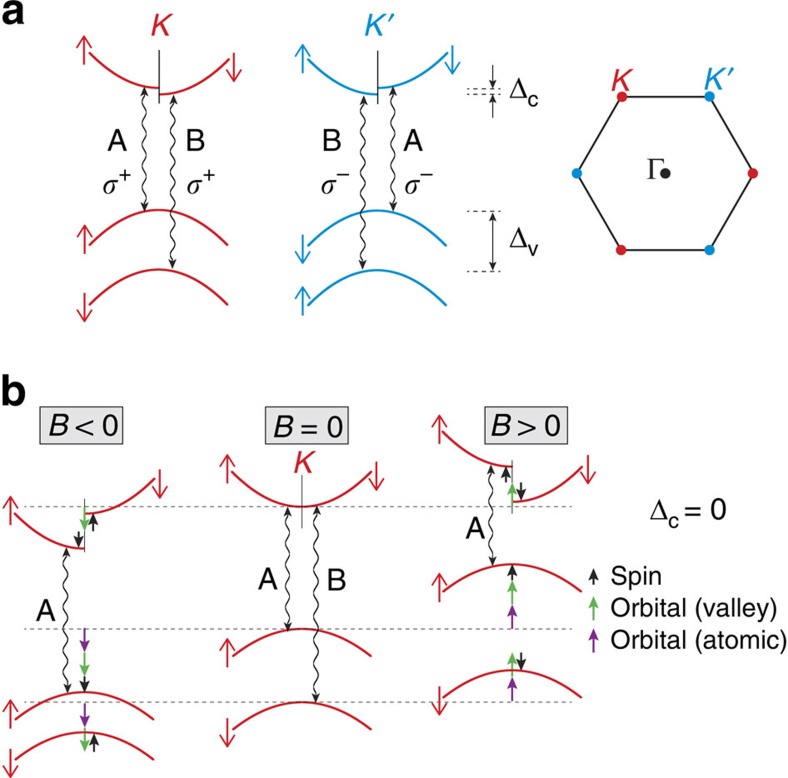
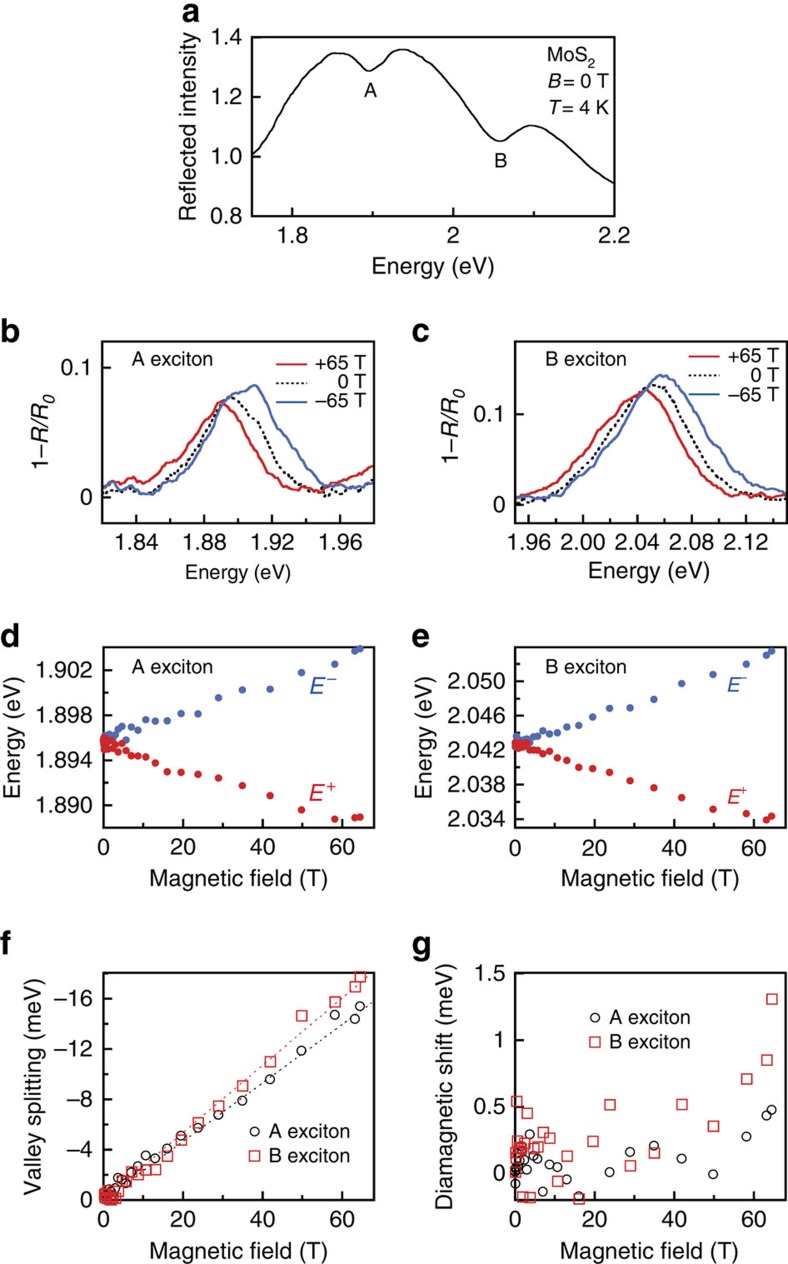
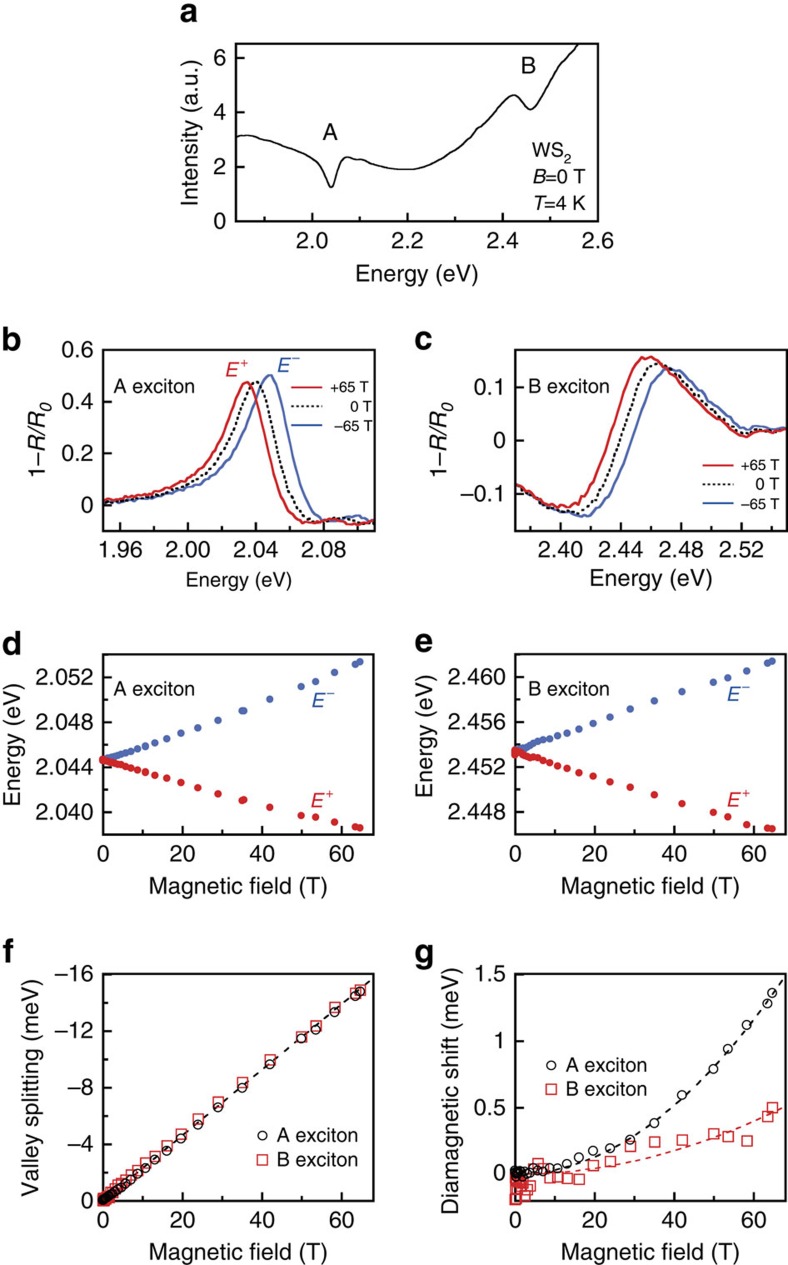
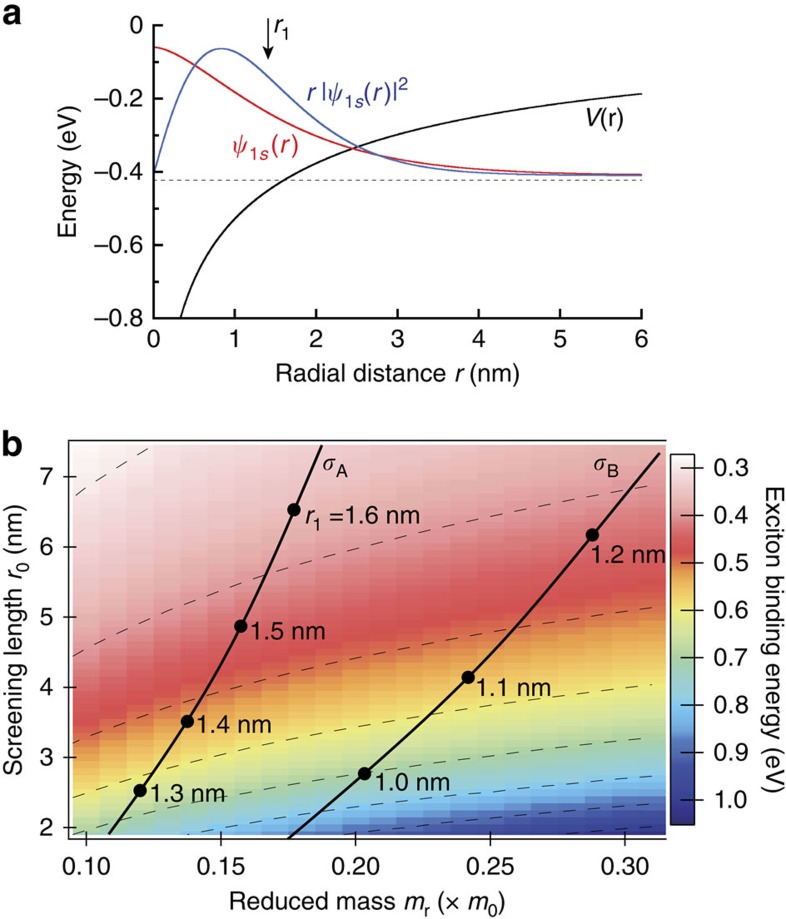
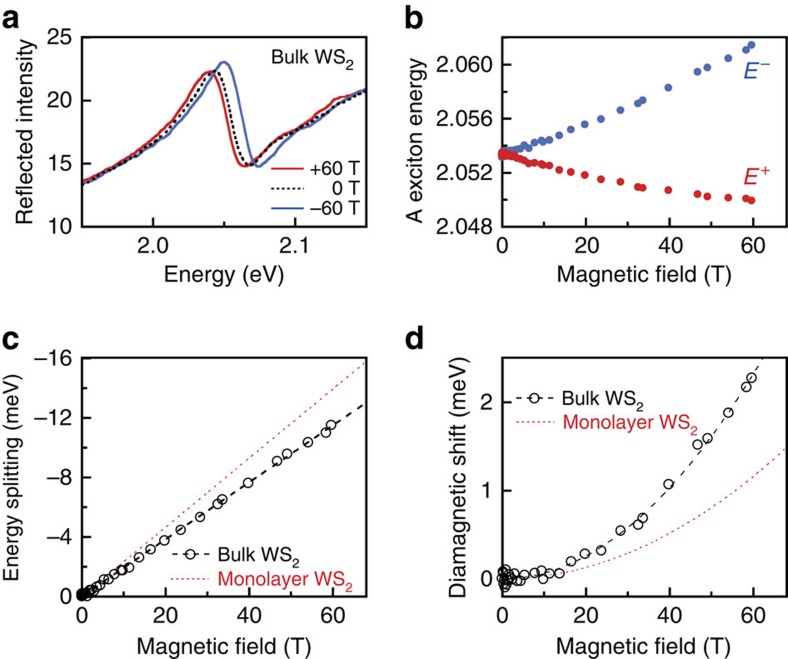
In bulk and quantum-confined semiconductors, magneto-optical studies have historically played an essential role in determining the fundamental parameters of excitons (size, binding energy, spin, dimensionality and so on). Here we report low-temperature polarized reflection spectroscopy of atomically thin WS2 and MoS2 in high magnetic fields to 65 T. Both the A and B excitons exhibit similar Zeeman splittings of approximately -230 μeV T(-1) (g-factor ≃-4), thereby quantifying the valley Zeeman effect in monolayer transition-metal disulphides. Crucially, these large fields also allow observation of the small quadratic diamagnetic shifts of both A and B excitons in monolayer WS2, from which radii of ∼1.53 and ∼1.16 nm are calculated. Further, when analysed within a model of non-local dielectric screening, these diamagnetic shifts also constrain estimates of the A and B exciton binding energies (410 and 470 meV, respectively, using a reduced A exciton mass of 0.16 times the free electron mass). These results highlight the utility of high magnetic fields for understanding new two-dimensional materials.
在体相和量子限制半导体中,磁光研究在确定激子的基本参数(尺寸、结合能、自旋、维度等)方面一直发挥着重要作用。在此,我们报告了在高达65 T的强磁场中对原子级薄的WS2和MoS2进行的低温偏振反射光谱研究。A激子和B激子都表现出类似的塞曼分裂,约为 -230 μeV T⁻¹(g因子≃ -4),从而量化了单层过渡金属二硫化物中的谷塞曼效应。至关重要的是,这些强磁场还使得能够观察到单层WS2中A激子和B激子的小二次反磁位移,据此计算出半径约为1.53和1.16 nm。此外,在非局部介电屏蔽模型中进行分析时,这些反磁位移还限制了对A激子和B激子结合能的估计(分别为410和470 meV,使用的A激子折合质量为自由电子质量的0.16倍)。这些结果突出了强磁场对于理解新型二维材料的实用性。