Pagabeleguem Soumaïla, Gimonneau Geoffrey, Seck Momar Talla, Vreysen Marc J B, Sall Baba, Rayaissé Jean-Baptiste, Sidibé Issa, Bouyer Jérémy, Ravel Sophie
Pan-African Tsetse and Trypanosomiasis Eradication Campaign, Bobo-Dioulasso, Burkina Faso.
CIRAD, UMR CMAEE, Montpellier, France.
PLoS Negl Trop Dis. 2016 Feb 22;10(2):e0004491. doi: 10.1371/journal.pntd.0004491. eCollection 2016 Feb.
The Government of Senegal has embarked several years ago on a project that aims to eradicate Glossina palpalis gambiensis from the Niayes area. The removal of the animal trypanosomosis would allow the development more efficient livestock production systems. The project was implemented using an area-wide integrated pest management strategy including a sterile insect technique (SIT) component. The released sterile male flies originated from a colony from Burkina Faso.
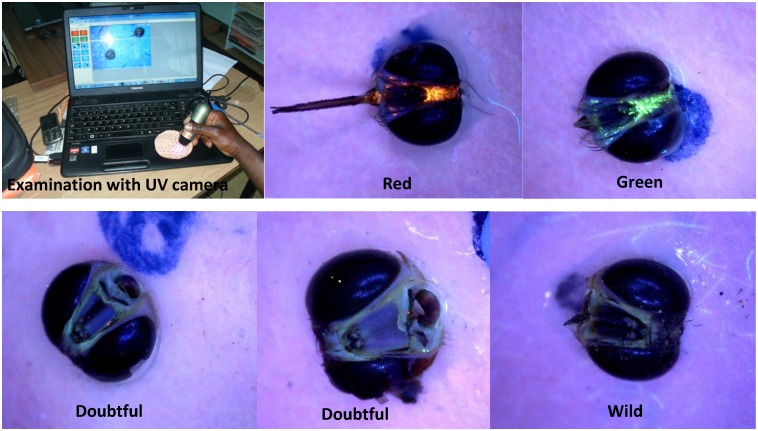
METHODOLOGY/PRINCIPAL FINDINGS: Monitoring the efficacy of the sterile male releases requires the discrimination between wild and sterile male G. p. gambiensis that are sampled in monitoring traps. Before being released, sterile male flies were marked with a fluorescent dye powder. The marking was however not infallible with some sterile flies only slightly marked or some wild flies contaminated with a few dye particles in the monitoring traps. Trapped flies can also be damaged due to predation by ants, making it difficult to discriminate between wild and sterile males using a fluorescence camera and / or a fluorescence microscope. We developed a molecular technique based on the determination of cytochrome oxidase haplotypes of G. p. gambiensis to discriminate between wild and sterile males. DNA was isolated from the head of flies and a portion of the 5' end of the mitochondrial gene cytochrome oxidase I was amplified to be finally sequenced. Our results indicated that all the sterile males from the Burkina Faso colony displayed the same haplotype and systematically differed from wild male flies trapped in Senegal and Burkina Faso. This allowed 100% discrimination between sterile and wild male G. p. gambiensis.
CONCLUSIONS/SIGNIFICANCE: This tool might be useful for other tsetse control campaigns with a SIT component in the framework of the Pan-African Tsetse and Trypanosomosis Eradication Campaign (PATTEC) and, more generally, for other vector or insect pest control programs.
几年前,塞内加尔政府启动了一个项目,旨在从尼亚耶斯地区根除冈比亚采采蝇。消除动物锥虫病将有助于发展更高效的畜牧生产系统。该项目采用区域综合虫害管理策略实施,其中包括不育昆虫技术(SIT)部分。释放的不育雄蝇来自布基纳法索的一个种群。
方法/主要发现:监测不育雄蝇释放的效果需要区分在监测诱捕器中捕获的野生和不育的冈比亚采采蝇。在释放之前,不育雄蝇用荧光染料粉末进行标记。然而,这种标记并非万无一失,一些不育蝇只是轻微标记,或者在监测诱捕器中有一些野生蝇被少量染料颗粒污染。捕获的苍蝇也可能因蚂蚁捕食而受损,这使得使用荧光相机和/或荧光显微镜难以区分野生和不育雄蝇。我们开发了一种基于测定冈比亚采采蝇细胞色素氧化酶单倍型的分子技术,以区分野生和不育雄蝇。从蝇头中分离DNA,并扩增线粒体基因细胞色素氧化酶I 5'端的一部分,最后进行测序。我们的结果表明,来自布基纳法索种群的所有不育雄蝇都显示相同的单倍型,并且与在塞内加尔和布基纳法索捕获的野生雄蝇系统地不同。这使得能够100%区分不育和野生的冈比亚采采蝇。
结论/意义:该工具可能对泛非采采蝇和锥虫病根除运动(PATTEC)框架内其他包含不育昆虫技术部分的采采蝇控制活动有用,更广泛地说,对其他病媒或害虫控制项目也有用。