Gupta Birendra Prasad, Singh Sneha, Kurmi Roshan, Malla Rajani, Sreekumar Easwaran, Manandhar Krishna Das
Central Department of Biotechnology, Tribhuvan University, Kathmandu, Nepal.
Rajiv Gandhi Centre for Biotechnology, Thiruvananthapuram, India.
Indian J Med Res. 2015 Dec;142 Suppl(Suppl 1):S1-6. doi: 10.4103/0971-5916.176564.
BACKGROUND & OBJECTIVES: Epidemiological interventions and mosquito control are the available measures for dengue control. The former approach uses serotype and genetic information on the circulating virus strains. Dengue has been frequently reported from Nepal, but this information is mostly lacking. The present study was done to generate a comprehensive clinical and virological picture of a dengue outbreak in Nepal during 2013.
A hospital-based study involving patients from five districts of Nepal was carried out. Demographic information, clinical details and dengue serological status were obtained. Viral RNA was characterized at the molecular level by reverse-transcription polymerase chain reaction (RT-PCR), nucleotide sequencing and phylogenetic analysis.
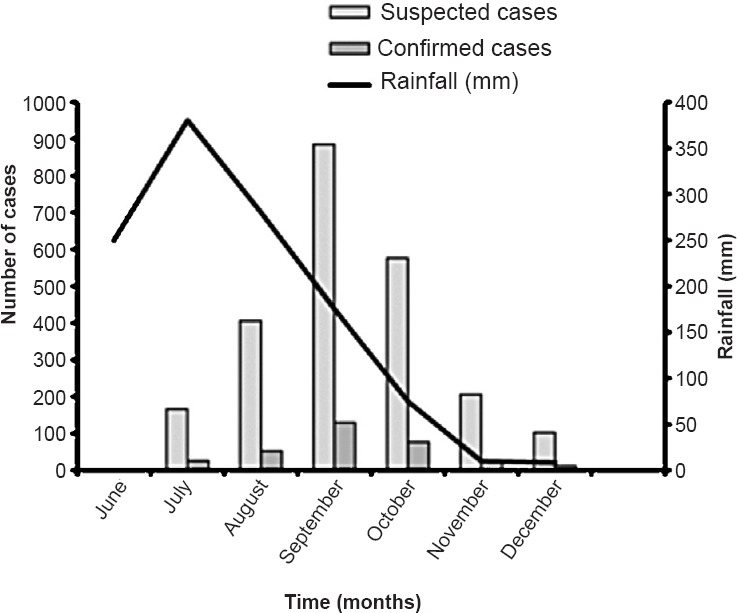
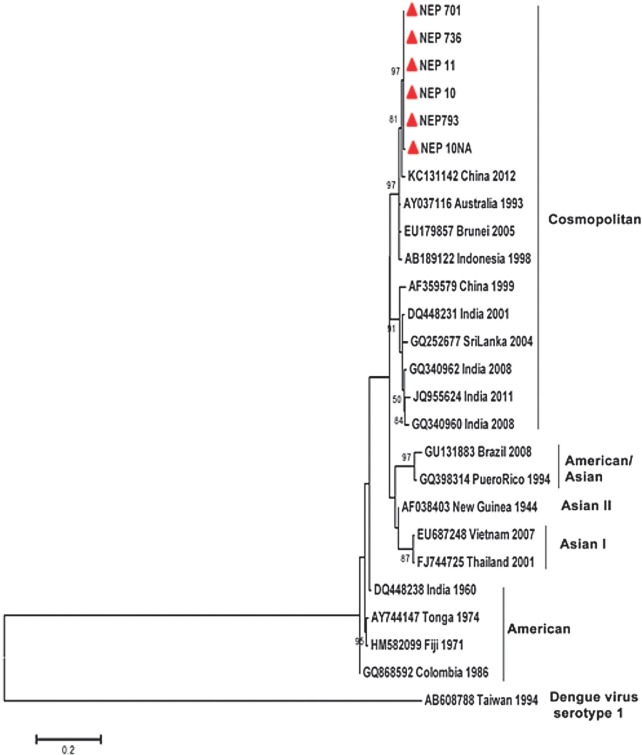
From among the 2340 laboratory-confirmed dengue cases during the study period, 198 patients consented for the study. Clinically they had fever (100%), headache (59.1%), rashes (18.2%), retro-orbital pain (30.3%), vomiting (15.1%), joint pain (28.8%) and thrombocytopenia (74.3%). Fifteen (7.5%) of them had mucosal bleeding manifestations, and the rest were uncomplicated dengue fever. The patients were mostly adults with a mean age of 45.75 ± 38.61 yr. Of the 52 acute serum samples tested, 15 were positive in RT-PCR. The causative virus was identified as DENV serotype 2 belonging to the Cosmopolitan genotype.
INTERPRETATIONS & CONCLUSIONS: We report here the involvement of DENV serotype 2 in an outbreak in Nepal in 2013. Earlier outbreaks in the region in 2010 were attributed to serotype 1 virus. As serotype shifts are frequently associated with secondary infections and severe disease, there is a need for enhancing surveillance especially in the monsoon and post-monsoon periods to prevent large-scale, severe dengue outbreaks in the region.
流行病学干预措施和蚊虫控制是登革热防控的现有手段。前一种方法利用流行病毒株的血清型和基因信息。尼泊尔经常报告登革热病例,但大多缺乏此类信息。本研究旨在全面呈现2013年尼泊尔一次登革热疫情的临床和病毒学情况。
开展了一项基于医院的研究,纳入了来自尼泊尔五个地区的患者。收集了人口统计学信息、临床细节和登革热血清学状况。通过逆转录聚合酶链反应(RT-PCR)、核苷酸测序和系统发育分析在分子水平对病毒RNA进行了特征分析。
在研究期间的2340例实验室确诊登革热病例中,198例患者同意参与研究。临床上,他们均有发热(100%)、头痛(59.1%)、皮疹(18.2%)、眼眶后疼痛(30.3%)、呕吐(15.1%)、关节疼痛(28.8%)和血小板减少(74.3%)。其中15例(7.5%)有黏膜出血表现,其余为无并发症的登革热。患者多为成年人,平均年龄45.75±38.61岁。在检测的52份急性血清样本中,15份RT-PCR呈阳性。致病病毒被鉴定为属于泛在基因型的登革病毒2型。
我们在此报告2013年尼泊尔一次疫情中登革病毒2型的感染情况。该地区2010年的早期疫情归因于1型病毒。由于血清型转变常与二次感染和重症疾病相关,有必要加强监测,尤其是在季风期和季风后期,以预防该地区大规模严重登革热疫情的发生。