Liaw Lucy, Prudovsky Igor, Koza Robert A, Anunciado-Koza Rea V, Siviski Matthew E, Lindner Volkhard, Friesel Robert E, Rosen Clifford J, Baker Paul R S, Simons Brigitte, Vary Calvin P H
Center for Molecular Medicine, Maine Medical Center Research Institute, Scarborough, Maine 04074.
The Graduate School of Biomedical Science and Engineering, University of Maine, Orono, Maine 04469.
J Cell Biochem. 2016 Sep;117(9):2182-93. doi: 10.1002/jcb.25522. Epub 2016 Mar 16.
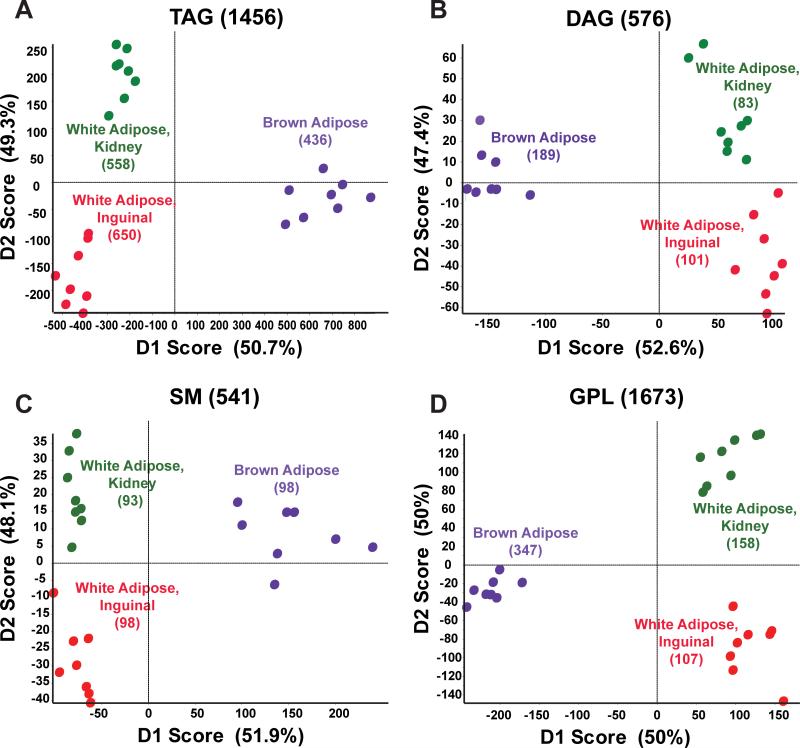
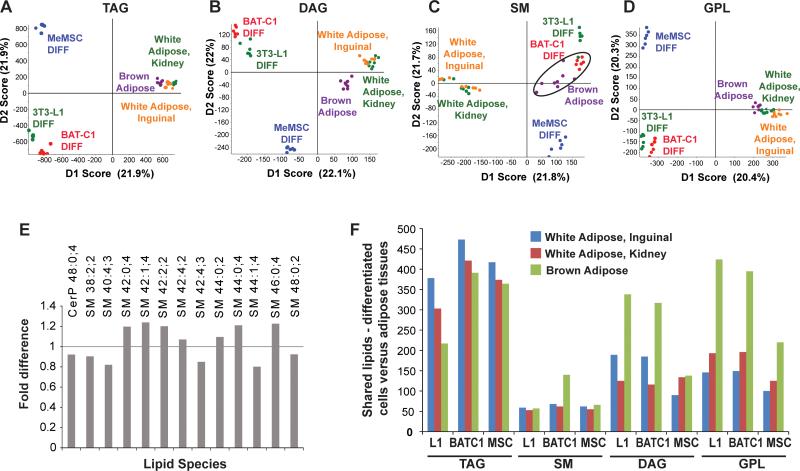
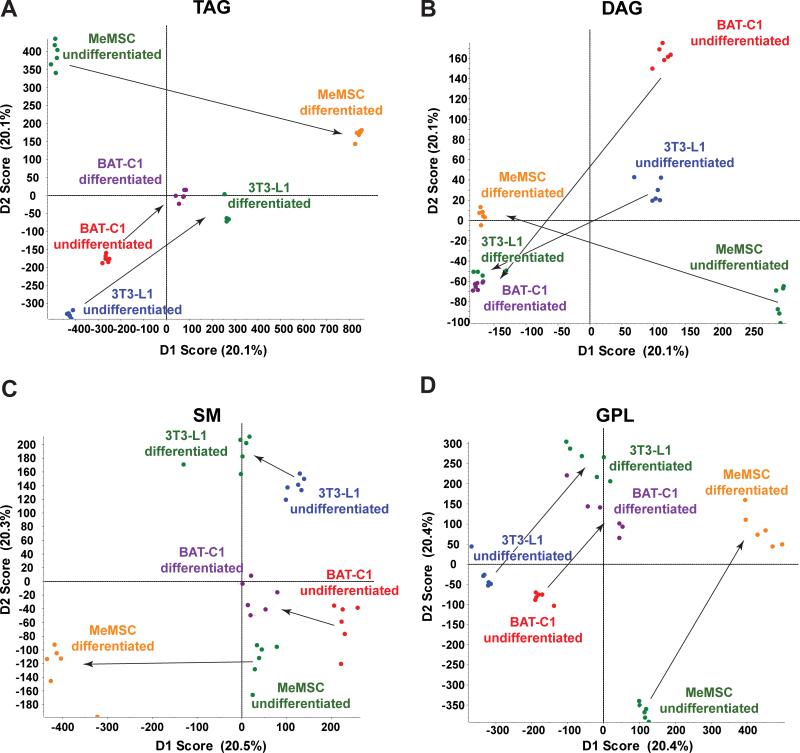
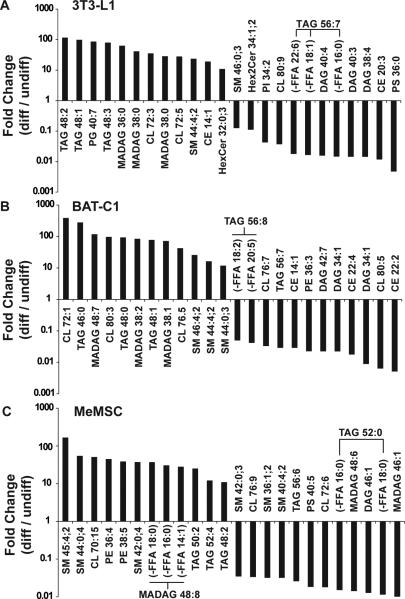
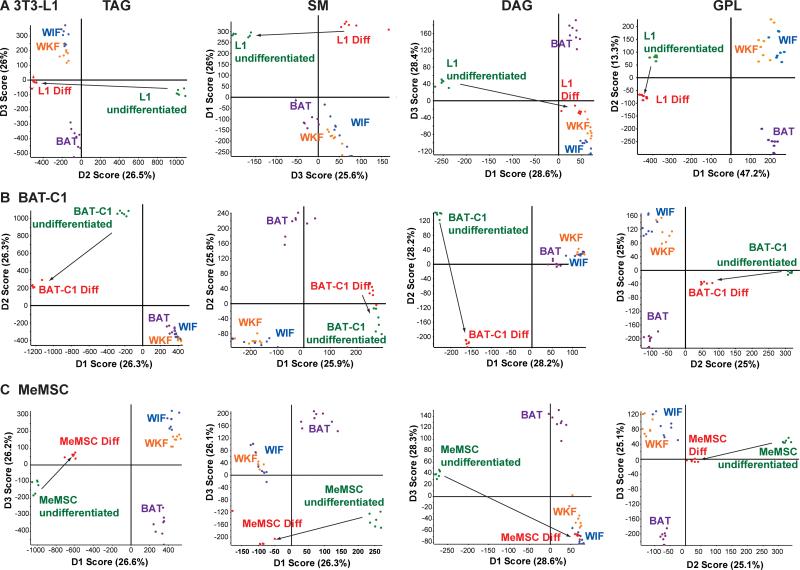
Our objective was to characterize lipid profiles in cell models of adipocyte differentiation in comparison to mouse adipose tissues in vivo. A novel lipid extraction strategy was combined with global lipid profiling using direct infusion and sequential precursor ion fragmentation, termed MS/MS(ALL) . Perirenal and inguinal white adipose tissue and interscapular brown adipose tissues from adult C57BL/6J mice were analyzed. 3T3-L1 preadipocytes, ear mesenchymal progenitor cells, and brown adipose-derived BAT-C1 cells were also characterized. Over 3000 unique lipid species were quantified. Principal component analysis showed that perirenal versus inguinal white adipose tissues varied in lipid composition of triacyl- and diacylglycerols, sphingomyelins, glycerophospholipids and, notably, cardiolipin CL 72:3. In contrast, hexosylceramides and sphingomyelins distinguished brown from white adipose. Adipocyte differentiation models showed broad differences in lipid composition among themselves, upon adipogenic differentiation, and with adipose tissues. Palmitoyl triacylglycerides predominate in 3T3-L1 differentiation models, whereas cardiolipin CL 72:1 and SM 45:4 were abundant in brown adipose-derived cell differentiation models, respectively. MS/MS(ALL) data suggest new lipid biomarkers for tissue-specific lipid contributions to adipogenesis, thus providing a foundation for using in vitro models of adipogenesis to reflect potential changes in adipose tissues in vivo. J. Cell. Biochem. 117: 2182-2193, 2016. © 2016 Wiley Periodicals, Inc.
我们的目标是与体内的小鼠脂肪组织相比,对脂肪细胞分化的细胞模型中的脂质谱进行表征。一种新的脂质提取策略与使用直接进样和顺序前体离子碎裂的全局脂质谱分析相结合,称为MS/MS(ALL)。对成年C57BL/6J小鼠的肾周和腹股沟白色脂肪组织以及肩胛间棕色脂肪组织进行了分析。还对3T3-L1前脂肪细胞、耳间充质祖细胞和棕色脂肪来源的BAT-C1细胞进行了表征。定量了3000多种独特的脂质种类。主成分分析表明,肾周白色脂肪组织与腹股沟白色脂肪组织在三酰甘油和二酰甘油、鞘磷脂、甘油磷脂尤其是心磷脂CL 72:3的脂质组成上存在差异。相比之下,己糖神经酰胺和鞘磷脂可区分棕色脂肪和白色脂肪。脂肪细胞分化模型在自身之间、脂肪生成分化过程中以及与脂肪组织之间的脂质组成存在广泛差异。棕榈酰三酰甘油在3T3-L1分化模型中占主导地位,而心磷脂CL 72:1和SM 45:4分别在棕色脂肪来源的细胞分化模型中含量丰富。MS/MS(ALL)数据表明了新的脂质生物标志物,可用于组织特异性脂质对脂肪生成的贡献,从而为使用脂肪生成的体外模型反映体内脂肪组织的潜在变化提供了基础。《细胞生物化学杂志》2016年第117卷:2182 - 2193页。© 2016威利期刊公司。