Sundaram Hema, Signorini Massimo, Liew Steven, Trindade de Almeida Ada R, Wu Yan, Vieira Braz André, Fagien Steven, Goodman Greg J, Monheit Gary, Raspaldo Hervé
Rockville, Md.; Milan, Italy; Sydney, New South Wales, and Carlton, Victoria, Australia; São Paolo and Rio de Janeiro, Brazil; Beijing, China; Boca Raton, Fla.; Seoul, Korea; and Cannes, France.
Plast Reconstr Surg. 2016 Mar;137(3):518e-529e. doi: 10.1097/01.prs.0000475758.63709.23.
Botulinum toxin type A injection remains the leading nonsurgical cosmetic procedure worldwide, with a high rate of efficacy and patient satisfaction.
A multinational, multidisciplinary group of plastic surgeons and dermatologists convened the Global Aesthetics Consensus Group to develop updated consensus recommendations with a worldwide perspective for botulinum toxin and hyaluronic acid fillers. This publication on botulinum toxin type A considers advances in facial analysis, injection techniques, and avoidance and management of complications.
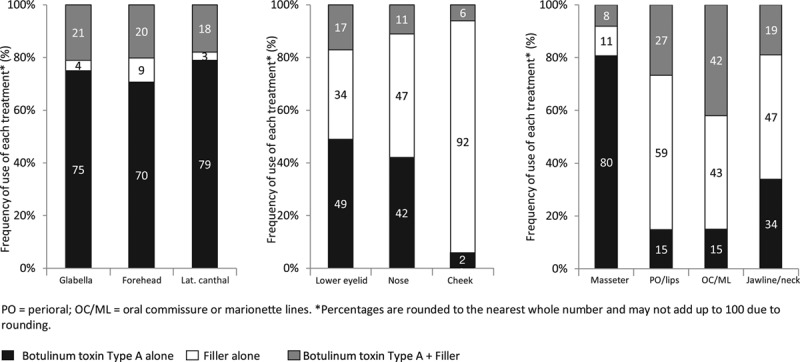
Use of botulinum toxin has evolved from the upper face to also encompass the lower face, neck, and midface. The Global Aesthetics Consensus Group emphasizes an integrative, diagnostic approach. Injection dosage and placement are based on analysis of target muscles in the context of adjacent ones and associated soft and hard tissues. The indication for selection of botulinum toxin as a primary intervention is that excessive muscular contraction is the primary etiology of the facial disharmony to be addressed. Global Aesthetics Consensus Group recommendations demonstrate a paradigm shift toward neuromodulation rather than paralysis, including lower dosing of the upper face, more frequent combination treatment with hyaluronic acid fillers, and intracutaneous injection where indicated to limit depth and degree of action.
The accumulation of clinical evidence and experience with botulinum toxin has led to refinements in treatment planning and implementation. The Global Aesthetics Consensus Group advocates an etiology-driven, patient-tailored approach, to enable achievement of optimal efficacy and safety in patient populations that are rapidly diversifying with respect to ethnicity, gender, and age.
CLINICAL QUESTION/LEVEL OF EVIDENCE: Therapeutic, V.
A型肉毒毒素注射仍是全球领先的非手术美容方法,具有很高的疗效和患者满意度。
一个由整形外科医生和皮肤科医生组成的跨国、多学科团队召集了全球美学共识小组,以全球视角制定关于肉毒毒素和透明质酸填充剂的最新共识建议。这本关于A型肉毒毒素的出版物考虑了面部分析、注射技术以及并发症的避免和管理方面的进展。
肉毒毒素的使用已从面部上半部分扩展到面部下半部分、颈部和中面部。全球美学共识小组强调采用综合的诊断方法。注射剂量和部位是基于对目标肌肉及其相邻肌肉以及相关软硬组织的分析。选择肉毒毒素作为主要干预手段的指征是,过度的肌肉收缩是要解决的面部不协调的主要病因。全球美学共识小组的建议表明了一种向神经调节而非麻痹转变的模式,包括减少面部上半部分的剂量、更频繁地与透明质酸填充剂联合治疗以及在必要时进行皮内注射以限制作用深度和程度。
肉毒毒素临床证据和经验的积累促使治疗计划和实施得到改进。全球美学共识小组提倡采用病因驱动、针对患者个体的方法,以便在种族、性别和年龄迅速多样化的患者群体中实现最佳疗效和安全性。
临床问题/证据水平:治疗性,V级