Freeman Shannon, Smith Trevor Frise, Neufeld Eva, Fisher Kathy, Ebihara Satoru
School of Nursing, University of Northern British Columbia, Prince George, British Columbia, Canada.
Department of Sociology, Nipissing University, North Bay, Ontario, Canada.
BMC Palliat Care. 2016 Feb 29;15:24. doi: 10.1186/s12904-016-0093-8.
In the pursuit to provide the highest quality of person centered palliative care, client preferences, needs, and wishes surrounding end of life should be used to inform the plan of care. During a clinical assessment for care services, clients may voluntarily express a 'wish to die' either directly to the clinician or it may be indirectly reported second-hand to the clinician through an informal caregiver or family member. This is the first study using data gathered from the interRAI Palliative Care Assessment instrument (interRAI PC) to examine socio-demographic, clinical, and psycho-social factors of palliative home care clients with the voluntary expression of a 'wish to die now'. Factors associated with the risk for depression within this group were also identified. Awareness and understanding of clients who express the 'wish to die' is needed to better tailor a person-centered approach to end-of-life care.
This cross-sectional study included assessment records gathered from 4,840 palliative home care clients collected as part of pilot implementation of the interRAI PC assessment instrument in Ontario, Canada from 2006 through 2011.
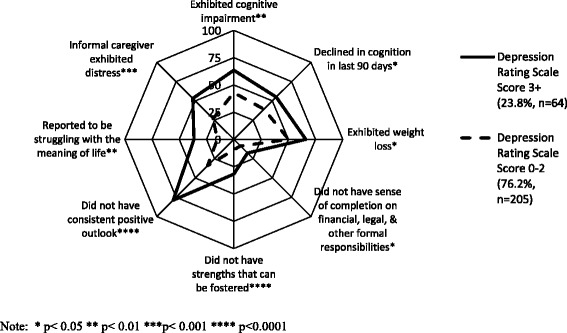
During the clinical assessment, 308 palliative home care clients (6.7%) had voluntarily expressed a 'wish to die now'. Independent factors emerging from multivariate logistic regression analyses predicting the expression of a 'wish to die' included not being married/widowed, a shorter estimated prognosis, depressive symptoms, functional impairment, too much sleep (excessive amount), feeling completion regarding financial/legal matters, and struggling with the meaning of life. Among persons who expressed a 'wish to die now', those who exhibited depressive symptoms (23.8%, n = 64) were also more likely to exhibit cognitive impairment, have decline in cognition in the last 90 days, exhibit weight loss, have informal caregivers exhibiting distress, 'not have a consistent positive outlook on life' and report 'struggling with the meaning of life'.
When clients voluntary express a wish to die clinicians should take notice and initiate follow-up to better understand the context of this meaning for the individual. Clients who expressed a 'wish to die' did not all experience pain, depression, and psychological distress suggesting an individualized approach to care management be taken.
为了提供最高质量的以患者为中心的姑息治疗,应根据患者围绕生命末期的偏好、需求和愿望来制定护理计划。在对护理服务进行临床评估期间,患者可能会直接向临床医生自愿表达“想死”的愿望,或者可能会通过非正式护理人员或家庭成员间接传达给临床医生。这是第一项利用从相互关系机构间姑息治疗评估工具(interRAI PC)收集的数据进行的研究,旨在研究自愿表达“现在想死”的姑息家庭护理患者的社会人口学、临床和心理社会因素。同时还确定了该群体中与抑郁风险相关的因素。为了更好地制定以患者为中心的临终护理方法,需要了解和理解表达“想死”的患者。
这项横断面研究包括从2006年至2011年在加拿大安大略省作为interRAI PC评估工具试点实施的一部分收集的4840名姑息家庭护理患者的评估记录。
在临床评估期间,308名姑息家庭护理患者(6.7%)自愿表达了“现在想死”的愿望。多因素逻辑回归分析中预测“想死”愿望表达的独立因素包括未婚/丧偶、预计预后较短、抑郁症状、功能障碍、睡眠过多(过量)、对财务/法律事务感到完成、以及与生命意义作斗争。在表达“现在想死”的人中,那些表现出抑郁症状的人(23.8%,n = 64)也更有可能表现出认知障碍、在过去90天内认知能力下降、体重减轻、非正式护理人员表现出痛苦、“对生活没有一贯的积极看法”以及报告“与生命意义作斗争”。
当患者自愿表达想死的愿望时,临床医生应予以关注并展开后续跟进,以更好地了解这一愿望对个体的意义背景。表达“想死”的患者并非都经历疼痛、抑郁和心理困扰,这表明应采取个性化的护理管理方法。