Wainiqolo Iris, Kafoa Berlin, Kool Bridget, Robinson Elizabeth, Herman Josephine, McCaig Eddie, Ameratunga Shanthi
School of Population Health, University of Auckland, Auckland, New Zealand.
College of Medicine, Nursing and Health Sciences, Fiji National University, Suva, Fiji.
PLoS One. 2016 Mar 1;11(3):e0149719. doi: 10.1371/journal.pone.0149719. eCollection 2016.
To investigate the association between kava use and the risk of four-wheeled motor vehicle crashes in Fiji. Kava is a traditional beverage commonly consumed in many Pacific Island Countries. Herbal anxiolytics containing smaller doses of kava are more widely available.
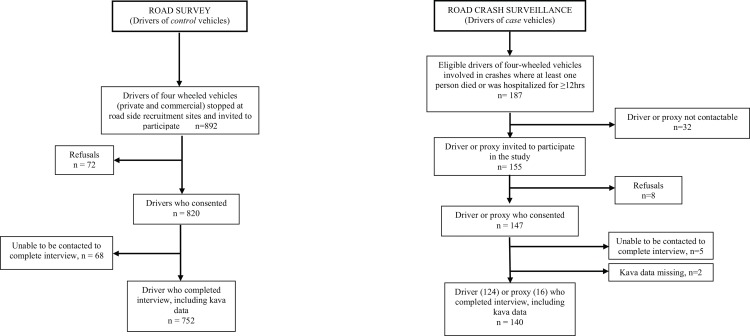
Data for this population-based case-control study were collected from drivers of 'case' vehicles involved in serious injury-involved crashes (where at least one road user was killed or admitted to hospital for 12 hours or more) and 'control' vehicles representative of 'driving time' in the study base. Structured interviewer administered questionnaires collected self-reported participant data on demographic characteristics and a range of risk factors including kava use and potential confounders. Unconditional logistic regression models estimated odds ratios relating to the association between kava use and injury-involved crash risk.
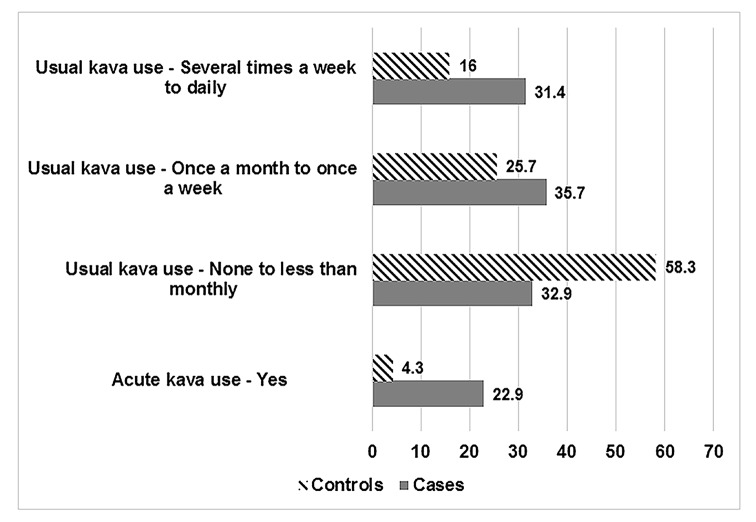
Overall, 23% and 4% of drivers of case and control vehicles, respectively, reported consuming kava in the 12 hours prior to the crash or road survey. After controlling for assessed confounders, driving following kava use was associated with a four-fold increase in the odds of crash involvement (Odds ratio: 4.70; 95% CI: 1.90-11.63). The related population attributable risk was 18.37% (95% CI: 13.77-22.72). Acknowledging limited statistical power, we did not find a significant interaction in this association with concurrent alcohol use.
In this study conducted in a setting where recreational kava consumption is common, driving following the use of kava was associated with a significant excess of serious-injury involved road crashes. The precautionary principle would suggest road safety strategies should explicitly recommend avoiding driving following kava use, particularly in communities where recreational use is common.
调查在斐济饮用卡瓦与四轮机动车碰撞风险之间的关联。卡瓦是许多太平洋岛国普遍饮用的一种传统饮品。含有小剂量卡瓦的草药抗焦虑药更容易获得。
这项基于人群的病例对照研究的数据收集自涉及严重受伤碰撞事故(至少有一名道路使用者死亡或住院12小时及以上)的“病例”车辆的驾驶员,以及研究基地中代表“驾驶时间”的“对照”车辆的驾驶员。由结构化访谈员管理的问卷收集了关于人口统计学特征以及一系列风险因素(包括卡瓦使用情况和潜在混杂因素)的自我报告参与者数据。无条件逻辑回归模型估计了与卡瓦使用和涉及受伤碰撞风险之间关联相关的比值比。
总体而言,分别有23%和4%的病例组和对照组车辆驾驶员报告在碰撞事故或道路调查前12小时内饮用过卡瓦。在控制了评估的混杂因素后,饮用卡瓦后驾驶与碰撞事故参与几率增加四倍相关(比值比:4.70;95%置信区间:1.90 - 11.63)。相关的人群归因风险为18.37%(95%置信区间:13.77 - 22.72)。考虑到统计效力有限,我们未发现该关联与同时饮酒之间存在显著交互作用。
在这项于休闲饮用卡瓦很常见的环境中进行的研究中,饮用卡瓦后驾驶与涉及严重伤害的道路碰撞事故显著增加有关。预防原则表明,道路安全策略应明确建议避免饮用卡瓦后驾驶,尤其是在休闲饮用卡瓦很常见的社区。