Molecular and Cell Biology Laboratory, The Salk Institute for Biological Studies, La Jolla, California 92037, USA;
Integrative Genomics and Bioinformatics Core, The Salk Institute for Biological Studies, La Jolla, California 92037, USA;
Genes Dev. 2016 Mar 1;30(5):535-52. doi: 10.1101/gad.274142.115.
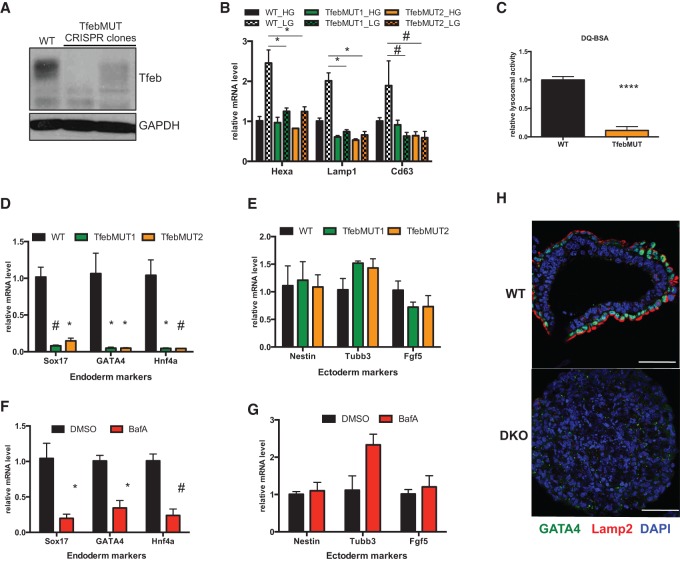
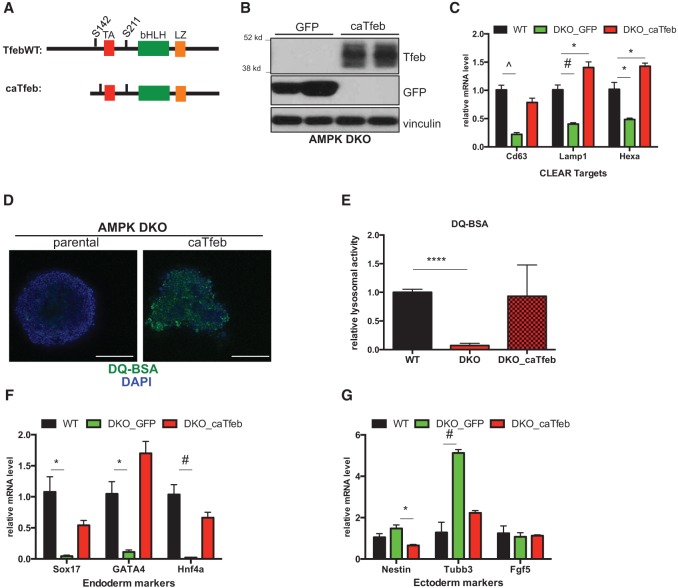
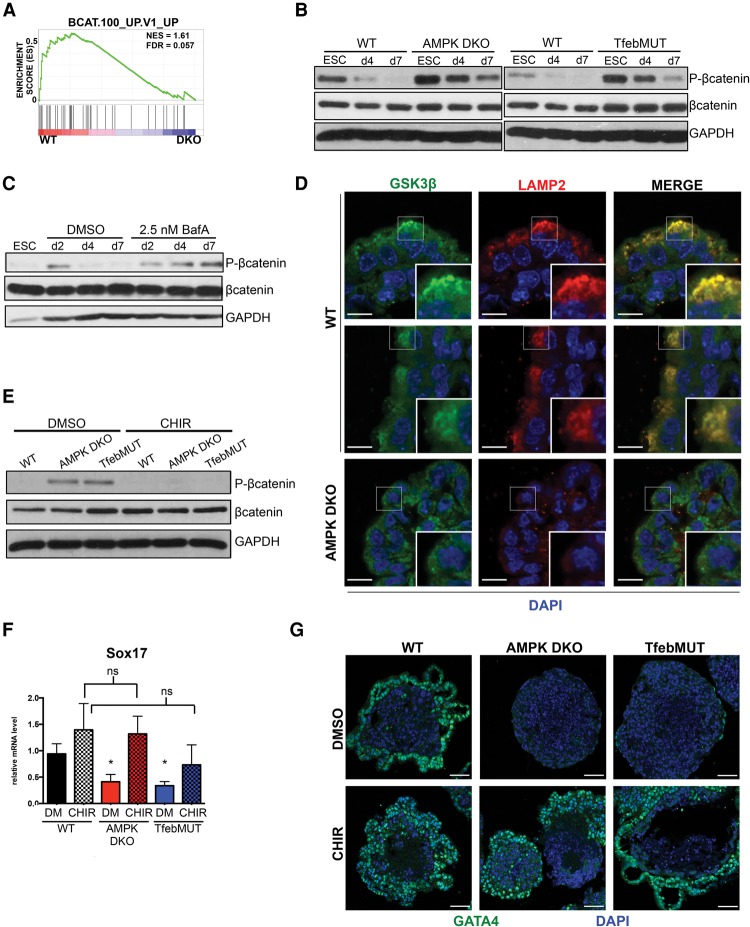
Faithful execution of developmental programs relies on the acquisition of unique cell identities from pluripotent progenitors, a process governed by combinatorial inputs from numerous signaling cascades that ultimately dictate lineage-specific transcriptional outputs. Despite growing evidence that metabolism is integrated with many molecular networks, how pathways that control energy homeostasis may affect cell fate decisions is largely unknown. Here, we show that AMP-activated protein kinase (AMPK), a central metabolic regulator, plays critical roles in lineage specification. Although AMPK-deficient embryonic stem cells (ESCs) were normal in the pluripotent state, these cells displayed profound defects upon differentiation, failing to generate chimeric embryos and preferentially adopting an ectodermal fate at the expense of the endoderm during embryoid body (EB) formation. AMPK(-/-) EBs exhibited reduced levels of Tfeb, a master transcriptional regulator of lysosomes, leading to diminished endolysosomal function. Remarkably, genetic loss of Tfeb also yielded endodermal defects, while AMPK-null ESCs overexpressing this transcription factor normalized their differential potential, revealing an intimate connection between Tfeb/lysosomes and germ layer specification. The compromised endolysosomal system resulting from AMPK or Tfeb inactivation blunted Wnt signaling, while up-regulating this pathway restored expression of endodermal markers. Collectively, these results uncover the AMPK pathway as a novel regulator of cell fate determination during differentiation.
忠实执行发育程序依赖于多能祖细胞获得独特的细胞身份,这一过程受来自众多信号级联的组合输入控制,最终决定谱系特异性转录输出。尽管越来越多的证据表明代谢与许多分子网络相整合,但控制能量稳态的途径如何影响细胞命运决定在很大程度上仍是未知的。在这里,我们表明 AMP 激活的蛋白激酶 (AMPK),一种核心代谢调节剂,在谱系特化中发挥关键作用。尽管 AMPK 缺陷型胚胎干细胞 (ESC) 在多能状态下是正常的,但这些细胞在分化时表现出明显的缺陷,无法生成嵌合胚胎,并在胚胎体 (EB) 形成过程中优先采用外胚层命运,而牺牲内胚层。AMPK(-/-)EBs 显示出 Tfeb 水平降低,Tfeb 是溶酶体的主要转录调节因子,导致内溶酶体功能降低。值得注意的是,Tfeb 的基因缺失也导致内胚层缺陷,而 AMPK 缺失的 ESC 过表达这种转录因子则使它们的分化潜能正常化,揭示了 Tfeb/溶酶体与胚层特化之间的密切联系。由于 AMPK 或 Tfeb 失活导致的受损内溶酶体系统削弱了 Wnt 信号通路,而上调该途径则恢复了内胚层标记物的表达。总之,这些结果揭示了 AMPK 途径是分化过程中细胞命运决定的一个新的调节因子。