Ren Guan-Yu, Chen Chun-Yang, Chen Guo-Chong, Chen Wei-Guo, Pan An, Pan Chen-Wei, Zhang Yong-Hong, Qin Li-Qiang, Chen Li-Hua
Jiangsu Key Laboratory of Preventive and Translational Medicine for Geriatric Diseases, Department of Nutrition and Food Hygiene, School of Public Health, Soochow University, 199 Renai Road, Dushu Lake Higher Education Town, Suzhou 215123, China.
Department of Urology, The First Affiliated Hospital of Soochow University, Soochow University, 188 Shizi street, Suzhou 215006, China.
Nutrients. 2016 Mar 4;8(3):136. doi: 10.3390/nu8030136.
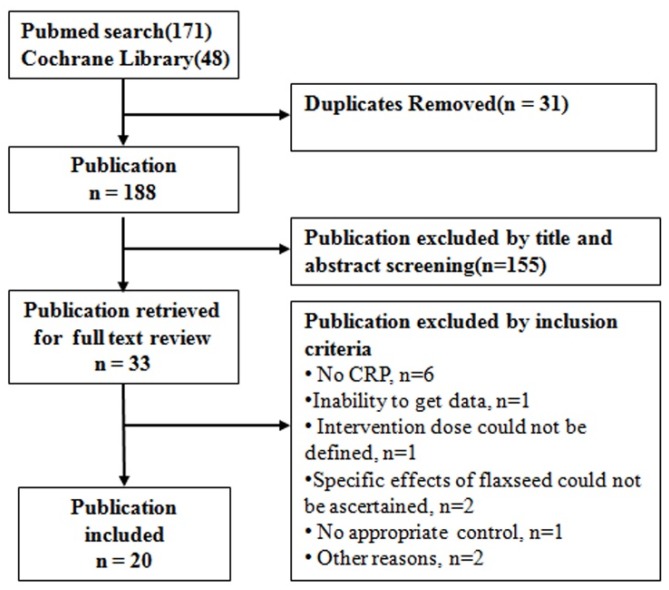
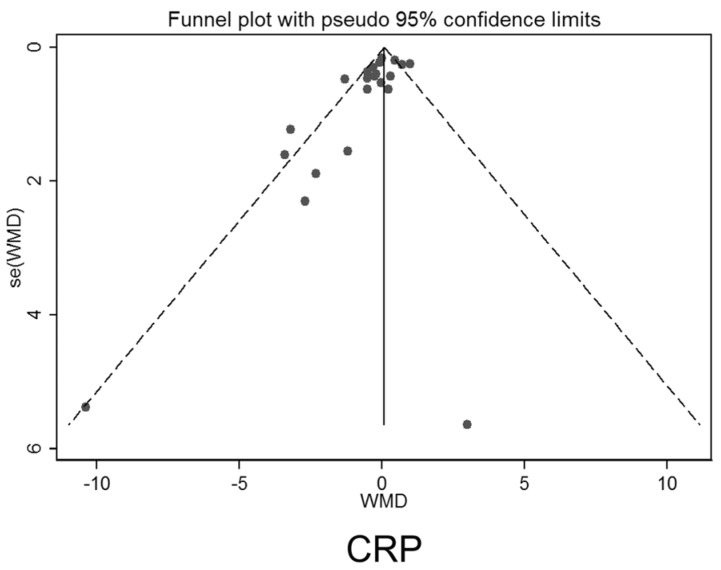
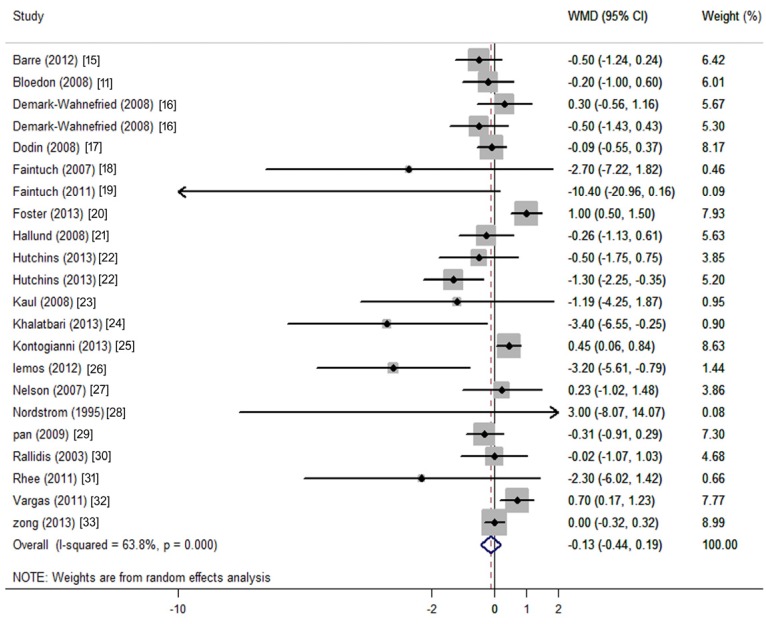
Functional food-flaxseed and its derivatives (flaxseed oil or lignans) are beneficial for human health, possibly because of their anti-inflammatory effects. C-reactive protein (CRP), a sensitive marker of inflammation was chosen to evaluate the anti-inflammatory effects of flaxseed. We searched randomized controlled trials from PubMed and the Cochrane Library in October 2015 and conducted a meta-analysis to evaluate the effectiveness of flaxseed and its derivatives on CRP. The mean differences (net change) in CRP (mg/L) concentrations were pooled with a random- or a fixed-effects model depending on the results of heterogeneity tests. Overall, flaxseed interventions had no effects on reduction of CRP (p = 0.428). The null effects were consistent in the subgroup analysis with multiple studies and population characteristics. Significant heterogeneity was observed in most of the analyses. Meta-regression identified baseline body mass index (BMI) as a significant source of heterogeneity (P-interaction = 0.032), with a significant reduction in CRP of 0.83 mg/L (95% confidence interval -1.34 to -0.31; p = 0.002) among subjects with a BMI of ≥30 kg/m². In conclusion, our meta-analysis did not find sufficient evidence that flaxseed and its derivatives have a beneficial effect on reducing circulating CRP. However, they may significantly reduce CRP in obese populations.
功能性食品——亚麻籽及其衍生物(亚麻籽油或木脂素)对人体健康有益,可能是因其具有抗炎作用。选择炎症敏感标志物C反应蛋白(CRP)来评估亚麻籽的抗炎效果。我们于2015年10月在PubMed和考克兰图书馆检索了随机对照试验,并进行荟萃分析以评估亚麻籽及其衍生物对CRP的有效性。根据异质性检验结果,采用随机效应模型或固定效应模型汇总CRP(mg/L)浓度的平均差值(净变化)。总体而言,亚麻籽干预对降低CRP无效果(p = 0.428)。在多项研究和人群特征的亚组分析中,无效结果一致。在大多数分析中观察到显著的异质性。Meta回归确定基线体重指数(BMI)是异质性的一个重要来源(P交互作用 = 0.032),在BMI≥30 kg/m²的受试者中,CRP显著降低0.83 mg/L(95%置信区间 -1.34至 -0.31;p = 0.002)。总之,我们的荟萃分析未找到充分证据表明亚麻籽及其衍生物对降低循环CRP有有益作用。然而,它们可能会显著降低肥胖人群的CRP。