Al-Daghri Nasser M, Mohammed Abdul Khader, Al-Attas Omar S, Amer Osama E, Clerici Mario, Alenad Amal, Alokail Majed S
Prince Mutaib Chair for Biomarkers of Osteoporosis, Biochemistry Department, College of Science, King Saud University, PO Box, 2455, Riyadh, 11451, Saudi Arabia.
Biomarkers Research Program, Biochemistry Department, College of Science, King Saud University, Riyadh, 11451, Saudi Arabia.
Lipids Health Dis. 2016 Mar 11;15:54. doi: 10.1186/s12944-016-0224-5.
Irisin is a recently identified myokine that plays an important role in preventing obesity and insulin resistance. We investigated whether the common FNDC5 (irisin precursor) gene variants influence susceptibility to obesity and type 2 diabetes (T2D) and verified the impact of FNDC5 gene variants on serum irisin levels, glucose and lipid metabolism in a Saudi population.
Genomic DNA from 814 (394 T2DM and 414 controls) subjects were genotyped for the five common SNPs (rs3480A/G, rs1746661G/T, rs1298190A/G, rs726344A/G and rs1570569G/T) of the FNDC5 gene using the TaqMan genotyping assay. Biochemical parameters and hematic concentrations of irisin and insulin as well as anthropometric indices were collected.
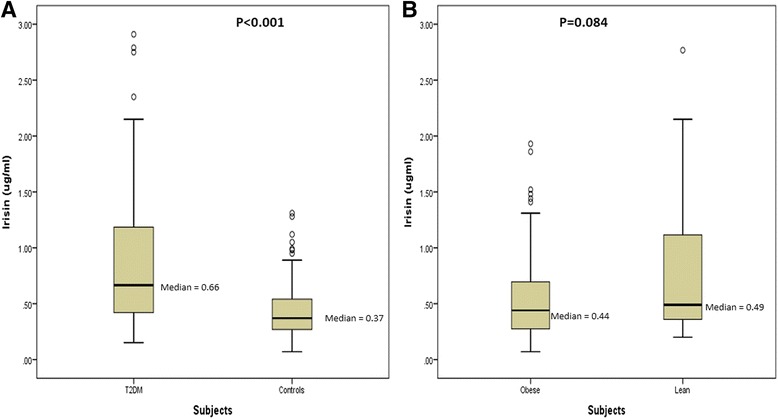
Serum irisin levels were higher in T2DM patients compared to controls (p < 0.0001). Analyses of FNDC5 SNPs showed that: 1) The rs3480 GG associates with decreased risk of obesity (p = 0.005; odds ratio: 0.48) and lower body mass index (BMI) values (p = 0.03). In addition, GGAAG was identified as the protective haplotype against risk of obesity (p = 0.001; odds ratio: 0.23). 2) The rs1746661 G allele associates with higher triglyceride (TG) levels (p = 0.019). 3) The rs157069 TT genotype associates with higher fasting insulin (p = 0.029) and HOMA-IR (p = 0.002) as well as with lower circulating irisin levels (p = 0.016).
SNPs in FNDC5 gene correlates with obesity and glucose-lipid metabolism possibly because they modulate the serum levels of irisin.
鸢尾素是最近发现的一种肌动蛋白,在预防肥胖和胰岛素抵抗方面发挥着重要作用。我们研究了常见的纤维连接蛋白Ⅲ型结构域包含蛋白5(FNDC5,鸢尾素前体)基因变异是否会影响肥胖和2型糖尿病(T2D)的易感性,并在沙特人群中验证了FNDC5基因变异对血清鸢尾素水平、糖脂代谢的影响。
采用TaqMan基因分型技术,对814名受试者(394例T2DM患者和414例对照)的基因组DNA进行FNDC5基因的5个常见单核苷酸多态性(SNP,rs3480A/G、rs1746661G/T、rs1298190A/G、rs726344A/G和rs1570569G/T)分型。收集生化参数、鸢尾素和胰岛素的血液浓度以及人体测量指标。
与对照组相比,T2DM患者血清鸢尾素水平更高(p<0.0001)。对FNDC5基因SNP的分析表明:1)rs3480 GG与肥胖风险降低相关(p = 0.005;优势比:0.48)以及较低的体重指数(BMI)值(p = 0.03)。此外,GGAAG被确定为预防肥胖风险的保护单倍型(p = 0.001;优势比:0.23)。2)rs1746661 G等位基因与较高的甘油三酯(TG)水平相关(p = 0.019)。3)rs157069 TT基因型与较高的空腹胰岛素水平(p = 0.029)和稳态模型评估的胰岛素抵抗(HOMA-IR,p = 0.002)以及较低的循环鸢尾素水平相关(p = 0.016)。
FNDC5基因中的SNP与肥胖和糖脂代谢相关,可能是因为它们调节了血清鸢尾素水平。