Department of Infectious Diseases and Clinical Microbiology, Ondokuz Mayis University Medical School, Samsun, Turkey.
Department of Infectious Diseases and Clinical Microbiology, Istanbul University Cerrahpasa Medical School, Istanbul, Turkey.
Travel Med Infect Dis. 2016 Mar-Apr;14(2):73-80. doi: 10.1016/j.tmaid.2016.03.002. Epub 2016 Mar 10.
The recent Ebola epidemic has increased public awareness of the risk of travel associated viral haemorrhagic fever (VHF). International preparedness to manage imported cases Ebola virus infection was inadequate, highlighted by cases of nosocomial transmission. Crimean-Congo haemorrhagic fever (CCHF) is a re-emerging tick-borne VHF centred in the Eurasian region, affecting a large geographical area and with human-to-human transmission reported, especially in the healthcare setting.
To systematically review the characteristics of travel associated Crimean-Congo haemorrhagic fever.
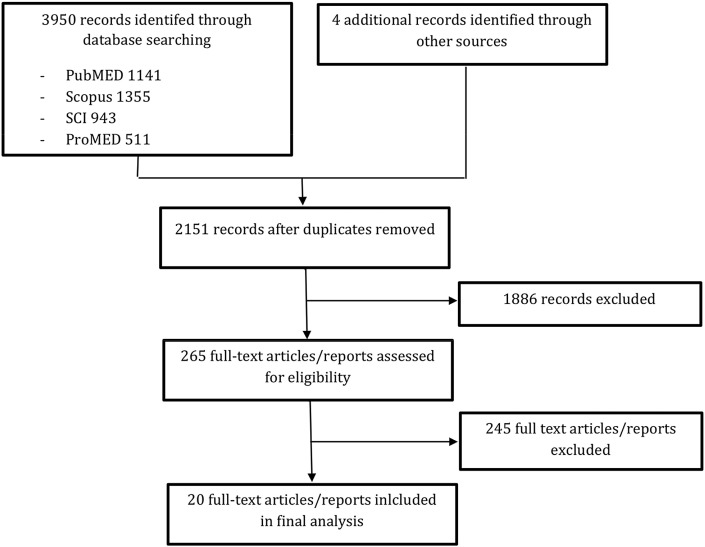
A systematic review of travel-associated cases of CCHF was performed following the Preferred Reporting Items for Systematic Reviews and Meta-Analyses (PRISMA) statement protocol. PubMed, SCOPUS, Science Citation Index (SCI) and ProMED databases were searched for reports published between January 1960 and January 2016. Three independent reviewers selected and reviewed studies and extracted data.
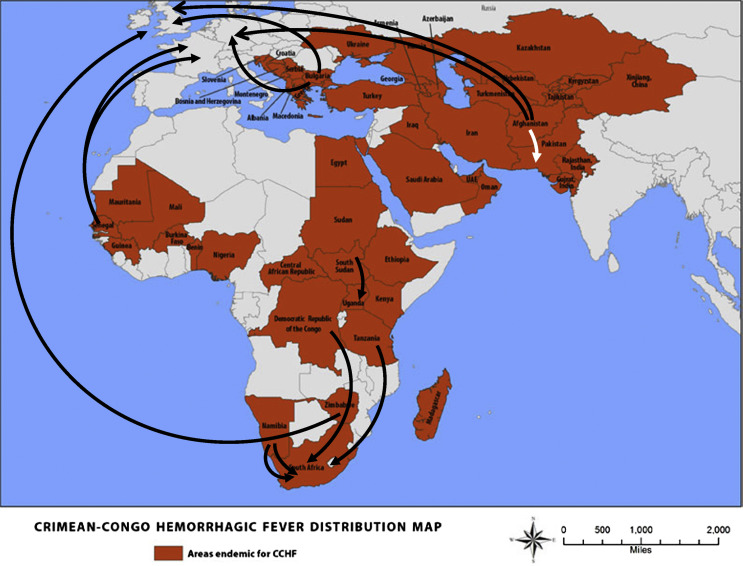
21 cases of travel associated CCHF were identified, of which 12 died (3 outcome unknown) and 4 secondary (nosocomial) infections were reported. Risk occupations or activities for CCHF infection were reported in 8/12 cases when data were available. Travel from Asia to Asia occurred in 9 cases, Africa to Africa occurred in 5 cases, Africa to Europe in 3 cases, Asia to Europe in 2 cases and Europe to Europe in 2 cases.
CCHF related to travel is rare, is generally associated with at risk activities/occupation and is frequently fatal. Key to early diagnosis and prevention of nosocomial transmission is an understanding of CCHF risk factors and the geographical distribution of CCHF. International travel to CCHF endemic areas is increasing and clinicians and laboratory personnel managing returning travellers should maintain a high index of suspicion.
最近的埃博拉疫情增加了公众对与旅行相关的病毒性出血热(VHF)风险的认识。国际上对埃博拉病毒感染输入病例的管理准备不足,突出表现在医院内传播的病例上。克里米亚-刚果出血热(CCHF)是一种重新出现的蜱传 VHF,主要集中在欧亚地区,影响到大面积的地理区域,并报告了人与人之间的传播,尤其是在医疗保健环境中。
系统综述与旅行相关的克里米亚-刚果出血热的特征。
根据《系统评价和荟萃分析的首选报告项目》(PRISMA)声明协议,对与旅行相关的 CCHF 病例进行了系统综述。检索了 1960 年 1 月至 2016 年 1 月期间发表的 PubMed、SCOPUS、科学引文索引(SCI)和 ProMED 数据库的报告。三名独立的评审员选择和审查了研究并提取了数据。
共发现 21 例与旅行相关的 CCHF,其中 12 例死亡(3 例结果未知),报告了 4 例继发性(医院内)感染。在可用数据的情况下,8/12 例报告了与 CCHF 感染相关的风险职业或活动。9 例为亚洲至亚洲旅行,5 例为非洲至非洲旅行,3 例为非洲至欧洲旅行,2 例为亚洲至欧洲旅行,2 例为欧洲至欧洲旅行。
与旅行相关的 CCHF 很少见,通常与风险活动/职业有关,并且经常是致命的。早期诊断和预防医院内传播的关键是了解 CCHF 的危险因素和 CCHF 的地理分布。前往 CCHF 流行地区的国际旅行正在增加,管理返回旅行者的临床医生和实验室人员应保持高度的怀疑态度。