More Sandeep Vasant, Choi Dong-Kug
Department of Biotechnology, College of Biomedical and Health Science, Konkuk University, Chungju, South Korea.
Oncotarget. 2016 May 17;7(20):29835-63. doi: 10.18632/oncotarget.8104.
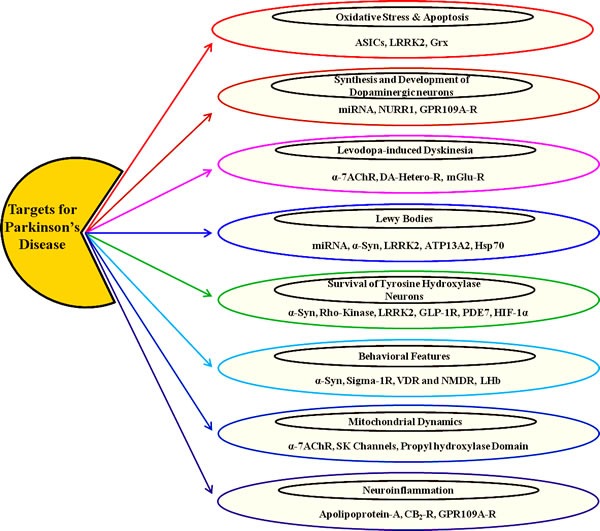
Parkinson's disease (PD) is a progressive neurological condition caused by the degeneration of dopaminergic neurons in the basal ganglia. It is the most prevalent form of Parkinsonism, categorized by cardinal features such as bradykinesia, rigidity, tremors, and postural instability. Due to the multicentric pathology of PD involving inflammation, oxidative stress, excitotoxicity, apoptosis, and protein aggregation, it has become difficult to pin-point a single therapeutic target and evaluate its potential application. Currently available drugs for treating PD provide only symptomatic relief and do not decrease or avert disease progression resulting in poor patient satisfaction and compliance. Significant amount of understanding concerning the pathophysiology of PD has offered a range of potential targets for PD. Several emerging targets including AAV-hAADC gene therapy, phosphodiesterase-4, potassium channels, myeloperoxidase, acetylcholinesterase, MAO-B, dopamine, A2A, mGlu5, and 5-HT-1A/1B receptors are in different stages of clinical development. Additionally, alternative interventions such as deep brain stimulation, thalamotomy, transcranial magnetic stimulation, and gamma knife surgery, are also being developed for patients with advanced PD. As much as these therapeutic targets hold potential to delay the onset and reverse the disease, more targets and alternative interventions need to be examined in different stages of PD. In this review, we discuss various emerging preclinical pharmacological targets that may serve as a new promising neuroprotective strategy that could actually help alleviate PD and its symptoms.
帕金森病(PD)是一种由基底神经节中多巴胺能神经元变性引起的进行性神经疾病。它是帕金森综合征最常见的形式,其主要特征包括运动迟缓、僵硬、震颤和姿势不稳。由于帕金森病的多中心病理涉及炎症、氧化应激、兴奋性毒性、细胞凋亡和蛋白质聚集,因此很难确定单一的治疗靶点并评估其潜在应用。目前用于治疗帕金森病的药物仅能缓解症状,无法减缓或避免疾病进展,导致患者满意度和依从性较差。对帕金森病病理生理学的大量了解为帕金森病提供了一系列潜在靶点。包括腺相关病毒 - 人芳香族氨基酸脱羧酶(AAV-hAADC)基因疗法、磷酸二酯酶 - 4、钾通道、髓过氧化物酶、乙酰胆碱酯酶、单胺氧化酶 - B(MAO-B)、多巴胺、A2A、代谢型谷氨酸受体5(mGlu5)和5-羟色胺1A/1B受体等几个新兴靶点正处于临床开发的不同阶段。此外,针对晚期帕金森病患者,也正在开发诸如深部脑刺激、丘脑切开术、经颅磁刺激和伽玛刀手术等替代干预措施。尽管这些治疗靶点有可能延缓疾病发作并逆转病情,但在帕金森病的不同阶段仍需要研究更多的靶点和替代干预措施。在本综述中,我们讨论了各种新兴的临床前药理学靶点,这些靶点可能成为一种新的有前景的神经保护策略,实际上有助于缓解帕金森病及其症状。