Bakkour Akram, Leuker Christina, Hover Ashleigh M, Giles Nathan, Poldrack Russell A, Schonberg Tom
Imaging Research Center, The University of Texas at AustinAustin, TX, USA; Department of Psychology, Columbia University in the City of New YorkNew York, NY, USA.
Imaging Research Center, The University of Texas at AustinAustin, TX, USA; Center for Adaptive Rationality, Max Planck Institute for Human DevelopmentBerlin, Germany.
Front Psychol. 2016 Mar 23;7:421. doi: 10.3389/fpsyg.2016.00421. eCollection 2016.
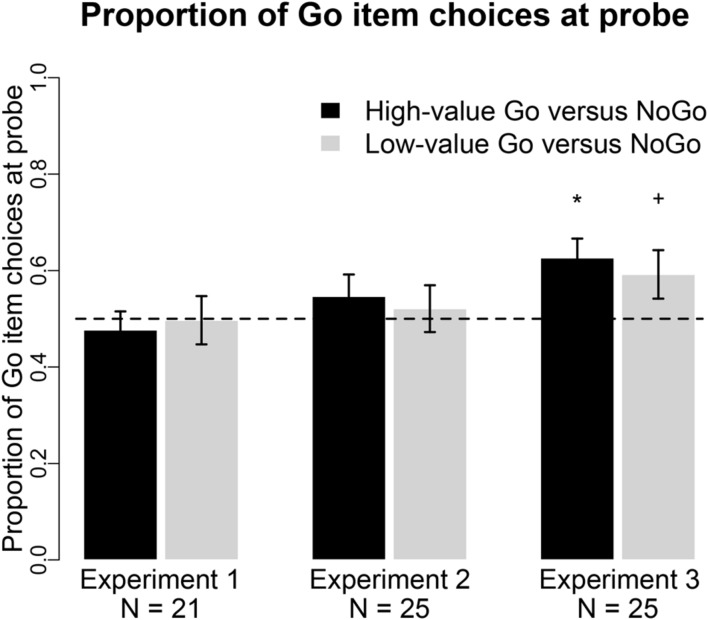
Cue-approach training has been shown to effectively shift choices for snack food items by associating a cued button-press motor response to particular food items. Furthermore, attention was biased toward previously cued items, even when the cued item is not chosen for real consumption during a choice phase. However, the exact mechanism by which preferences shift during cue-approach training is not entirely clear. In three experiments, we shed light on the possible underlying mechanisms at play during this novel paradigm: (1) Uncued, wholly predictable motor responses paired with particular food items were not sufficient to elicit a preference shift; (2) Cueing motor responses early - concurrently with food item onset - and thus eliminating the need for heightened top-down attention to the food stimulus in preparation for a motor response also eliminated the shift in food preferences. This finding reinforces our hypothesis that heightened attention at behaviorally relevant points in time is key to changing choice behavior in the cue-approach task; (3) Crucially, indicating choice using eye movements rather than manual button presses preserves the effect, thus demonstrating that the shift in preferences is not governed by a learned motor response but more likely via modulation of subjective value in higher associative regions, consistent with previous neuroimaging results. Cue-approach training drives attention at behaviorally relevant points in time to modulate the subjective value of individual items, providing a mechanism for behavior change that does not rely on external reinforcement and that holds great promise for developing real world behavioral interventions.
线索接近训练已被证明可以通过将线索提示的按键动作反应与特定食品相关联,有效地改变对零食的选择。此外,注意力会偏向于之前被提示的物品,即使在选择阶段被提示的物品并未被实际选择食用。然而,在线索接近训练过程中偏好发生改变的确切机制尚不完全清楚。在三项实验中,我们揭示了在这种新范式中可能起作用的潜在机制:(1)与特定食品配对的未提示、完全可预测的动作反应不足以引发偏好改变;(2)早期提示动作反应——与食品出现同时进行——从而消除了为准备动作反应而对食品刺激进行增强的自上而下注意力的需求,这也消除了食品偏好的改变。这一发现强化了我们的假设,即在与行为相关的时间点上增强注意力是在线索接近任务中改变选择行为的关键;(3)至关重要的是,使用眼球运动而非手动按键来表明选择能保留这种效果,从而表明偏好的改变并非由习得的动作反应所控制,而更有可能是通过更高层次联想区域中主观价值的调节,这与之前的神经成像结果一致。线索接近训练在与行为相关的时间点上驱动注意力,以调节单个物品的主观价值,提供了一种不依赖外部强化的行为改变机制,并且对于开发现实世界的行为干预措施具有很大的前景。