Husby Ingrid Marie, Stray Kaia Mølbach-Thellefsen, Olsen Alexander, Lydersen Stian, Indredavik Marit Sæbø, Brubakk Ann-Mari, Skranes Jon, Evensen Kari Anne I
Department of Laboratory Medicine, Children's and Women's Health, Norwegian University of Science and Technology, Trondheim, Norway.
Stamina Helse, Lillestrøm, Norway.
Health Qual Life Outcomes. 2016 Apr 7;14:56. doi: 10.1186/s12955-016-0458-y.
Being born with very low birth weight (VLBW: ≤ 1,500 g) is related to long-term disability and neurodevelopmental problems, possibly affecting mental health and health-related quality of life (HRQoL). However, studies in young adulthood yield mixed findings. The aim of this study was to examine mental health and HRQoL at 23 years, including changes from 20 to 23 years and associations with motor skills in VLBW young adults compared with controls.
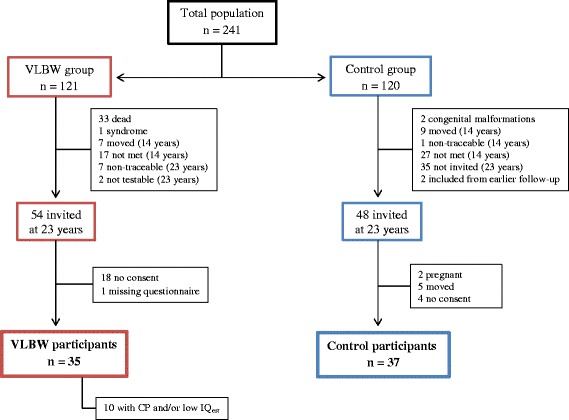
In a geographically based follow-up study, 35 VLBW and 37 term-born young adults were assessed at 23 years by using Achenbach Adult Self-Report (ASR), Short Form 36 Health Survey (SF-36), Beck Depression Inventory (BDI) and various motor tests. The ASR and SF-36 were also used at 20 years. Longitudinal changes in ASR and SF-36 from 20 to 23 years were analysed by linear mixed models and associations with motor skills at 23 years by linear regression.
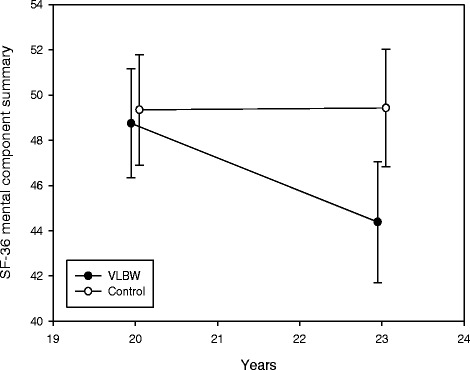
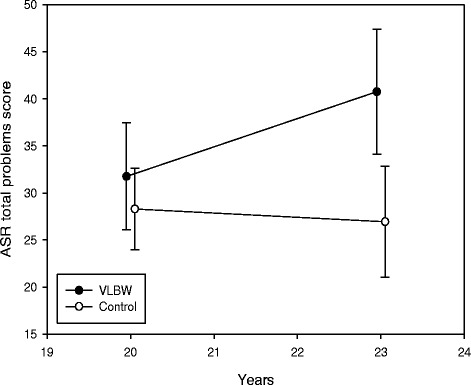
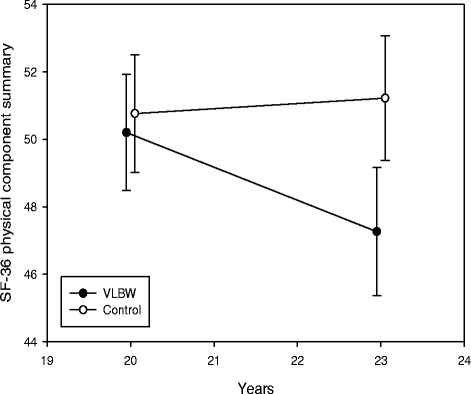
At 23 years, total ASR score was 38.6 (SD: 21.7) in the VLBW group compared with 29.0 (SD: 18.6) in the control group (p = 0.048). VLBW participants had higher scores for attention problems, internalizing problems and critical items, and they reported to drink less alcohol than controls. BDI total score did not differ between groups. On SF-36, VLBW participants reported significantly poorer physical and social functioning, more role-limitations due to physical and emotional problems, more bodily pain and lower physical and mental component summaries than controls. In the VLBW group, total ASR score increased by 9.0 (95 % CI: 3.3 to 14.7) points from 20 to 23 years (p = 0.009 vs controls), physical and mental component summaries of SF-36 decreased by 2.9 (95 % CI: -4.8 to -1.1) and 4.4 (95 % CI: -7.1 to -1.7) points, respectively (p = 0.012 and p = 0.022 vs controls). Among VLBW participants, more mental health problems and lower physical and mental HRQoL were associated with poorer motor skills at 23 years.
VLBW young adults reported poorer and declining mental health and HRQoL in the transitional phase into adulthood. They seemed to have a cautious lifestyle with more internalizing problems and less alcohol use. The associations of mental health problems and HRQoL with motor skills are likely to reflect a shared aetiology.
极低出生体重(VLBW:≤1500克)出生与长期残疾和神经发育问题相关,可能影响心理健康和健康相关生活质量(HRQoL)。然而,针对青年期的研究结果不一。本研究的目的是调查23岁时的心理健康和HRQoL,包括从20岁到23岁的变化以及与极低出生体重青年成人运动技能的关联,并与对照组进行比较。
在一项基于地理位置的随访研究中,35名极低出生体重青年成人和37名足月儿出生的青年成人在23岁时接受了阿chenbach成人自我报告(ASR)、简短36项健康调查(SF - 36)、贝克抑郁量表(BDI)和各种运动测试评估。在20岁时也使用了ASR和SF - 36。通过线性混合模型分析20岁到23岁时ASR和SF - 36的纵向变化,并通过线性回归分析23岁时与运动技能的关联。
23岁时,极低出生体重组的ASR总分是38.6(标准差:21.7),而对照组为29.0(标准差:18.6)(p = 0.048)。极低出生体重参与者在注意力问题、内化问题和关键项目上得分更高,且他们报告饮酒比对照组少。两组间BDI总分无差异。在SF - 36上,极低出生体重参与者报告身体和社会功能明显较差,因身体和情感问题导致的角色限制更多,身体疼痛更多,身体和心理成分总结得分比对照组更低。在极低出生体重组中,从20岁到23岁,ASR总分增加了9.0(95%置信区间:3.3至14.7)分(与对照组相比p = 0.009),SF - 36的身体和心理成分总结得分分别下降了2.9(95%置信区间: - 4.8至 - 1.1)分和4.4(95%置信区间: - 7.1至 - 1.7)分(与对照组相比p = 0.012和p = 0.022)。在极低出生体重参与者中,23岁时更多的心理健康问题以及更低的身体和心理HRQoL与较差的运动技能相关。
极低出生体重青年成人在步入成年的过渡阶段报告了较差且下降的心理健康和HRQoL。他们似乎有一种谨慎的生活方式,内化问题更多且饮酒更少。心理健康问题和HRQoL与运动技能的关联可能反映了共同的病因。