Binder David C, Davis Andrew A, Wainwright Derek A
Commitee on Cancer Biology; Department of Pathology, The University of Chicago, Chicago, IL, USA.
Department of Medicine, Northwestern University Feinberg School of Medicine , Chicago, IL, USA.
Oncoimmunology. 2015 Sep 11;5(2):e1082027. doi: 10.1080/2162402X.2015.1082027. eCollection 2016 Feb.
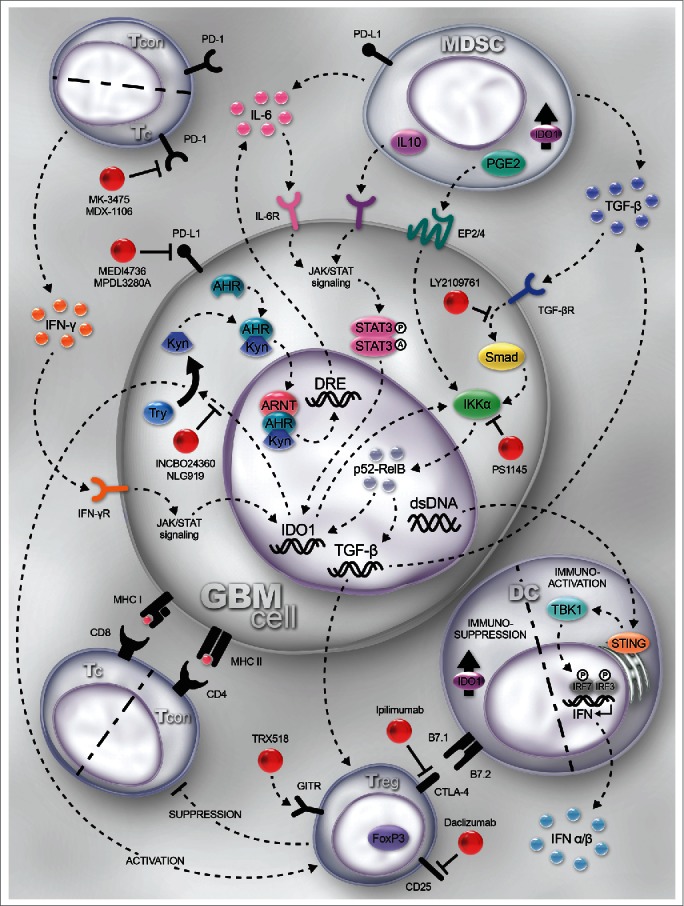
Glioblastoma multiforme (GBM) is the most common primary brain tumor in adults and still remains incurable. Although immunotherapeutic vaccination against GBM has demonstrated immune-stimulating activity with some promising survival benefits, tumor relapse is common, highlighting the need for additional and/or combinatorial approaches. Recently, antibodies targeting immune checkpoints were demonstrated to generate impressive clinical responses against advanced melanoma and other malignancies, in addition to showing potential for enhancing vaccination and radiotherapy (RT). Here, we summarize the current knowledge of central nervous system (CNS) immunosuppression, evaluate past and current immunotherapeutic trials and discuss promising future immunotherapeutic directions to treat CNS-localized malignancies.
多形性胶质母细胞瘤(GBM)是成人中最常见的原发性脑肿瘤,至今仍无法治愈。尽管针对GBM的免疫治疗性疫苗已显示出免疫刺激活性,并带来了一些有希望的生存益处,但肿瘤复发很常见,这凸显了需要额外的和/或联合治疗方法。最近,靶向免疫检查点的抗体除了显示出增强疫苗接种和放射治疗(RT)的潜力外,还被证明对晚期黑色素瘤和其他恶性肿瘤产生了令人印象深刻的临床反应。在这里,我们总结了目前关于中枢神经系统(CNS)免疫抑制的知识,评估了过去和当前的免疫治疗试验,并讨论了治疗CNS局部恶性肿瘤的未来有前景的免疫治疗方向。