University of Minnesota, School of Nursing, Minneapolis, MN, United States.
JMIR Mhealth Uhealth. 2016 Apr 13;4(2):e35. doi: 10.2196/mhealth.5120.
Physical activity contributes to older adults' autonomy, mobility, and quality of life as they age, yet fewer than 1 in 5 engage in activities as recommended. Many older adults track their exercise using pencil and paper, or their memory. Commercially available physical activity monitors (PAM) have the potential to facilitate these tracking practices and, in turn, physical activity. An assessment of older adults' long-term experiences with PAM is needed to understand this potential.
To assess short and long-term experiences of adults >70 years old using a PAM (Fitbit One) in terms of acceptance, ease-of-use, and usefulness: domains in the technology acceptance model.
This prospective study included 95 community-dwelling older adults, all of whom received a PAM as part of randomized controlled trial piloting a fall-reducing physical activity promotion intervention. Ten-item surveys were administered 10 weeks and 8 months after the study started. Survey ratings are described and analyzed over time, and compared by sex, education, and age.
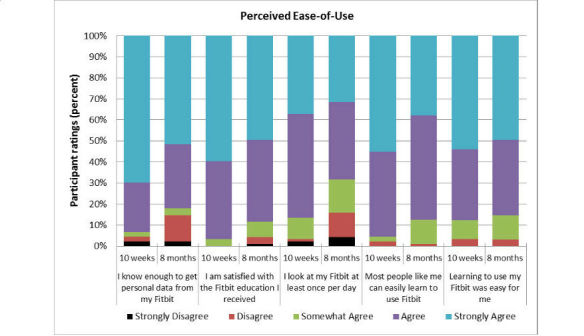
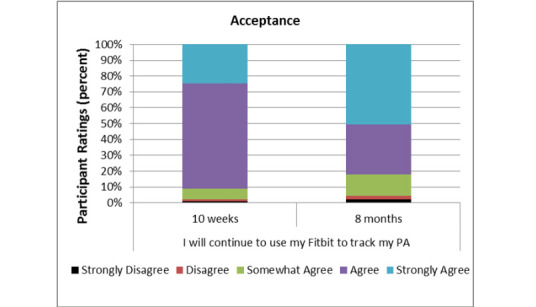
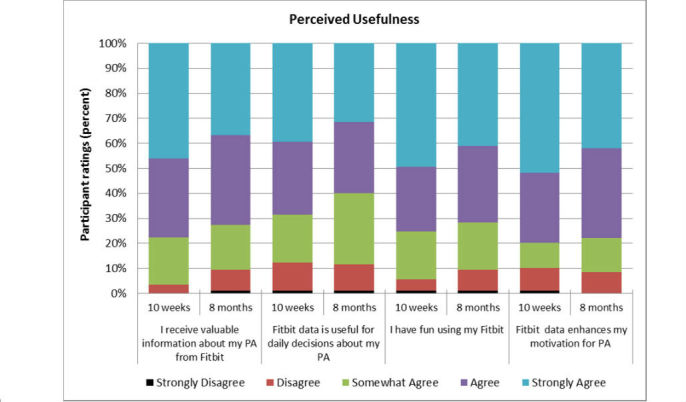
Participants were mostly women (71/95, 75%), 70 to 96 years old, and had some college education (68/95, 72%). Most participants (86/95, 91%) agreed or strongly agreed that the PAM was easy to use, useful, and acceptable both 10 weeks and 8 months after enrolling in the study. Ratings dropped between these time points in all survey domains: ease-of-use (median difference 0.66 points, P=.001); usefulness (median difference 0.16 points, P=.193); and acceptance (median difference 0.17 points, P=.032). Differences in ratings by sex or educational attainment were not statistically significant at either time point. Most participants 80+ years of age (28/37, 76%) agreed or strongly agreed with survey items at long-term follow-up, however their ratings were significantly lower than participants in younger age groups at both time points.
Study results indicate it is feasible for older adults (70-90+ years of age) to use PAMs when self-tracking their physical activity, and provide a basis for developing recommendations to integrate PAMs into promotional efforts.
Clinicaltrials.gov NCT02433249; https://clinicaltrials.gov/ct2/show/NCT02433249 (Archived by WebCite at http://www.webcitation.org/6gED6eh0I).
随着年龄的增长,身体活动有助于老年人的自主性、流动性和生活质量,但只有不到 1/5 的人进行推荐的活动。许多老年人使用铅笔和纸或他们的记忆来记录他们的运动。市售的身体活动监测器(PAM)有可能促进这些跟踪实践,并进而促进身体活动。需要评估老年人长期使用 PAM 的经验,以了解这种潜力。
根据接受度、易用性和有用性(技术接受模型的领域)评估 70 岁以上成年人短期和长期使用 PAM(Fitbit One)的情况。
这项前瞻性研究包括 95 名居住在社区的老年人,他们都收到了 PAM,作为一项减少跌倒的促进身体活动干预措施的随机对照试验的一部分。在研究开始后 10 周和 8 个月进行了 10 项调查。随着时间的推移描述和分析调查评分,并按性别、教育程度和年龄进行比较。
参与者主要为女性(71/95,75%),年龄在 70 至 96 岁之间,具有一定的大学教育程度(68/95,72%)。大多数参与者(86/95,91%)在研究开始后 10 周和 8 个月时均同意或强烈同意 PAM 易于使用、有用和可接受。在所有调查领域,评分在这两个时间点之间都有所下降:易用性(中位数差异 0.66 分,P=.001);有用性(中位数差异 0.16 分,P=.193);接受度(中位数差异 0.17 分,P=.032)。在任何时间点,按性别或教育程度划分的评分差异均无统计学意义。大多数 80 岁以上的参与者(28/37,76%)在长期随访时对调查项目表示同意或强烈同意,但他们的评分在两个时间点都明显低于年轻年龄组的参与者。
研究结果表明,老年人(70-90 岁以上)在自我跟踪身体活动时使用 PAM 是可行的,并为将 PAM 纳入推广工作的建议提供了依据。
Clinicaltrials.gov NCT02433249;https://clinicaltrials.gov/ct2/show/NCT02433249(由 WebCite 存档,http://www.webcitation.org/6gED6eh0I)。