Al-Massarani Shaza Mohamed, El-Gamal Ali Ali, Al-Said Mansour Sulaiman, Abdel-Kader Maged S, Ashour Abdelkader E, Kumar Ashok, Abdel-Mageed Wael M, Al-Rehaily Adnan Jathlan, Ghabbour Hazem A, Fun Hoong-Kun
Department of Pharmacognosy, College of Pharmacy, King Saud University, P.O. Box 2457, Riyadh 11451, Saudi Arabia.
Department of Pharmacognosy, College of Pharmacy, King Saud University, P.O. Box 2457, Riyadh 11451, Saudi Arabia; Department of Pharmacognosy, Faculty of Pharmacy, Mansoura University, El-Mansoura 35516, Egypt.
Pharmacogn Mag. 2016 Apr-Jun;12(46):114-9. doi: 10.4103/0973-1296.177906.
A great number of novel compounds with rich chemical diversity and significant bioactivity have been reported from Red Sea sponges.
To isolate, identify, and evaluate the cytotoxic activity of the chemical constituents of a sponge belonging to genus Haliclona collected from the Eastern coast of the Red Sea.
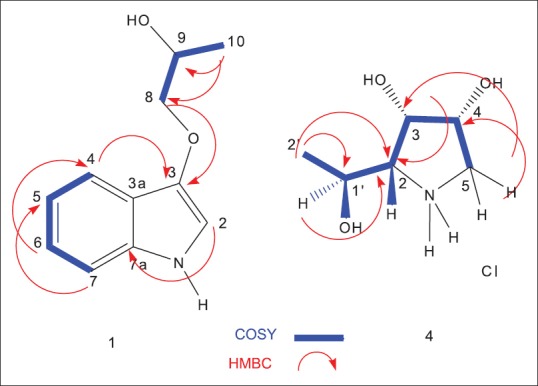
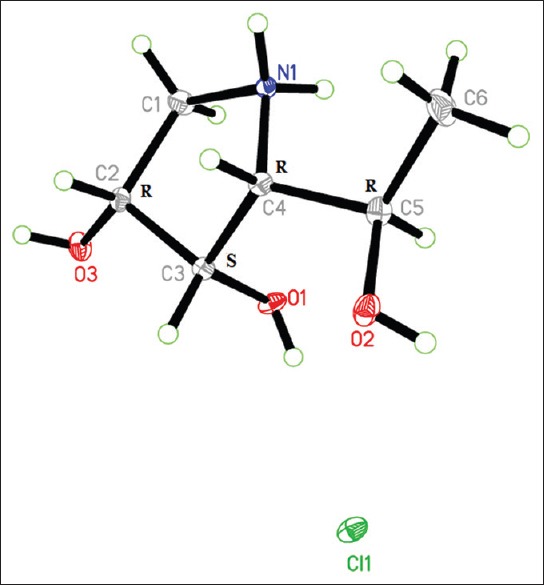
The total ethanolic extract of the titled sponge was subjected to intensive chromatographic fractionation and purification guided by cytotoxic bioassay toward various cancer cell lines. The structures of the isolated compounds were elucidated using spectroscopic techniques including one-dimension and two-dimension nuclear magnetic resonance, mass spectrometry, ultraviolet, and infrared data, as well as comparison with the reported spectral data for the known compounds. X-ray single-crystal structure determination was performed to determine the absolute configuration of compound 4. The screening of antiproliferative activity of the compounds was carried on three tumor cell lines, namely the human cervical cancer (HeLa), human hepatocellular carcinoma (HepG2), and human medulloblastoma (Daoy) cells using MTT assay.
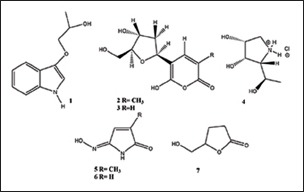
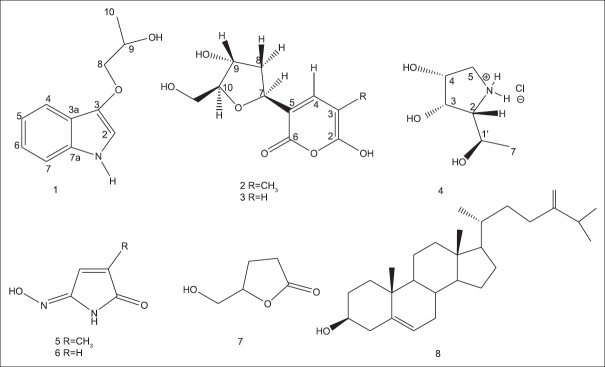
This investigation resulted in the isolation of a new indole alkaloid, 1-(1H-indol-3-yloxy) propan-2-ol (1), with the previously synthesized pyrrolidine alkaloid, (2R, 3S, 4R, 5R) pyrrolidine-(1-hydroxyethyl)-3,4-diol hydrochloride (4), isolated here from a natural source for the first time. In addition, six known compounds tetillapyrone (2), nortetillapyrone (3), 2-methyl maleimide-5-oxime (5), maleimide-5-oxime (6), 5-(hydroxymethyl) dihydrofuran-2 (3H)-one (7), and ergosta-5,24 (28)-dien-3-ol (8) were also identified. Most of the isolated compounds exhibited weak cytotoxic activity against HepG-2, Daoy, and HeLa cancer cell lines.
This is the first report of the occurrence of the indole and pyrrolidine alkaloids, 1-(1H-indol-2-yloxy) propan-2-ol (1), and the - (1-hydroxyethyl)-3,4-diol hydrochloride (4), in the Red Sea Haliclona sp.
From the Red Sea Haliclona sp. two alkaloids with indole and pyrrolidine nuclei, 1-(1H-indol-2-yloxy) propan-2-ol-(1) and pyrrolidine-(1-hydroxyethyl)-3,4-diol hydrochloride (4) were isolated and fully characterized; in addition to six known compounds (2, 3, 5-8)The absolute configuration and the three-dimension stereo-molecular structure of compound 4 were determined by X-ray crystallographyThe different extracts and isolated compounds showed weak cytotoxic activity against HepG-2, Daoy, and HeLa cancer cell lines.
红海海绵中已报道了大量具有丰富化学多样性和显著生物活性的新型化合物。
从红海东海岸采集的一种属于Haliclona属的海绵中分离、鉴定并评估其化学成分的细胞毒性活性。
以对多种癌细胞系的细胞毒性生物测定为指导,对该标题海绵的总乙醇提取物进行深入的色谱分离和纯化。使用包括一维和二维核磁共振、质谱、紫外和红外数据等光谱技术,以及与已知化合物的报道光谱数据进行比较,阐明分离出的化合物的结构。进行X射线单晶结构测定以确定化合物4的绝对构型。使用MTT法对三种肿瘤细胞系,即人宫颈癌(HeLa)、人肝癌(HepG2)和人髓母细胞瘤(Daoy)细胞进行化合物抗增殖活性筛选。
本研究分离出一种新的吲哚生物碱1-(1H-吲哚-3-基氧基)丙-2-醇(1),以及之前合成的吡咯烷生物碱(2R, 3S, 4R, 5R)吡咯烷-(1-羟乙基)-3,4-二醇盐酸盐(4),该化合物首次从天然来源分离得到。此外,还鉴定出六种已知化合物:tetillapyrone(2)、去甲tetillapyrone(3)、2-甲基马来酰亚胺-5-肟(5)、马来酰亚胺-5-肟(6)、5-(羟甲基)二氢呋喃-2(3H)-酮(7)和麦角甾-5,24(28)-二烯-3-醇(8)。大多数分离出的化合物对HepG-2、Daoy和HeLa癌细胞系表现出较弱的细胞毒性活性。
这是红海Haliclona属海绵中首次报道吲哚和吡咯烷生物碱1-(1H-吲哚-2-基氧基)丙-2-醇(1)和(1-羟乙基)-3,4-二醇盐酸盐(4)的存在。
从红海Haliclona属海绵中分离并完全表征了两种具有吲哚和吡咯烷核的生物碱1-(1H-吲哚-2-基氧基)丙-2-醇(1)和吡咯烷-(1-羟乙基)-3,4-二醇盐酸盐(4);此外还有六种已知化合物(2、3、5 - 8)。通过X射线晶体学确定了化合物4的绝对构型和三维立体分子结构。不同提取物和分离出的化合物对HepG-2、Daoy和HeLa癌细胞系表现出较弱的细胞毒性活性。