Kesterke Matthew J, Raffensperger Zachary D, Heike Carrie L, Cunningham Michael L, Hecht Jacqueline T, Kau Chung How, Nidey Nichole L, Moreno Lina M, Wehby George L, Marazita Mary L, Weinberg Seth M
Department of Anthropology, University of Pittsburgh, Pittsburgh, PA USA.
Center for Craniofacial and Dental Genetics, Department of Oral Biology, University of Pittsburgh, 100 Technology Drive, Suite 500, Pittsburgh, PA 15219 USA.
Biol Sex Differ. 2016 Apr 22;7:23. doi: 10.1186/s13293-016-0076-8. eCollection 2016.
Although craniofacial sex differences have been extensively studied in humans, relatively little is known about when various dimorphic features manifest during postnatal life. Using cross-sectional data derived from the 3D Facial Norms data repository, we tested for sexual dimorphism of craniofacial soft-tissue morphology at different ages.
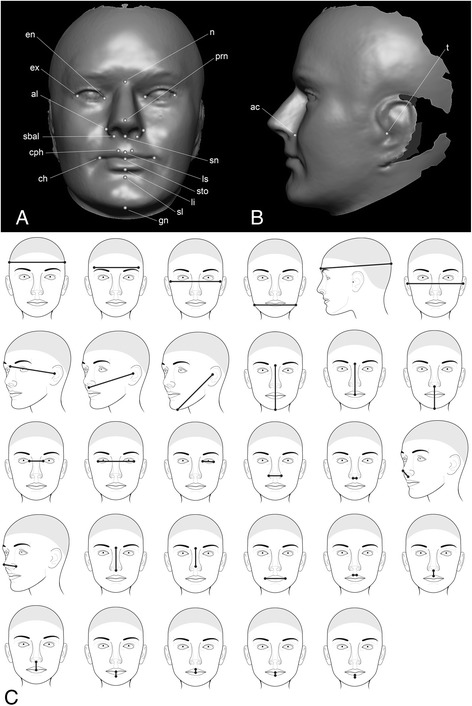
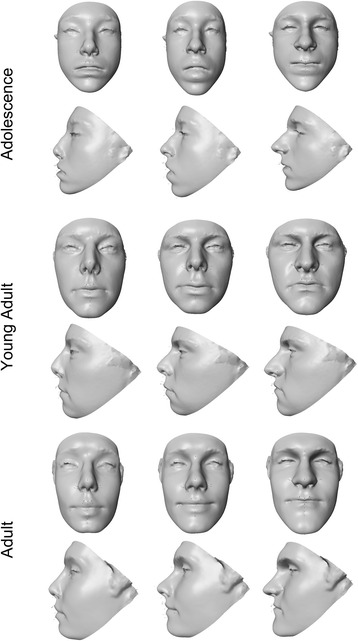
One thousand five hundred fifty-five individuals, pre-screened for craniofacial conditions, between 3 and 25 years of age were placed in to one of six age-defined categories: early childhood, late childhood, puberty, adolescence, young adult, and adult. At each age group, sex differences were tested by ANCOVA for 29 traditional soft-tissue anthropometric measurements collected from 3D facial scans. Additionally, sex differences in shape were tested using a geometric morphometric analysis of 24 3D facial landmarks.
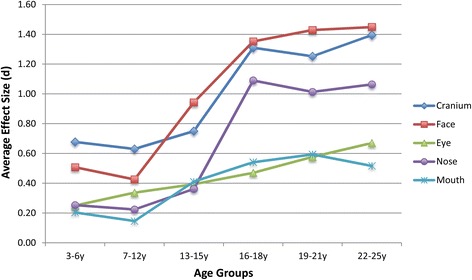
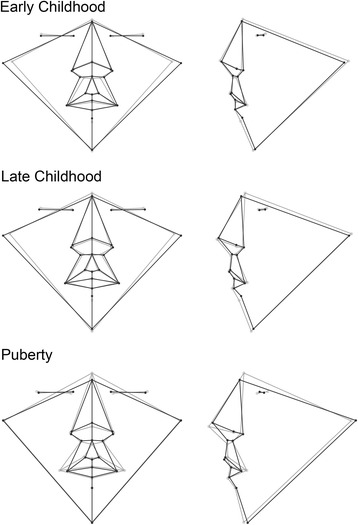
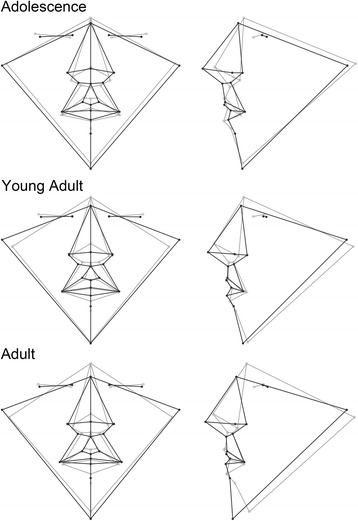
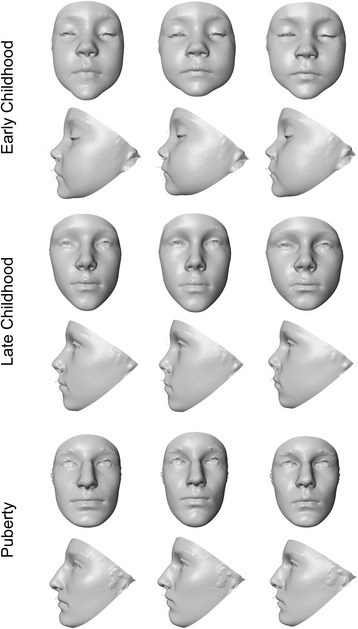
Significant (p < 0.05) sex differences were observed in every age group for measurements covering multiple aspects of the craniofacial complex. The magnitude of the dimorphism generally increased with age, with large spikes in the nasal, cranial, and facial measurements observed after puberty. Significant facial shape differences (p < 0.05) were also seen at each age, with some dimorphic features already present in young children (eye fissure inclination) and others emerging only after puberty (mandibular position).
Several craniofacial soft-tissue sex differences were already present in the youngest age group studied, indicating that these differences emerged prior to 3 years of age. The results paint a complex and heterogeneous picture, with different groups of traits exhibiting distinct patterns of dimorphism during ontogeny. The definitive adult male and female facial shape was present following puberty, but arose from numerous distinct changes taking place at earlier stages.
尽管颅面部的性别差异在人类中已得到广泛研究,但对于各种二态特征在出生后何时显现却知之甚少。利用从三维面部规范数据存储库获得的横断面数据,我们测试了不同年龄颅面部软组织形态的性别差异。
1555名年龄在3至25岁之间、经颅面部疾病预筛查的个体被分为六个年龄定义类别之一:幼儿期、儿童后期、青春期、青少年期、青年期和成年期。在每个年龄组,通过协方差分析对从三维面部扫描中收集的29项传统软组织人体测量指标进行性别差异测试。此外,使用对24个三维面部标志点的几何形态测量分析来测试形状方面的性别差异。
在每个年龄组中,对于涵盖颅面部复合体多个方面的测量指标,均观察到显著(p < 0.05)的性别差异。二态性的程度通常随年龄增加,在青春期后观察到鼻部、颅骨和面部测量指标有大幅增长。在每个年龄也观察到显著的面部形状差异(p < 0.05),一些二态特征在幼儿期就已存在(眼裂倾斜度),而其他特征仅在青春期后出现(下颌位置)。
在所研究的最年幼年龄组中已经存在几种颅面部软组织性别差异,这表明这些差异在3岁之前就已出现。结果描绘了一幅复杂且异质的图景,不同组的特征在个体发育过程中表现出不同的二态模式。青春期后出现了明确的成年男性和女性面部形状,但这是由早期阶段发生的众多不同变化所导致的。