Lysandropoulos Andreas P, Absil Julie, Metens Thierry, Mavroudakis Nicolas, Guisset François, Van Vlierberghe Eline, Smeets Dirk, David Philippe, Maertens Anke, Van Hecke Wim
Department of Neurology Hôpital Erasme Université Libre de Bruxelles Anderlecht Belgium.
Department of Radiology Hôpital Erasme Université Libre de Bruxelles Anderlecht Belgium.
Brain Behav. 2016 Jan 12;6(2):e00422. doi: 10.1002/brb3.422. eCollection 2016 Feb.
There is emerging evidence that brain atrophy is a part of the pathophysiology of Multiple Sclerosis (MS) and correlates with several clinical outcomes of the disease, both physical and cognitive. Consequently, brain atrophy is becoming an important parameter in patients' follow-up. Since in clinical practice both 1.5Tesla (T) and 3T magnetic resonance imaging (MRI) systems are used for MS patients follow-up, questions arise regarding compatibility and a possible need for standardization.
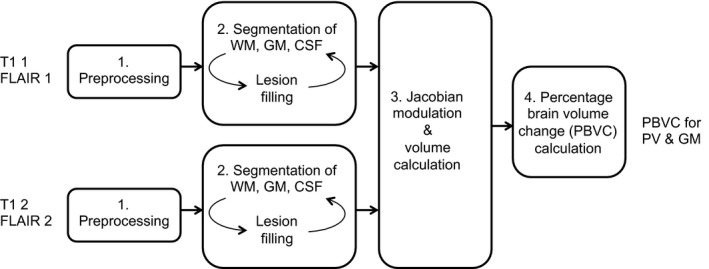
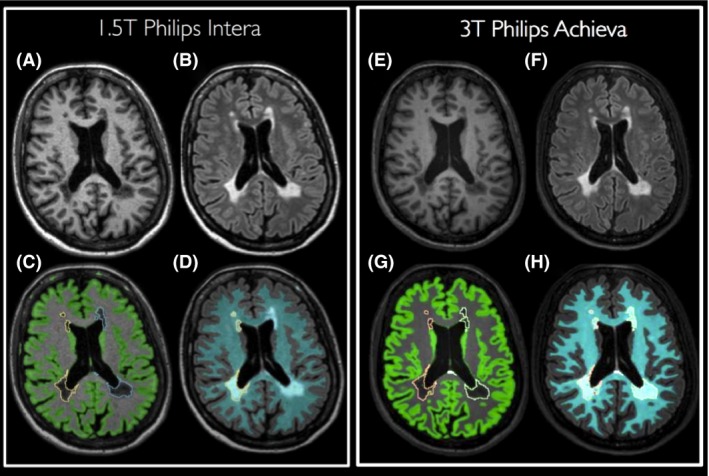
Therefore, in this study 18 MS patients were scanned on the same day on a 1.5T and a 3T scanner. For each scanner, a 3D T1 and a 3D FLAIR were acquired. As no atrophy is expected within 1 day, these datasets can be used to evaluate the median percentage error of the brain volume measurement for gray matter (GM) volume and parenchymal volume (PV) between 1.5T and 3T scanners. The results are obtained with MSmetrix, which is developed especially for use in the MS clinical care path, and compared to Siena (FSL), a widely used software for research purposes.
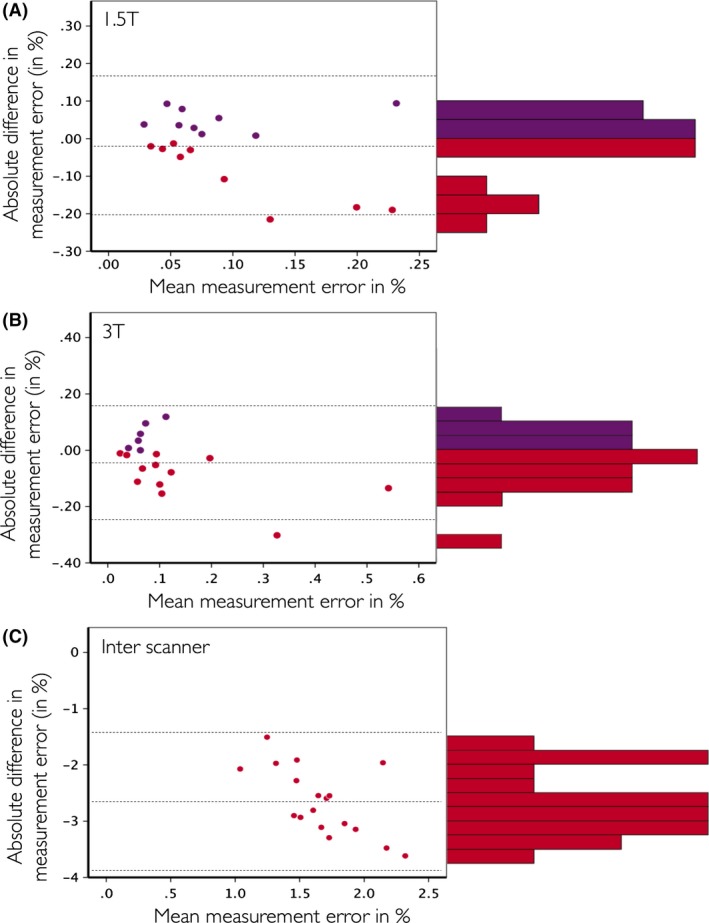
The MSmetrix median percentage error of the brain volume measurement between a 1.5T and a 3T scanner is 0.52% for GM and 0.35% for PV. For Siena this error equals 2.99%. When data of the same scanner are compared, the error is in the order of 0.06-0.08% for both MSmetrix and Siena.
MSmetrix appears robust on both the 1.5T and 3T systems and the measurement error becomes an order of magnitude higher between scanners with different field strength.
越来越多的证据表明,脑萎缩是多发性硬化症(MS)病理生理学的一部分,并且与该疾病的多种临床结果相关,包括身体和认知方面。因此,脑萎缩正成为患者随访中的一个重要参数。由于在临床实践中,1.5特斯拉(T)和3T磁共振成像(MRI)系统都用于MS患者的随访,因此出现了关于兼容性以及是否可能需要标准化的问题。
因此,在本研究中,18名MS患者在同一天分别在1.5T和3T扫描仪上进行扫描。对于每台扫描仪,采集了三维T1加权成像和三维液体衰减反转恢复序列(FLAIR)图像。由于预计一天内不会出现萎缩,这些数据集可用于评估1.5T和3T扫描仪之间灰质(GM)体积和实质体积(PV)的脑体积测量的中位百分比误差。结果是使用专门为MS临床护理路径开发的MSmetrix获得的,并与广泛用于研究目的的Siena(FSL)软件进行比较。
1.5T和3T扫描仪之间脑体积测量的MSmetrix中位百分比误差,GM为0.52%,PV为0.35%。对于Siena,该误差为2.99%。当比较同一台扫描仪的数据时,MSmetrix和Siena的误差均在0.06 - 0.08%左右。
MSmetrix在1.5T和3T系统上似乎都很稳定,并且不同场强扫描仪之间的测量误差会高出一个数量级。