Department of Clinical Neuroscience, Karolinska Institutet, Stockholm, Sweden.
Department of Neuroradiology, Karolinska University Hospital, Stockholm, Sweden.
J Neurol. 2020 Nov;267(11):3199-3212. doi: 10.1007/s00415-020-09971-5. Epub 2020 Jun 13.
Perivascular spaces can become detectable on magnetic resonance imaging (MRI) upon enlargement, referred to as enlarged perivascular spaces (EPVS) or Virchow-Robin spaces. EPVS have been linked to small vessel disease. Some studies have also indicated an association of EPVS to neuroinflammation and/or neurodegeneration. However, there is conflicting evidence with regards to their potential as a clinically relevant imaging biomarker in multiple sclerosis (MS).
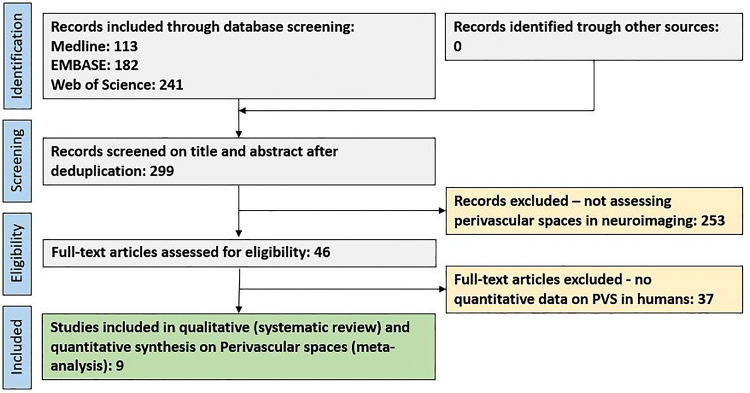
To perform a systematic review and meta-analysis of EPVS as visualized by MRI in MS. Nine out of 299 original studies addressing EPVS in humans using MRI were eligible for the systematic review and meta-analysis including a total of 457 MS patients and 352 control subjects.
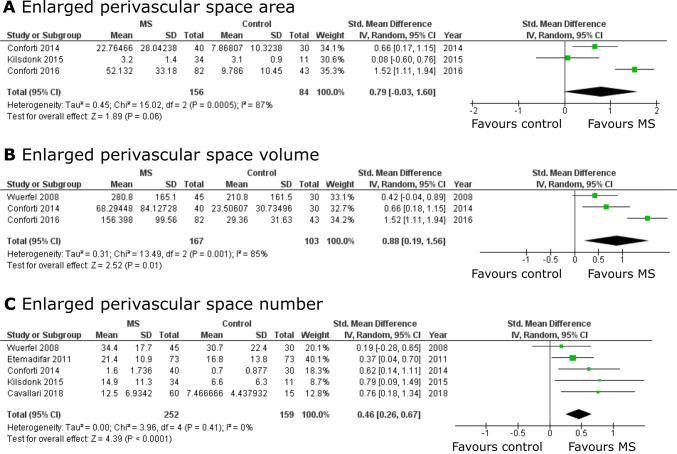
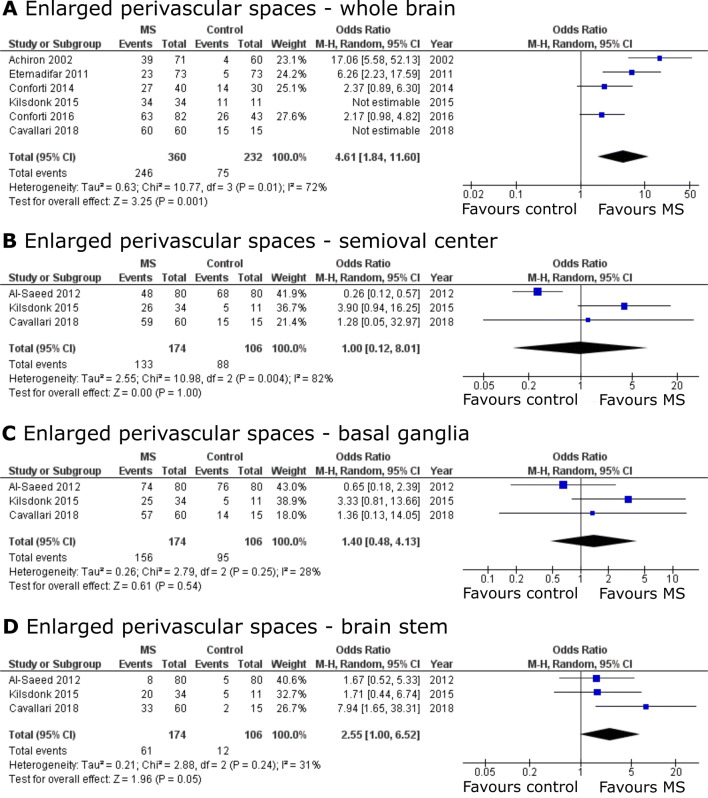
In MS, EPVS have been associated with cognitive decline, contrast-enhancing MRI lesions, and brain atrophy. Yet, these associations were not consistent between studies. The meta-analysis revealed that MS patients have greater EPVS prevalence (odds ratio = 4.61, 95% CI = [1.84; 11.60], p = 0.001) as well as higher EPVS counts (standardized mean difference [SMD] = 0.46, 95% CI = [0.26; 0.67], p < 0.001) and larger volumes (SMD = 0.88, 95% CI = [0.19; 1.56], p = 0.01) compared to controls.
Available literature suggests a higher EPVS burden in MS patients compared to controls. The association of EPVS to neuroinflammatory or -degenerative pathology in MS remains inconsistent. Thus, there is currently insufficient evidence supporting EPVS as diagnostic and/or prognostic marker in MS. In order to benefit future comparisons of studies, we propose recommendations on EPVS assessment standardization in MS. PROSPERO No: CRD42019133946.
血管周围间隙在扩大时可在磁共振成像(MRI)上检测到,称为扩大的血管周围间隙(EPVS)或 Virchow-Robin 空间。EPVS 与小血管疾病有关。一些研究还表明 EPVS 与神经炎症和/或神经退行性变有关。然而,在多发性硬化症(MS)中,EPVS 作为一种有临床意义的影像学生物标志物的潜力存在相互矛盾的证据。
对 MRI 显示的 MS 中 EPVS 进行系统评价和荟萃分析。9 项共 299 项原始研究中,有 9 项使用 MRI 研究人类 EPVS,符合系统评价和荟萃分析的标准,共纳入 457 例 MS 患者和 352 例对照。
在 MS 中,EPVS 与认知能力下降、对比增强 MRI 病变和脑萎缩有关。然而,这些关联在研究之间并不一致。荟萃分析显示,MS 患者的 EPVS 患病率更高(优势比=4.61,95%可信区间[1.84;11.60],p=0.001),EPVS 计数更高(标准化均数差[SMD]=0.46,95%可信区间[0.26;0.67],p<0.001)和更大的体积(SMD=0.88,95%可信区间[0.19;1.56],p=0.01)与对照组相比。
现有文献表明,MS 患者的 EPVS 负担高于对照组。EPVS 与 MS 中的神经炎症或神经退行性病变的关联仍然不一致。因此,目前没有足够的证据支持 EPVS 作为 MS 的诊断和/或预后标志物。为了使未来的研究比较受益,我们提出了 MS 中 EPVS 评估标准化的建议。PROSPERO 编号:CRD42019133946。