Narayan Siddharth, Beck Michael W, Reguero Borja G, Losada Iñigo J, van Wesenbeeck Bregje, Pontee Nigel, Sanchirico James N, Ingram Jane Carter, Lange Glenn-Marie, Burks-Copes Kelly A
National Center for Ecological Analysis and Synthesis (NCEAS), University of California Santa Barbara, Santa Barbara, California, United States of America.
The Nature Conservancy / University of California Santa Cruz, Santa Cruz, California, United States of America.
PLoS One. 2016 May 2;11(5):e0154735. doi: 10.1371/journal.pone.0154735. eCollection 2016.
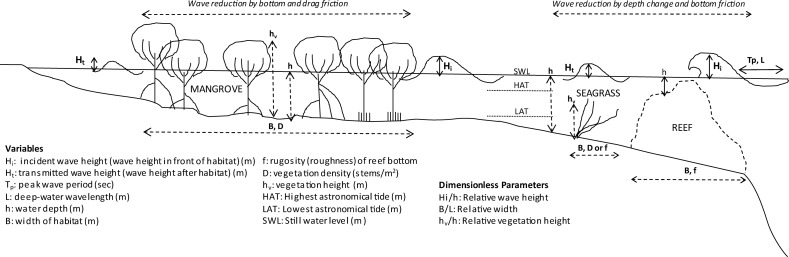
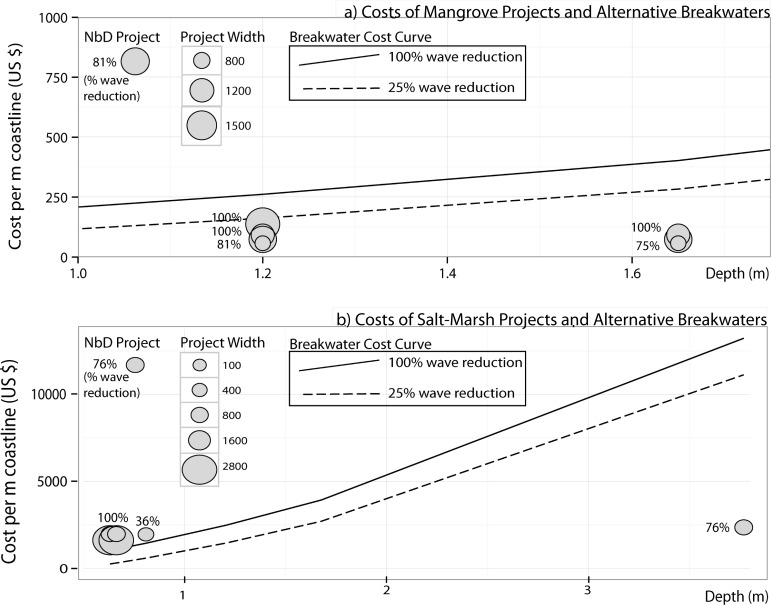
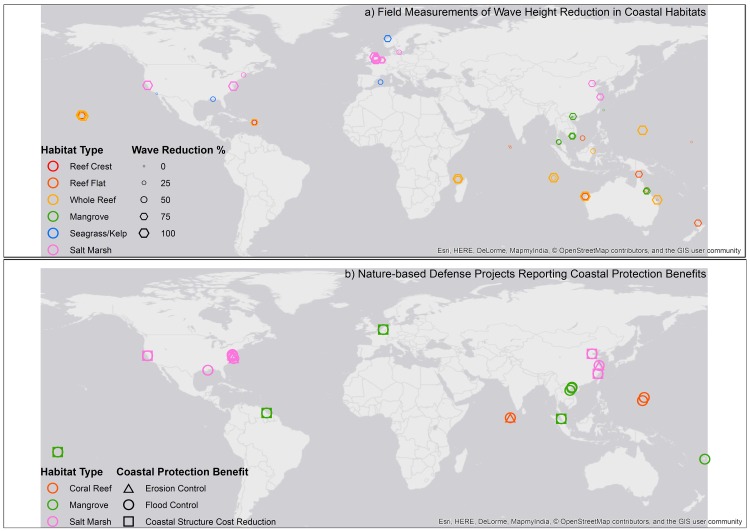
There is great interest in the restoration and conservation of coastal habitats for protection from flooding and erosion. This is evidenced by the growing number of analyses and reviews of the effectiveness of habitats as natural defences and increasing funding world-wide for nature-based defences-i.e. restoration projects aimed at coastal protection; yet, there is no synthetic information on what kinds of projects are effective and cost effective for this purpose. This paper addresses two issues critical for designing restoration projects for coastal protection: (i) a synthesis of the costs and benefits of projects designed for coastal protection (nature-based defences) and (ii) analyses of the effectiveness of coastal habitats (natural defences) in reducing wave heights and the biophysical parameters that influence this effectiveness. We (i) analyse data from sixty-nine field measurements in coastal habitats globally and examine measures of effectiveness of mangroves, salt-marshes, coral reefs and seagrass/kelp beds for wave height reduction; (ii) synthesise the costs and coastal protection benefits of fifty-two nature-based defence projects and; (iii) estimate the benefits of each restoration project by combining information on restoration costs with data from nearby field measurements. The analyses of field measurements show that coastal habitats have significant potential for reducing wave heights that varies by habitat and site. In general, coral reefs and salt-marshes have the highest overall potential. Habitat effectiveness is influenced by: a) the ratios of wave height-to-water depth and habitat width-to-wavelength in coral reefs; and b) the ratio of vegetation height-to-water depth in salt-marshes. The comparison of costs of nature-based defence projects and engineering structures show that salt-marshes and mangroves can be two to five times cheaper than a submerged breakwater for wave heights up to half a metre and, within their limits, become more cost effective at greater depths. Nature-based defence projects also report benefits ranging from reductions in storm damage to reductions in coastal structure costs.
人们对恢复和保护沿海栖息地以抵御洪水和侵蚀有着浓厚兴趣。越来越多关于栖息地作为自然防御手段有效性的分析和综述,以及全球范围内对基于自然的防御措施(即旨在保护海岸的恢复项目)投入资金的增加,都证明了这一点。然而,对于何种项目在此目的上有效且具有成本效益,尚无综合性信息。本文探讨了设计海岸保护恢复项目至关重要的两个问题:(i)对为海岸保护设计的项目(基于自然的防御措施)的成本和效益进行综合分析;(ii)分析沿海栖息地(自然防御措施)在降低波高方面的有效性以及影响这种有效性的生物物理参数。我们(i)分析了全球沿海栖息地69次实地测量的数据,并研究了红树林、盐沼、珊瑚礁和海草/海带床降低波高的有效性指标;(ii)综合了52个基于自然的防御项目的成本和海岸保护效益;以及(iii)通过将恢复成本信息与附近实地测量数据相结合,估算每个恢复项目的效益。实地测量分析表明,沿海栖息地在降低波高方面具有巨大潜力,且因栖息地和地点而异。总体而言,珊瑚礁和盐沼的总体潜力最高。栖息地的有效性受以下因素影响:a)珊瑚礁中波高与水深的比值以及栖息地宽度与波长的比值;b)盐沼中植被高度与水深的比值。基于自然的防御项目与工程结构成本的比较表明,对于波高达到半米的情况,盐沼和红树林的成本可能比潜堤便宜两到五倍,并且在其适用范围内,在更深的水域成本效益更高。基于自然的防御项目还报告了从减少风暴破坏到降低海岸结构成本等一系列效益。