Skogstad Marit, Lunde Lars-Kristian, Skare Øivind, Mamen Asgeir, Alfonso Jose Hernán, Øvstebø Reidun, Ulvestad Bente
Department of Occupational Medicine and Epidemiology, National Institute of Occupational Health, Box 8149 Dep, 0033, Oslo, Norway.
Department for Work Psychology and Physiology, National Institute of Occupational Health, Box 8149 Dep, 0033, Oslo, Norway.
BMC Public Health. 2016 May 4;16:377. doi: 10.1186/s12889-016-3035-8.
While the health benefits of physical activity are well established, little is known about health effects of physical activity programs initiated by employer.
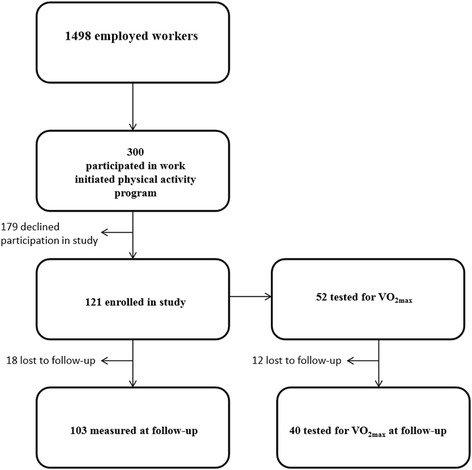
Background data and level of physical activity were collected by questionnaire among 78 men and 43 women working in road maintenance pre and post an 8-week physical activity motivational program. As a part of the program steps measured by accelerometer were registered online where team and individual performances could be continuously monitored. The physical activity levels were registered as 1) those physical active ≤1 time per week, 2) 2-3 times per week and 3) ≥4 times a week. Maximal oxygen uptake (VO2max), blood pressure, resting heart rate (RHR) and blood samples (glycosylated hemoglobin, lipids and C-reactive protein) were obtained at baseline and after eight weeks. Mixed models were applied to evaluate associations between physical activity and health parameters.
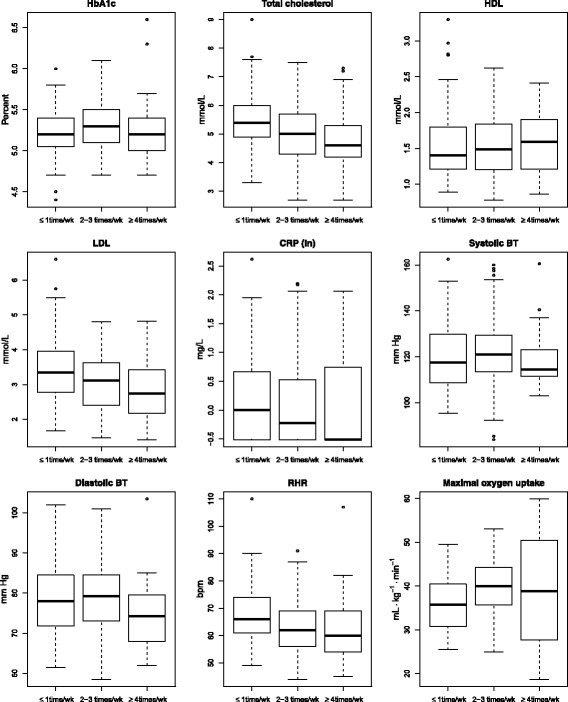
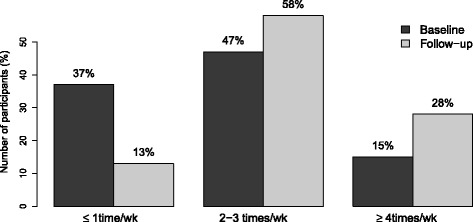
With ≤1 time per week as reference, exercising 2-3 times per week at baseline was associated with higher levels of VO2max. During follow-up, VO2max increased with 2.8 mL ∙ kg(-1)∙ min(-1) (95 % CI = 1.4, 4.3). Women had more favorable body mass index (BMI), blood pressure, RHR and lipid profile than men. Total cholesterol, low density lipoprotein (LDL), RHR and diastolic blood pressure (dBP) were lower among participants who exercised 2-3 times per week or ≥4 times a week, compared with those with ≤1 time per week. Half of the participants reported increased daily PA during follow-up, with high intensity PA such as jogging by 8.6 min (SD 14.6) and 8.3 min (SD 18.2), among women and men, respectively. During follow-up dBP increased among men. Further, total cholesterol and LDL were reduced by 0.12 mmol/L and 0.13 mmol/L, respectively (95 % CI = -022, -0.01 and -0.22,-0.04).
Exercise several times a week was associated with lower blood pressure and a favorable lipid status compared to lower weekly activity. During the 8-week follow-up of an employer initiated exercise program VO2max increased, while total cholesterol and LDL were reduced.
Current Controlled Trials ISRCTN13033050 . Registered 21 August 2015.
虽然体育活动对健康的益处已得到充分证实,但对于雇主发起的体育活动计划对健康的影响却知之甚少。
通过问卷调查收集了78名男性和43名女性道路养护工人在为期8周的体育活动激励计划前后的背景数据和体育活动水平。作为该计划的一部分,通过加速度计测量的步数在线记录,团队和个人表现可得到持续监测。体育活动水平分为1)每周体育活动≤1次,2)每周2 - 3次,3)每周≥4次。在基线和8周后获取最大摄氧量(VO2max)、血压、静息心率(RHR)和血样(糖化血红蛋白、血脂和C反应蛋白)。应用混合模型评估体育活动与健康参数之间的关联。
以每周≤1次为参照,基线时每周锻炼2 - 3次与更高的VO2max水平相关。在随访期间,VO2max增加了2.8 mL∙kg(-1)∙min(-1)(95%置信区间 = 1.4,4.3)。女性的体重指数(BMI)、血压、RHR和血脂状况比男性更有利。与每周体育活动≤1次的参与者相比,每周锻炼2 - 3次或≥4次的参与者总胆固醇、低密度脂蛋白(LDL)、RHR和舒张压(dBP)更低。一半的参与者报告在随访期间日常体育活动增加,女性和男性高强度体育活动如慢跑分别增加了8.6分钟(标准差14.6)和8.3分钟(标准差18.2)。随访期间男性的dBP升高。此外,总胆固醇和LDL分别降低了0.12 mmol/L和0.13 mmol/L(95%置信区间 = -0.22,-0.01和 -0.22,-0.04)。
与每周较低的体育活动量相比,每周进行几次锻炼与较低的血压和良好的血脂状况相关。在雇主发起的锻炼计划的8周随访期间,VO2max增加,而总胆固醇和LDL降低。
当前对照试验ISRCTN13033050。于2015年8月21日注册。