Knight-Jones T J D, McLaws M, Rushton J
International Livestock Research Institute [ILRI], Lusaka, Zambia.
European Commission for the Control of FMD, FAO, Rome, Italy.
Transbound Emerg Dis. 2017 Aug;64(4):1079-1094. doi: 10.1111/tbed.12507. Epub 2016 May 11.
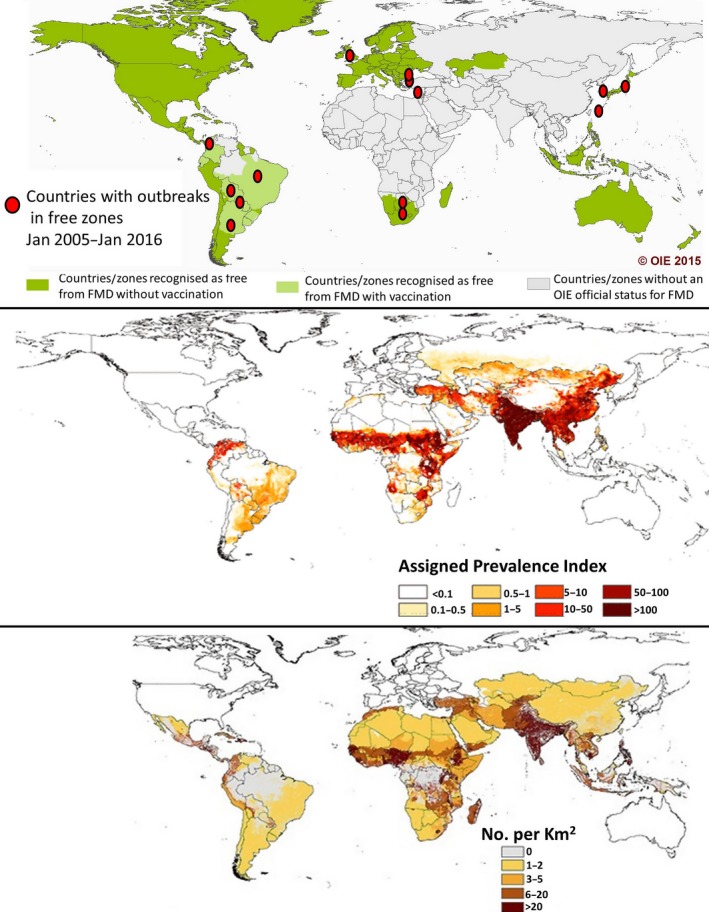
Foot-and-mouth disease (FMD) endemic regions contain three-quarters of the world's FMD susceptible livestock and most of the world's poor livestock keepers. Yet FMD impact on smallholders in these regions is poorly understood. Diseases of low mortality can exert a large impact if incidence is high. Modelling and field studies commonly find high FMD incidence in endemic countries. Sero-surveys typically find a third of young cattle are sero-positive, however, the proportion of sero-positive animals that developed disease, and resulting impact, are unknown. The few smallholder FMD impact studies that have been performed assessed different aspects of impact, using different approaches. They find that FMD impact can be high (>10% of annual household income). However, impact is highly variable, being a function of FMD incidence and dependency on activities affected by FMD. FMD restricts investment in productive but less FMD-resilient farming methods, however, other barriers to efficient production may exist, reducing the benefits of FMD control. Applying control measures is costly and can have wide-reaching negative impacts; veterinary-cordon-fences may damage wildlife populations, and livestock movement restrictions and trade bans damage farmer profits and the wider economy. When control measures are ineffective, farmers, society and wildlife may experience the burden of control without reducing disease burden. Foot-and-mouth disease control has benefitted smallholders in South America and elsewhere. Success takes decades of regional cooperation with effective veterinary services and widespread farmer participation. However, both the likelihood of success and the full cost of control measures must be considered. Controlling FMD in smallholder systems is challenging, particularly when movement restrictions are hard to enforce. In parts of Africa this is compounded by endemically infected wildlife and limited vaccine performance. This paper reviews FMD impact on smallholders in endemic countries. Significant evidence gaps exist and guidance on the design of FMD impact studies is provided.
口蹄疫(FMD)流行地区饲养着全球四分之三易感染口蹄疫的牲畜,且世界上大多数贫困的牲畜饲养者也集中在这些地区。然而,人们对口蹄疫对这些地区小农户的影响却知之甚少。低死亡率的疾病如果发病率高,也会产生巨大影响。建模和实地研究通常发现,口蹄疫流行国家的发病率很高。血清学调查通常发现三分之一的幼牛血清呈阳性,然而,血清呈阳性的动物中发病的比例以及由此产生的影响尚不清楚。少数针对小农户口蹄疫影响的研究采用了不同方法,评估了影响的不同方面。这些研究发现,口蹄疫的影响可能很大(超过家庭年收入的10%)。然而,影响差异很大,它是口蹄疫发病率以及对口蹄疫影响的相关活动的依赖程度的函数。口蹄疫限制了对生产性但对口蹄疫抵抗力较弱的养殖方法的投资,然而,可能还存在其他影响高效生产的障碍,从而降低了口蹄疫防控的效益。实施防控措施成本高昂,且可能产生广泛的负面影响;兽医防疫隔离围栏可能会损害野生动物种群,而牲畜流动限制和贸易禁令会损害农民利益和更广泛的经济。当防控措施无效时,农民、社会和野生动物可能会承受防控负担,却无法减轻疾病负担。口蹄疫防控已使南美洲和其他地区的小农户受益。成功需要几十年的区域合作,配备有效的兽医服务并让农民广泛参与。然而,必须同时考虑成功的可能性和防控措施的全部成本。在小农户体系中控制口蹄疫具有挑战性,尤其是在难以实施流动限制的情况下。在非洲部分地区,当地受感染的野生动物以及疫苗效果有限使这一情况更加复杂。本文综述了口蹄疫对流行国家小农户的影响。目前存在重大的证据空白,并提供了关于口蹄疫影响研究设计的指导。