Li Zhixia, Yang Xinghua, Yang Jun, Yang Zhirong, Wang Shengfeng, Sun Feng, Zhan Siyan
Department of Epidemiology and Biostatistics, School of Public Health, Peking University Health Science Center, Beijing, China.
Department of Epidemiology and Health Statistics, School of Public Health, Capital Medical University, Beijing, China.
PLoS One. 2016 May 19;11(5):e0154990. doi: 10.1371/journal.pone.0154990. eCollection 2016.
The aim was to evaluate the impact of metabolic syndrome (MS), MS individual components and 32 kinds of MS specific component combinations on all-cause mortality risk in a fixed cohort of MJ check-up population.
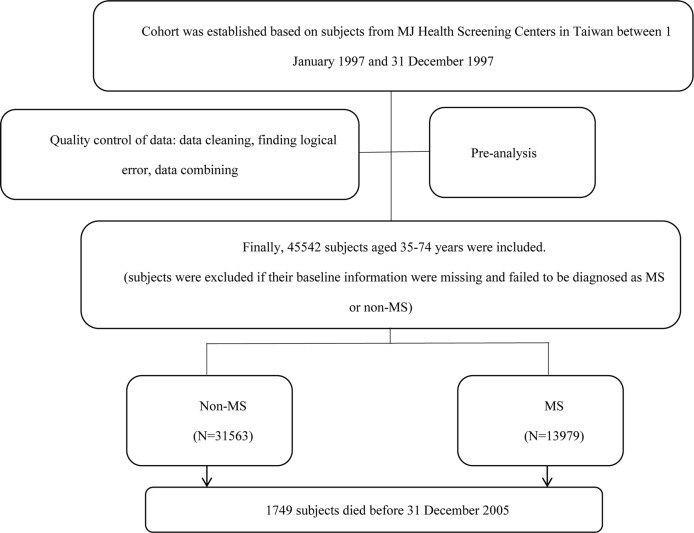
We observed the events of death in a fixed cohort, where the population was composed of 45,542 individuals aged 35-74 who were examined at MJ Health check-up Center in 1997 as baseline examination, and were followed up to 2005. Median duration of follow-up was 7.44 years. MS was defined according to the National Cholesterol Educational Program (the revised NCEP-ATPIII for Asian in 2004), the prevalence of MS was standardized according to China's fifth census data. We constructed common Cox regression model, simultaneously adjusting the classic risk factors (such as age, sex, smoking, alcohol drinking, physical activity, family history, etc.) to examine the relationship between MS, MS individual components and 32 kinds of MS specific component combinations on the occurrence of death with the fixed cohort.
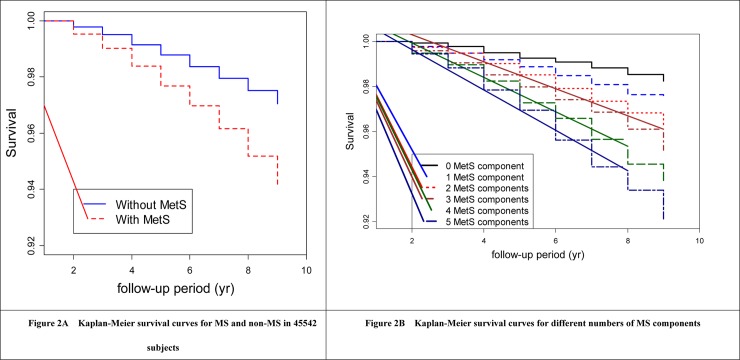
The standardized prevalence of MS was 29.75% (male: 30.36%, female: 29.51%). There were 1,749 persons who died during the median 7.44-years follow-up, the mortality rate was 46 per 10,000 person years. The mortality rates were 71 and 35 per 10,000 person years for those with and without MS, respectively. After adjustment for age, sex and classical risk factors, compared with subjects without MS, the hazard ratio of all-cause mortality was 1.26 (95% CI: 1.14-1.40). The all-cause mortality were more highly significant than other combinations (P <0.05) when the following combinations exist: "elevated blood pressure", "elevated fasting plasma glucose + low high-density lipoprotein cholesterol", "elevated blood pressure + elevated triglyceride + elevated fasting plasma glucose", "elevated fasting plasma glucose + low high-density lipoprotein cholesterol + elevated blood pressure + elevated triglyceride". After adjusting age, sex and classical risk factors, the HRs for those with 0 to 5 components were 1, 1.22, 1.25, 1.33, 1.66, and 1.92, respectively. There was a significant dose-response relationship (P for liner trend <0.001) between the number of MS components and the risk of all-cause mortality in the overall fixed cohort sample.
In a large scale middle-aged Taiwan check-up population, MS may be associated with a much higher risk for all-cause mortality. These results may underline the fact that MS is a non-homogeneous syndrome and have a significant impact on detecting high-risk individuals suffering from metabolic disorders for preventing and controlling death.
评估代谢综合征(MS)、MS的各个组分以及32种MS特定组分组合对MJ体检人群固定队列全因死亡风险的影响。
我们观察了一个固定队列中的死亡事件,该队列由45542名年龄在35 - 74岁之间的个体组成,他们于1997年在MJ健康体检中心接受了基线检查,并随访至2005年。随访的中位时长为7.44年。MS根据美国国家胆固醇教育计划(2004年修订的针对亚洲人的NCEP - ATPIII)进行定义,MS的患病率根据中国第五次人口普查数据进行标准化。我们构建了普通Cox回归模型,同时调整经典危险因素(如年龄、性别、吸烟、饮酒、体力活动、家族史等),以研究MS、MS的各个组分以及32种MS特定组分组合与该固定队列死亡发生之间的关系。
MS的标准化患病率为29.75%(男性:30.36%,女性:29.51%)。在中位7.44年的随访期间有1749人死亡,死亡率为每10000人年46例。患有和未患有MS的人群死亡率分别为每10000人年71例和35例。在调整年龄、性别和经典危险因素后,与未患有MS的受试者相比,全因死亡的风险比为1.26(95%置信区间:1.14 - 1.40)。当存在以下组合时,全因死亡率比其他组合更具高度显著性(P <0.05):“血压升高”、“空腹血糖升高 + 高密度脂蛋白胆固醇降低”、“血压升高 + 甘油三酯升高 + 空腹血糖升高”、“空腹血糖升高 + 高密度脂蛋白胆固醇降低 + 血压升高 + 甘油三酯升高”。在调整年龄、性别和经典危险因素后,具有0至5个组分的人群的风险比分别为1、1.22、1.25、1.33、1.66和1.92。在整个固定队列样本中,MS组分数量与全因死亡风险之间存在显著的剂量反应关系(线性趋势P <0.001)。
在台湾大规模中年体检人群中,MS可能与全因死亡风险显著升高相关。这些结果可能强调了MS是一种异质性综合征这一事实,并且对检测患有代谢紊乱的高危个体以预防和控制死亡具有重要影响。