Zahidi Ahmed, Zahidi Meriem, Taoufik Jamal
Department of Drug Sciences, Laboratory of Medicinal Chemistry, Faculty of Medicine and Pharmacy, Mohammed V University in Rabat, P. O. Box 6203, Rabat_Institutes, Rabat, Morocco.
BMC Public Health. 2016 May 20;16:418. doi: 10.1186/s12889-016-3108-8.
Following WHO recommendations, Morocco adopted in 1995 the universal salt iodization (USI) as a strategy to prevent and control iodine deficiency disorders. In 2009, the standard salt iodine concentration was adjusted to 15-40 mg/kg. The success of USI for the control of iodine deficiency disorders requires an evaluation of iodine concentration in salt prior to assessing the iodine nutritional status of a population.
In our study we refer to the anterior studies that were made in Morocco in 1993 and 1998. 178 salt samples from households were tested for iodine using spot-testing kits. The iodometric titration method was used to analyze accurately the concentration of iodine in the 178 household salt samples. An empiric polling method was adopted, using a non-probability sampling method; across the different twelve regions in the country.
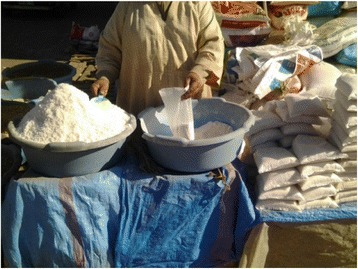
The median and interquartile range iodine concentration in salt was 2.9 mg/kg (IQR: 2.4-3.7). The results show that only 25 % of households use iodized salt. The recommended iodine concentration in salt of 15-40 mg/kg was met only in 4.5 % of salt samples. The bulk salt is used by 8 % of households. All samples of this bulk salt were found in rural areas. According to nonparametric appropriate tests used, there is no significant difference in iodine concentrations between regions, between urban and rural areas and between packaged and bulk salt.
Two decades since introducing legislation on Universal Salt Iodization, our survey shows that generalization of iodized salt is far from being reached. In 2015, only a quarter of Moroccan households use the iodized salt and only 4.5 % of salt is in conformity with regulations. The use of bulk salt by households in rural areas constitutes a major obstacle to the success of USI. The National Iodine Deficiency Disorders Control Program can only be achieved if an internal follow-up and a control of external quality of program is put in place.
根据世界卫生组织的建议,摩洛哥于1995年采用了全民食盐加碘(USI)作为预防和控制碘缺乏病的战略。2009年,食盐碘标准浓度调整为15 - 40毫克/千克。全民食盐加碘战略在控制碘缺乏病方面取得成功,需要在评估人群碘营养状况之前先评估食盐中的碘浓度。
在我们的研究中,我们参考了1993年和1998年在摩洛哥进行的前期研究。使用现场检测试剂盒对178份家庭食盐样本进行碘检测。采用碘量滴定法准确分析这178份家庭食盐样本中的碘浓度。采用经验性抽样方法,即非概率抽样方法,在该国不同的十二个地区进行抽样。
食盐中碘浓度的中位数和四分位数间距为2.9毫克/千克(四分位数间距:2.4 - 3.7)。结果显示,只有25%的家庭使用加碘盐。只有4.5%的食盐样本达到了建议的15 - 40毫克/千克的碘浓度。8%的家庭使用大包装食盐。所有这种大包装食盐样本均来自农村地区。根据所采用的非参数适当检验,各地区之间、城乡之间以及包装盐和大包装盐之间的碘浓度没有显著差异。
自实行全民食盐加碘立法二十年来,我们的调查显示加碘盐的普及程度远未达到。2015年,只有四分之一的摩洛哥家庭使用加碘盐,只有4.5%的食盐符合规定。农村家庭使用大包装食盐是全民食盐加碘战略成功的主要障碍。只有建立内部跟踪机制并控制项目外部质量,国家碘缺乏病控制项目才能实现。