El Hachioui Hanane, Visch-Brink Evy G, de Lau Lonneke M L, van de Sandt-Koenderman Mieke W M E, Nouwens Femke, Koudstaal Peter J, Dippel Diederik W J
Department of Neurology, Erasmus MC University Medical Center, Room EE 2291, P.O. Box 2040, 3000 CA, Rotterdam, The Netherlands.
Rijndam Rehabilitation Institute, Rotterdam, The Netherlands.
J Neurol. 2017 Feb;264(2):211-220. doi: 10.1007/s00415-016-8170-8. Epub 2016 Jun 3.
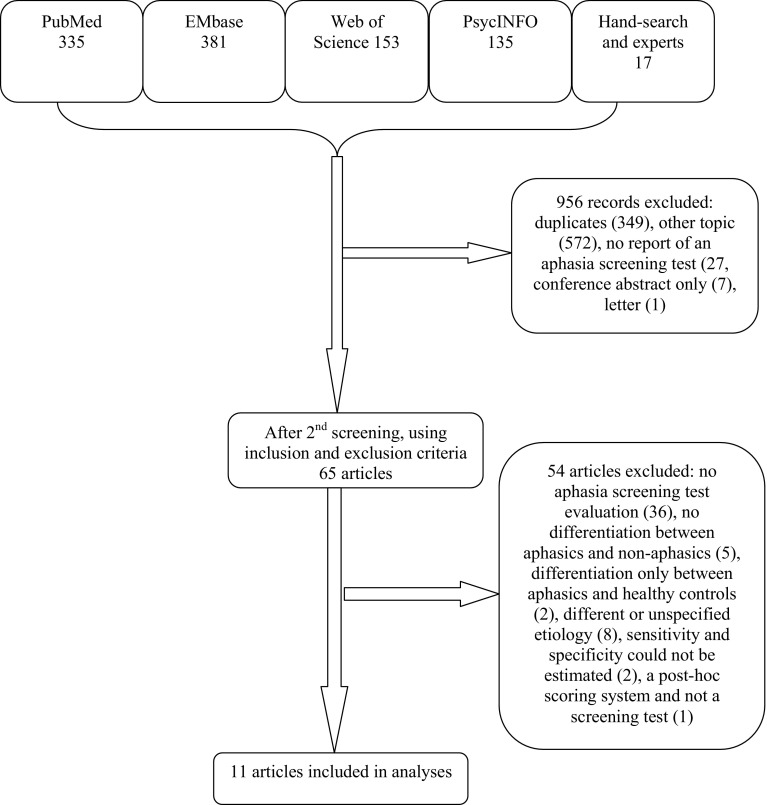
Aphasia has a large impact on the quality of life and adds significantly to the costs of stroke care. Early recognition of aphasia in stroke patients is important for prognostication and well-timed treatment planning. We aimed to identify available screening tests for differentiating between aphasic and non-aphasic stroke patients, and to evaluate test accuracy, reliability, and feasibility. We searched PubMed, EMbase, Web of Science, and PsycINFO for published studies on screening tests aimed at assessing aphasia in stroke patients. The reference lists of the selected articles were scanned, and several experts were contacted to detect additional references. Of each screening test, we estimated the sensitivity, specificity, likelihood ratio of a positive test, likelihood ratio of a negative test, and diagnostic odds ratio (DOR), and rated the degree of bias of the validation method. We included ten studies evaluating eight screening tests. There was a large variation across studies regarding sample size, patient characteristics, and reference tests used for validation. Many papers failed to report on the consecutiveness of patient inclusion, time between aphasia onset and administration of the screening test, and blinding. Of the three studies that were rated as having an intermediate or low risk of bias, the DOR was highest for the Language Screening Test and ScreeLing. Several screening tools for aphasia in stroke are available, but many tests have not been verified properly. Methodologically sound validation studies of aphasia screening tests are needed to determine their usefulness in clinical practice.
失语症对生活质量有很大影响,并显著增加了中风护理的成本。早期识别中风患者的失语症对于预后评估和及时的治疗规划很重要。我们旨在确定可用于区分失语和非失语中风患者的筛查测试,并评估测试的准确性、可靠性和可行性。我们在PubMed、EMbase、科学网和PsycINFO中搜索了关于旨在评估中风患者失语症的筛查测试的已发表研究。对所选文章的参考文献列表进行了扫描,并联系了几位专家以查找其他参考文献。对于每项筛查测试,我们估计了敏感性、特异性、阳性似然比、阴性似然比和诊断比值比(DOR),并对验证方法的偏倚程度进行了评级。我们纳入了十项评估八项筛查测试的研究。在样本量、患者特征和用于验证的参考测试方面,不同研究之间存在很大差异。许多论文未报告患者纳入的连续性、失语症发作与筛查测试实施之间的时间以及盲法情况。在三项被评为偏倚风险为中度或低度的研究中,语言筛查测试和ScreeLing的DOR最高。有几种用于中风失语症的筛查工具,但许多测试尚未得到充分验证。需要对失语症筛查测试进行方法学上合理的验证研究,以确定它们在临床实践中的有用性。