McLachlan Stela, Giambartolomei Claudia, White Jon, Charoen Pimphen, Wong Andrew, Finan Chris, Engmann Jorgen, Shah Tina, Hersch Micha, Podmore Clara, Cavadino Alana, Jefferis Barbara J, Dale Caroline E, Hypponen Elina, Morris Richard W, Casas Juan P, Kumari Meena, Ben-Shlomo Yoav, Gaunt Tom R, Drenos Fotios, Langenberg Claudia, Kuh Diana, Kivimaki Mika, Rueedi Rico, Waeber Gerard, Hingorani Aroon D, Price Jacqueline F, Walker Ann P
Centre for Population Health Sciences, Usher Institute of Population Health Sciences and Informatics, University of Edinburgh, Edinburgh, United Kingdom.
Department of Psychiatry, Icahn Institute for Genomics and Multiscale Biology, Icahn School of Medicine at Mount Sinai, The Leon and Norma Hess Center for Science and Medicine, New York, New York, United States of America.
PLoS One. 2016 Jun 9;11(6):e0156914. doi: 10.1371/journal.pone.0156914. eCollection 2016.
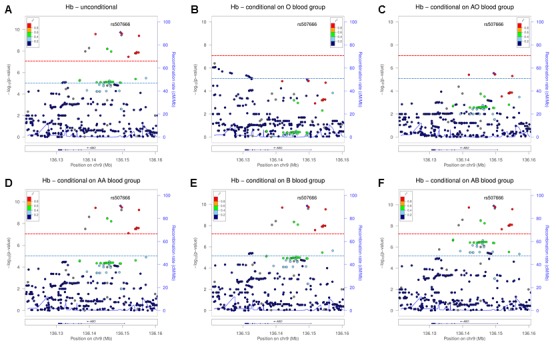
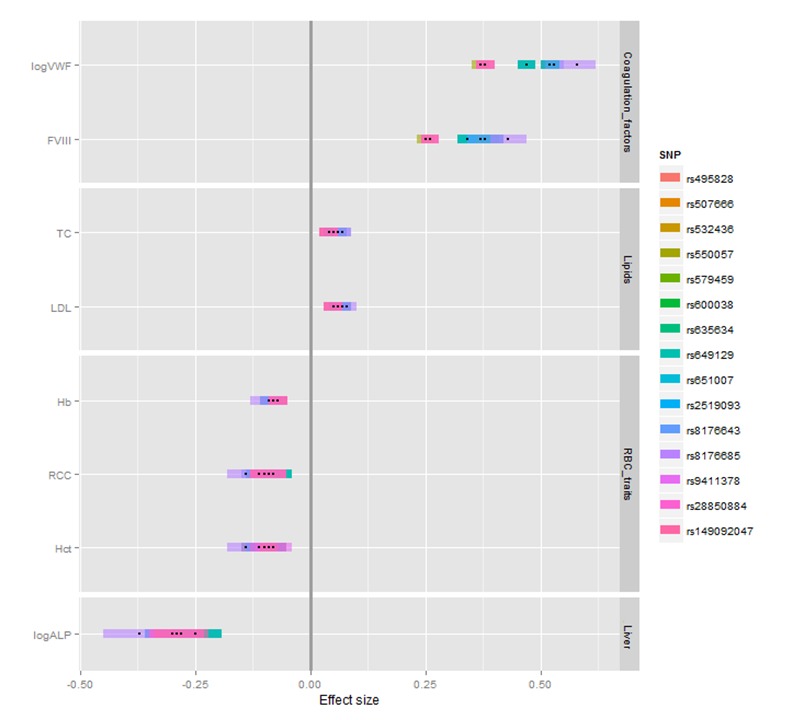
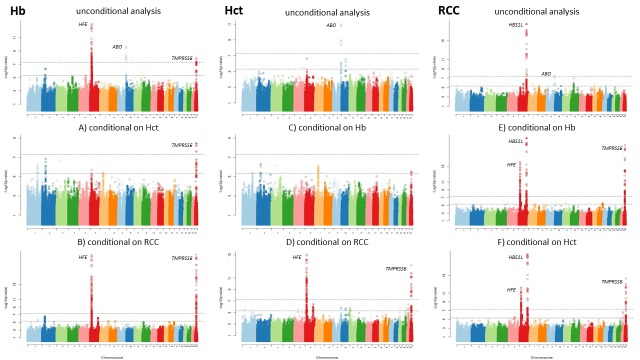
Red blood cell (RBC) traits are routinely measured in clinical practice as important markers of health. Deviations from the physiological ranges are usually a sign of disease, although variation between healthy individuals also occurs, at least partly due to genetic factors. Recent large scale genetic studies identified loci associated with one or more of these traits; further characterization of known loci and identification of new loci is necessary to better understand their role in health and disease and to identify potential molecular mechanisms. We performed meta-analysis of Metabochip association results for six RBC traits-hemoglobin concentration (Hb), hematocrit (Hct), mean corpuscular hemoglobin (MCH), mean corpuscular hemoglobin concentration (MCHC), mean corpuscular volume (MCV) and red blood cell count (RCC)-in 11 093 Europeans from seven studies of the UCL-LSHTM-Edinburgh-Bristol (UCLEB) Consortium. We identified 394 non-overlapping SNPs in five loci at genome-wide significance: 6p22.1-6p21.33 (with HFE among others), 6q23.2 (with HBS1L among others), 6q23.3 (contains no genes), 9q34.3 (only ABO gene) and 22q13.1 (with TMPRSS6 among others), replicating previous findings of association with RBC traits at these loci and extending them by imputation to 1000 Genomes. We further characterized associations between ABO SNPs and three traits: hemoglobin, hematocrit and red blood cell count, replicating them in an independent cohort. Conditional analyses indicated the independent association of each of these traits with ABO SNPs and a role for blood group O in mediating the association. The 15 most significant RBC-associated ABO SNPs were also associated with five cardiometabolic traits, with discordance in the direction of effect between groups of traits, suggesting that ABO may act through more than one mechanism to influence cardiometabolic risk.
红细胞(RBC)特征在临床实践中常作为健康的重要指标进行常规检测。尽管健康个体之间也存在差异,至少部分是由于遗传因素,但偏离生理范围通常是疾病的迹象。最近的大规模基因研究确定了与这些特征中的一种或多种相关的基因座;有必要对已知基因座进行进一步表征并鉴定新的基因座,以更好地了解它们在健康和疾病中的作用,并确定潜在的分子机制。我们对来自UCL-LSHTM-爱丁堡-布里斯托尔(UCLEB)联盟七项研究的11093名欧洲人的六项红细胞特征——血红蛋白浓度(Hb)、血细胞比容(Hct)、平均红细胞血红蛋白含量(MCH)、平均红细胞血红蛋白浓度(MCHC)、平均红细胞体积(MCV)和红细胞计数(RCC)——的代谢芯片关联结果进行了荟萃分析。我们在全基因组显著性水平上确定了五个基因座中的394个非重叠单核苷酸多态性(SNP):6p22.1-6p21.33(其中包括HFE等)、6q23.2(其中包括HBS1L等)、6q23.3(不包含基因)、9q34.3(仅ABO基因)和22q13.1(其中包括TMPRSS6等),重复了之前在这些基因座与红细胞特征关联的研究结果,并通过推算将其扩展到千人基因组计划。我们进一步表征了ABO SNP与三种特征之间的关联:血红蛋白、血细胞比容和红细胞计数,并在一个独立队列中进行了重复验证。条件分析表明这些特征中的每一个与ABO SNP的独立关联以及血型O在介导这种关联中的作用。15个与红细胞最显著相关的ABO SNP也与五种心血管代谢特征相关,不同特征组之间效应方向不一致,这表明ABO可能通过多种机制影响心血管代谢风险。