Bernard Renaldo, Sabariego Carla, Cieza Alarcos
Department of Medical Informatics, Biometry and Epidemiology - IBE, Chair for Public Health and Health Services Research, Research Unit for Biopsychosocial Health, Ludwig-Maximilians-Universität München, Munich, Germany.
J Med Internet Res. 2016 Jun 9;18(6):e157. doi: 10.2196/jmir.5442.
Mental disorders (MDs) affect almost 1 in 4 adults at some point during their lifetime, and coupled with substance use disorders are the fifth leading cause of disability adjusted life years worldwide. People with these disorders often use the Web as an informational resource, platform for convenient self-directed treatment, and a means for many other kinds of support. However, some features of the Web can potentially erect barriers for this group that limit their access to these benefits, and there is a lack of research looking into this eventuality. Therefore, it is important to identify gaps in knowledge about "what" barriers exist and "how" they could be addressed so that this knowledge can inform Web professionals who aim to ensure the Web is inclusive to this population.
The objective of this study was to provide an overview of existing evidence regarding the barriers people with mental disorders experience when using the Web and the facilitation measures used to address such barriers.
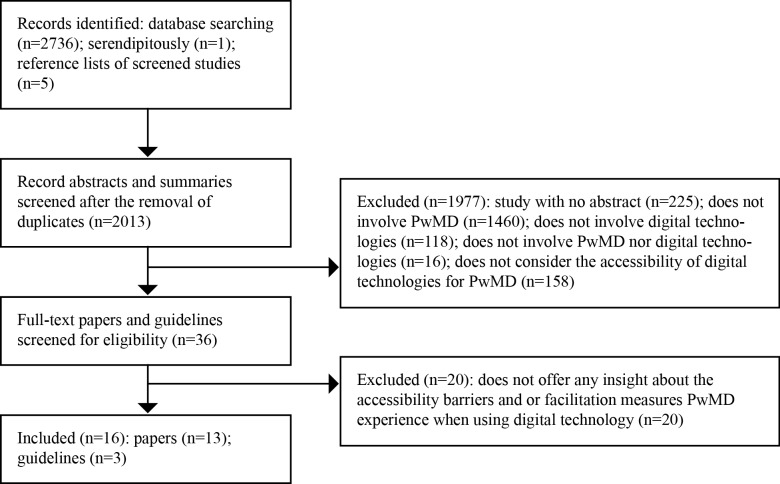
This study involved a systematic review of studies that have considered the difficulties people with mental disorders experience when using digital technologies. Digital technologies were included because knowledge about any barriers here would likely be also applicable to the Web. A synthesis was performed by categorizing data according to the 4 foundational principles of Web accessibility as proposed by the World Wide Web Consortium, which forms the necessary basis for anyone to gain adequate access to the Web. Facilitation measures recommended by studies were later summarized into a set of minimal recommendations.
A total of 16 publications were included in this review, comprising 13 studies and 3 international guidelines. Findings suggest that people with mental disorders experience barriers that limit how they perceive, understand, and operate websites. Identified facilitation measures target these barriers in addition to ensuring that Web content can be reliably interpreted by a wide range of user applications.
People with mental disorders encounter barriers on the Web, and attempts have been made to remove or reduce these barriers. As forewarned by experts in the area, only a few studies investigating this issue were found. More rigorous research is needed to be exhaustive and to have a larger impact on improving the Web for people with mental disorders.
精神障碍(MDs)在一生中的某个阶段影响着近四分之一的成年人,并且与物质使用障碍一起,是全球伤残调整生命年的第五大主要原因。患有这些障碍的人经常将网络用作信息资源、方便的自我指导治疗平台以及许多其他支持手段。然而,网络的一些特性可能会给这一群体设置障碍,限制他们获得这些益处,并且缺乏针对这种可能性的研究。因此,识别关于“存在哪些”障碍以及“如何”解决这些障碍的知识空白非常重要,以便这些知识能够为旨在确保网络对这一人群具有包容性的网络专业人员提供参考。
本研究的目的是概述关于精神障碍患者在使用网络时所遇到的障碍以及用于解决此类障碍的促进措施的现有证据。
本研究对考虑精神障碍患者在使用数字技术时所遇到困难的研究进行了系统综述。纳入数字技术是因为这里关于任何障碍的知识可能也适用于网络。根据万维网联盟提出的网络可访问性的4项基本原则对数据进行分类,从而进行综合分析,这为任何人充分访问网络奠定了必要基础。随后将研究所推荐的促进措施总结为一套最低限度的建议。
本综述共纳入16篇出版物,包括13项研究和3项国际指南。研究结果表明精神障碍患者会遇到限制其对网站的感知、理解和操作的障碍。除了确保网络内容能够被广泛的用户应用可靠解读外,已确定的促进措施还针对这些障碍。
精神障碍患者在网络上会遇到障碍,并且已经有人尝试消除或减少这些障碍。正如该领域专家所警告的,仅发现了少数几项针对此问题的研究。需要进行更严格的研究,以做到详尽无遗,并对改善精神障碍患者的网络环境产生更大影响。