Department of Chemical Physics, Weizmann Institute of Science, POB 26, Rehovot 76100, Israel.
Department of Chemical Research Support, Weizmann Institute of Science, Rehovot 76100, Israel.
Nat Commun. 2016 Jun 13;7:ncomms11823. doi: 10.1038/ncomms11823.
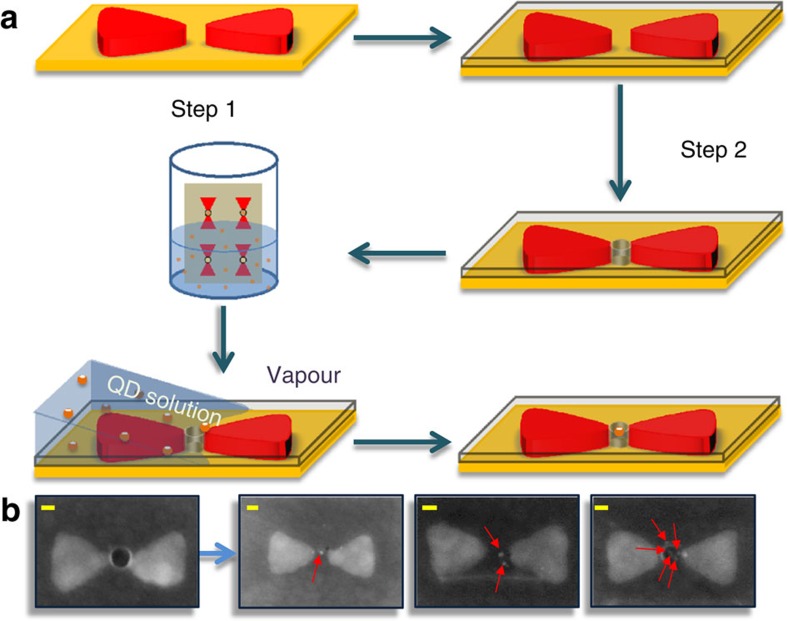
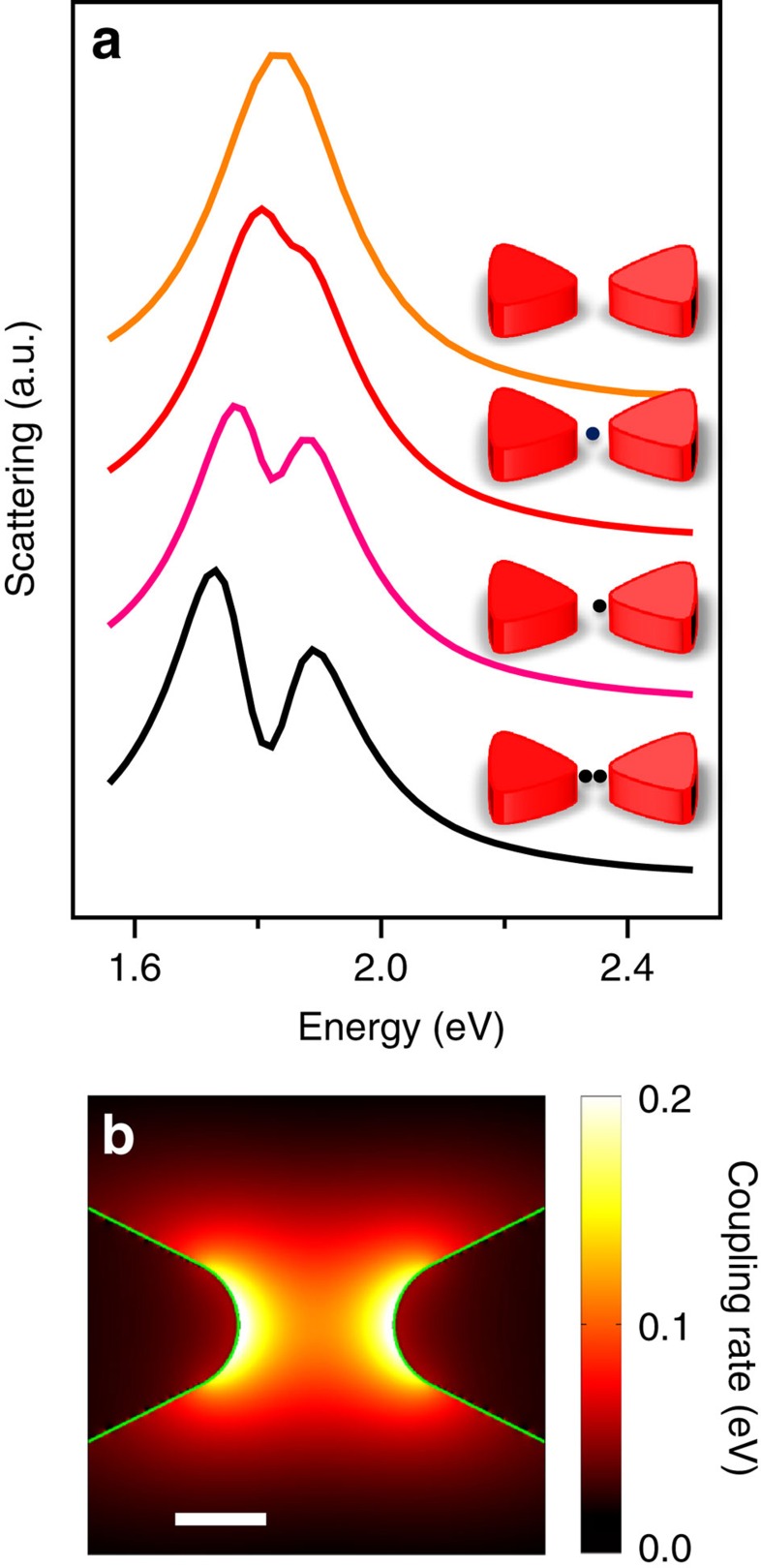
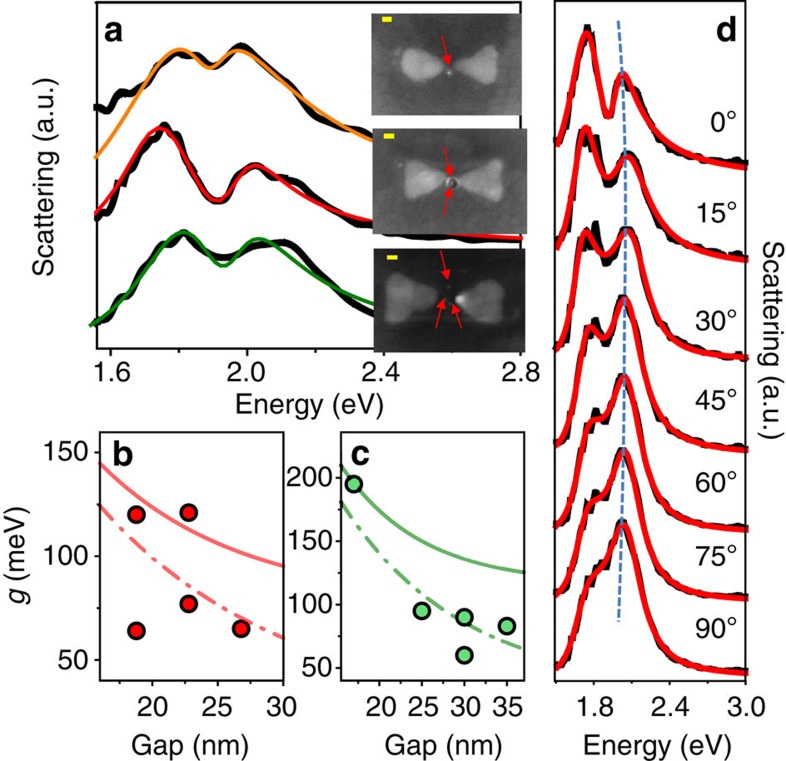
The strong interaction of individual quantum emitters with resonant cavities is of fundamental interest for understanding light-matter interactions. Plasmonic cavities hold the promise of attaining the strong coupling regime even under ambient conditions and within subdiffraction volumes. Recent experiments revealed strong coupling between individual plasmonic structures and multiple organic molecules; however, strong coupling at the limit of a single quantum emitter has not been reported so far. Here we demonstrate vacuum Rabi splitting, a manifestation of strong coupling, using silver bowtie plasmonic cavities loaded with semiconductor quantum dots (QDs). A transparency dip is observed in the scattering spectra of individual bowties with one to a few QDs, which are directly counted in their gaps. A coupling rate as high as 120 meV is registered even with a single QD, placing the bowtie-QD constructs close to the strong coupling regime. These observations are verified by polarization-dependent experiments and validated by electromagnetic calculations.
单个量子发射器与共振腔的强相互作用对于理解光与物质的相互作用至关重要。等离子体腔有望在环境条件下甚至在亚衍射体积内达到强耦合状态。最近的实验揭示了单个等离子体结构与多个有机分子之间的强耦合;然而,到目前为止,还没有报道单个量子发射器的强耦合。在这里,我们使用加载半导体量子点 (QD) 的银蝴蝶结等离子体腔演示了真空拉比分裂,这是强耦合的一种表现。在带有一个到几个 QD 的单个蝴蝶结的散射光谱中观察到透明下降,这些 QD 直接在它们的间隙中计数。即使只有一个 QD,也记录到高达 120 meV 的耦合速率,这使得蝴蝶结-QD 结构接近强耦合状态。这些观察结果通过偏振相关实验得到验证,并通过电磁计算得到验证。