Friedrich Ralf P, Zaloga Jan, Schreiber Eveline, Tóth Ildikó Y, Tombácz Etelka, Lyer Stefan, Alexiou Christoph
Department of Otorhinolaryngology, Head and Neck, Section for Experimental Oncology and Nanomedicine (SEON), Else Kröner-Fresenius-Stiftung-Professorship, University Hospital Erlangen, Glueckstraße 10a, 91054, Erlangen, Germany.
Department of Physical Chemistry and Materials Science, University of Szeged, Szeged, Hungary.
Nanoscale Res Lett. 2016 Dec;11(1):297. doi: 10.1186/s11671-016-1521-7. Epub 2016 Jun 14.
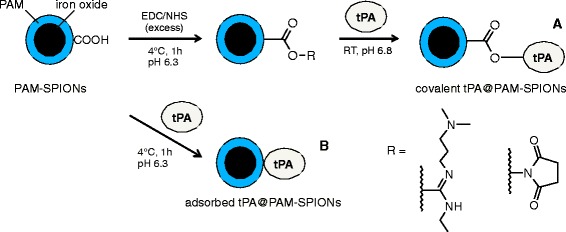
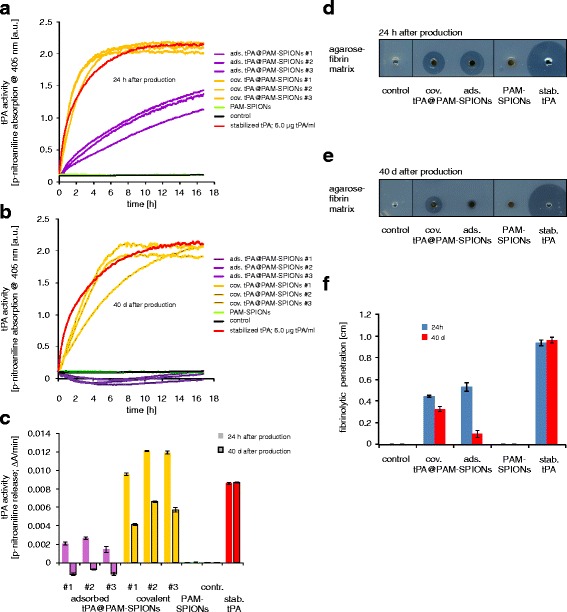
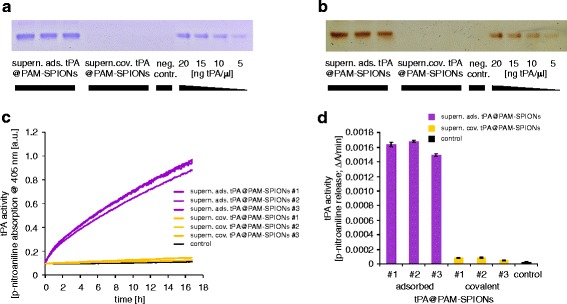
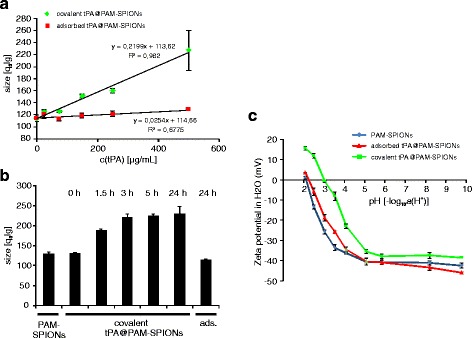
Functionalized superparamagnetic iron oxide nanoparticles are frequently used to develop vehicles for drug delivery, hyperthermia, and photodynamic therapy and as tools used for magnetic separation and purification of proteins or for biomolecular imaging. Depending on the application, there are various possible covalent and non-covalent approaches for the functionalization of particles, each of them shows different advantages and disadvantages for drug release and activity at the desired location.Particularly important for the production of adsorptive and covalent bound drugs to nanoparticles is the pureness of the involved formulation. Especially the covalent binding strategy demands defined chemistry of the drug, which is stabilized by excess free amino acids which could reduce reaction efficiency. In this study, we therefore used tangential flow filtration (TFF) method to purify the drugs before the reaction and used the frequently applied and clinically available recombinant tissue plasminogen activator (tPA; Actilyse(®)) as a proof of concept. We then coupled the tPA preparation to polyacrylic acid-co-maleic acid (PAM)-coated superparamagnetic iron oxide nanoparticles (SPIONs) using an amino-reactive activated ester reaction and compared these particles to PAM-coated SPIONs with electrostatically adsorbed tPA.Using dynamic light scattering (DLS) and pH-dependent electrokinetic mobility measurements, we showed that surface properties of the SPIONs were significantly greater affected after activation of the particles compared to the adsorption controls. Different in vitro assays were used to investigate the activity of tPA after coupling to the particles and purification of the ferrofluid. Covalent linkage significantly improves the reactivity and long-term stability of the conjugated SPION-tPA system compared to simple adsorption. In conclusion, we have shown an effective way to produce SPIONs with covalent and non-covalent ultra-filtrated drugs. We showed that using activated ester reaction, immobilization of the protein was significantly better than in adsorptive approaches. Investigation of those functionalized SPIONs revealed diverging attributes, which should be taken into account when developing nanoparticles for different applications.
功能化超顺磁性氧化铁纳米颗粒常用于开发药物递送、热疗和光动力治疗的载体,以及用于蛋白质的磁分离和纯化或生物分子成像的工具。根据应用的不同,颗粒功能化有多种可能的共价和非共价方法,每种方法在药物释放和在所需位置的活性方面都有不同的优缺点。对于纳米颗粒吸附和共价结合药物的生产来说,所涉及制剂的纯度尤为重要。特别是共价结合策略要求药物具有特定的化学性质,而过量的游离氨基酸会使其稳定,这可能会降低反应效率。因此,在本研究中,我们在反应前使用切向流过滤(TFF)方法纯化药物,并使用常用且临床可用的重组组织型纤溶酶原激活剂(tPA;阿替普酶(Actilyse®))作为概念验证。然后,我们使用氨基反应性活化酯反应将tPA制剂偶联到聚丙烯酸-马来酸共聚物(PAM)包被的超顺磁性氧化铁纳米颗粒(SPIONs)上,并将这些颗粒与静电吸附tPA的PAM包被的SPIONs进行比较。通过动态光散射(DLS)和pH依赖性电动迁移率测量,我们发现与吸附对照相比,颗粒活化后SPIONs的表面性质受到的影响显著更大。使用不同的体外试验来研究tPA偶联到颗粒上并纯化铁磁流体后的活性。与简单吸附相比,共价连接显著提高了共轭SPION-tPA系统的反应性和长期稳定性。总之,我们展示了一种生产共价和非共价超滤药物的SPIONs的有效方法。我们表明,使用活化酯反应,蛋白质的固定化明显优于吸附方法。对那些功能化SPIONs的研究揭示了不同的特性,在开发用于不同应用的纳米颗粒时应予以考虑。