Tan Juntao, Yang Nuo, Hu Zixi, Su Jing, Zhong Jianhong, Yang Yang, Yu Yating, Zhu Jianmeng, Xue Dabin, Huang Yingying, Lai Zongqiang, Huang Yong, Lu Xiaoling, Zhao Yongxiang
National Center for International Research of Biological Targeting Diagnosis and Therapy, Guangxi Key Laboratory of Biological Targeting Diagnosis and Therapy Research, Collaborative Innovation Center for Targeting Tumor Diagnosis and Therapy, Guangxi Medical University, Nanning, Guangxi, 530021, China.
Department of Oncologic Surgery, Affiliated Tumor Hospital of Guangxi Medical University, Nanning, Guangxi, China.
Nanoscale Res Lett. 2016 Dec;11(1):298. doi: 10.1186/s11671-016-1512-8. Epub 2016 Jun 14.
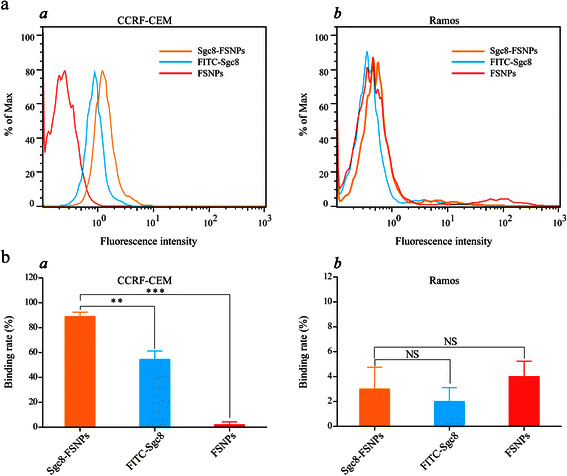
A simple, highly sensitive method to detect leukemia cells has been developed based on aptamer-modified fluorescent silica nanoparticles (FSNPs). In this strategy, the amine-labeled Sgc8 aptamer was conjugated to carboxyl-modified FSNPs via amide coupling between amino and carboxyl groups. Sensitivity and specificity of Sgc8-FSNPs were assessed using flow cytometry and fluorescence microscopy. These results showed that Sgc8-FSNPs detected leukemia cells with high sensitivity and specificity. Aptamer-modified FSNPs hold promise for sensitive and specific detection of leukemia cells. Changing the aptamer may allow the FSNPs to detect other types of cancer cells.
基于适体修饰的荧光二氧化硅纳米颗粒(FSNPs),开发了一种简单、高灵敏度的检测白血病细胞的方法。在该策略中,通过氨基和羧基之间的酰胺偶联,将胺标记的Sgc8适体与羧基修饰的FSNPs偶联。使用流式细胞术和荧光显微镜评估Sgc8-FSNPs的灵敏度和特异性。这些结果表明,Sgc8-FSNPs能够高灵敏度和特异性地检测白血病细胞。适体修饰的FSNPs有望用于白血病细胞的灵敏且特异的检测。改变适体可能使FSNPs能够检测其他类型的癌细胞。