Hu Zixi, Tan Juntao, Lai Zongqiang, Zheng Rong, Zhong Jianhong, Wang Yiwei, Li Xiaoxue, Yang Nuo, Li Jieping, Yang Wei, Huang Yong, Zhao Yongxiang, Lu Xiaoling
National Center for International Research of Biological Targeting Diagnosis and Therapy, Guangxi Key Laboratory of Biological Targeting Diagnosis and Therapy Research, Collaborative Innovation Center for Targeting Tumor Diagnosis and Therapy, Guangxi Medical University, Nanning, Guangxi, China.
Surgery Oncology Department, Affiliated Tumor Hospital of Guangxi Medical University, Nanning, China.
Nanoscale Res Lett. 2017 Dec;12(1):96. doi: 10.1186/s11671-017-1890-6. Epub 2017 Feb 7.
The purpose of this study is to develop a simple, effective method to label hepatoma cells with aptamers and then detect them using fluorescent silica nanoparticles (FSNPs).
Streptavidin was conjugated to carboxyl-modified fluorescein isothiocyanate (FITC)-doped silica nanoparticles which were prepared by the reverse microemulsion method. The resulting streptavidin-conjugated fluorescent silica nanoparticles (SA-FSNPs) were mixed with hepatoma cells that had been labeled with biotin-conjugated aptamer TLS11a (Bio-TLS11a). The specificity and sensitivity of the nanoprobes were assessed using flow cytometry and fluorescence microscopy. Their toxicity was assessed in normal human liver cell cultures using the MTT assay, as well as in nude mice using immunohistochemistry.
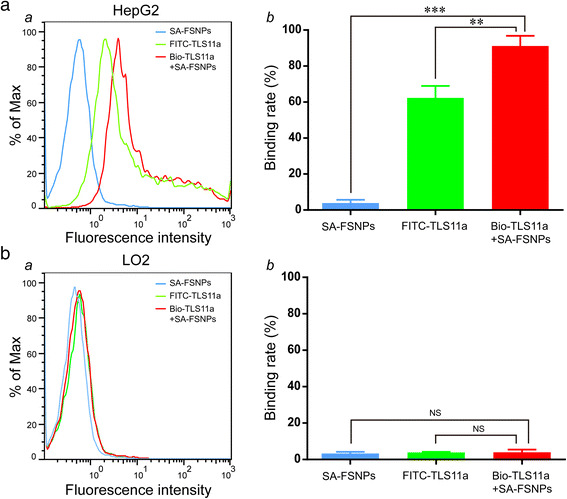
SA-FSNPs showed uniform size and shape, and fluorescence properties of them was similar to the free FITC dye. SA-FSNPs were able to detect aptamer-labeled hepatoma cells with excellent specificity and good sensitivity, and they emitted strong, photobleach-resistant fluorescent signal. SA-FSNPs showed no significant toxic effects in vitro or in vivo.
The combination of biotin-conjugated aptamers and SA-FSNPs shows promise for sensitive detection of hepatoma cells, and potentially of other tumor cell types as well.
本研究的目的是开发一种简单有效的方法,用适体标记肝癌细胞,然后使用荧光二氧化硅纳米颗粒(FSNPs)对其进行检测。
将链霉亲和素与通过反相微乳液法制备的羧基修饰的异硫氰酸荧光素(FITC)掺杂的二氧化硅纳米颗粒偶联。将所得的链霉亲和素偶联的荧光二氧化硅纳米颗粒(SA-FSNPs)与已用生物素偶联的适体TLS11a(Bio-TLS11a)标记的肝癌细胞混合。使用流式细胞术和荧光显微镜评估纳米探针的特异性和敏感性。使用MTT法在正常人肝细胞培养物中以及使用免疫组织化学在裸鼠中评估它们的毒性。
SA-FSNPs显示出均匀的大小和形状,并且它们的荧光特性与游离FITC染料相似。SA-FSNPs能够以优异的特异性和良好的敏感性检测适体标记的肝癌细胞,并且它们发出强烈的、抗光漂白的荧光信号。SA-FSNPs在体外或体内均未显示出明显的毒性作用。
生物素偶联的适体与SA-FSNPs的组合显示出有望灵敏检测肝癌细胞,并且也可能用于检测其他肿瘤细胞类型。