Aliasghari Azam, Rabbani Khorasgani Mohammad, Vaezifar Sedigheh, Rahimi Fateh, Younesi Habibollah, Khoroushi Maryam
Department of Biology, Faculty of Sciences, University of Isfahan, Iran.
Department of Medical Engineering, Payame Noor University, Iran.
Iran J Microbiol. 2016 Apr;8(2):93-100.
The most prevalent and worldwide oral disease is dental caries that affects a significant proportion of the world population. There are some classical approaches for control, prevention and treatment of this pathologic condition; however, the results are still not completely successful. Therefore new methods are needed for better management of this important challenge. Chitosan is a natural and non-toxic polysaccharide with many biological applications, particularly as an antimicrobial agent. Chitosan nanoparticle is a bioactive and environment friendly material with unique physicochemical properties. The aim of the present study was to investigate the antimicrobial effect of chitosan and nano-chitosan on the most important cariogenic streptococci.
For evaluation of antimicrobial effect of chitosan and nano-chitosan against oral streptococci broth micro-dilution method was carried out for four bacterial species; Streptococcus mutans, Streptococcus sobrinus, Streptococcus sanguis and Streptococcus salivarius. Also the effect of these materials on adhesion of above bacteria was evaluated. One-way ANOVA and post hoc Tukey test were used for statistical analysis.
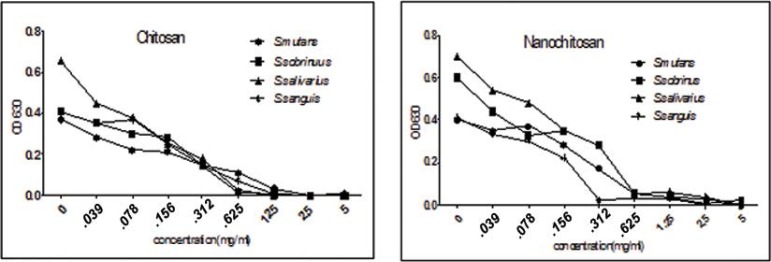
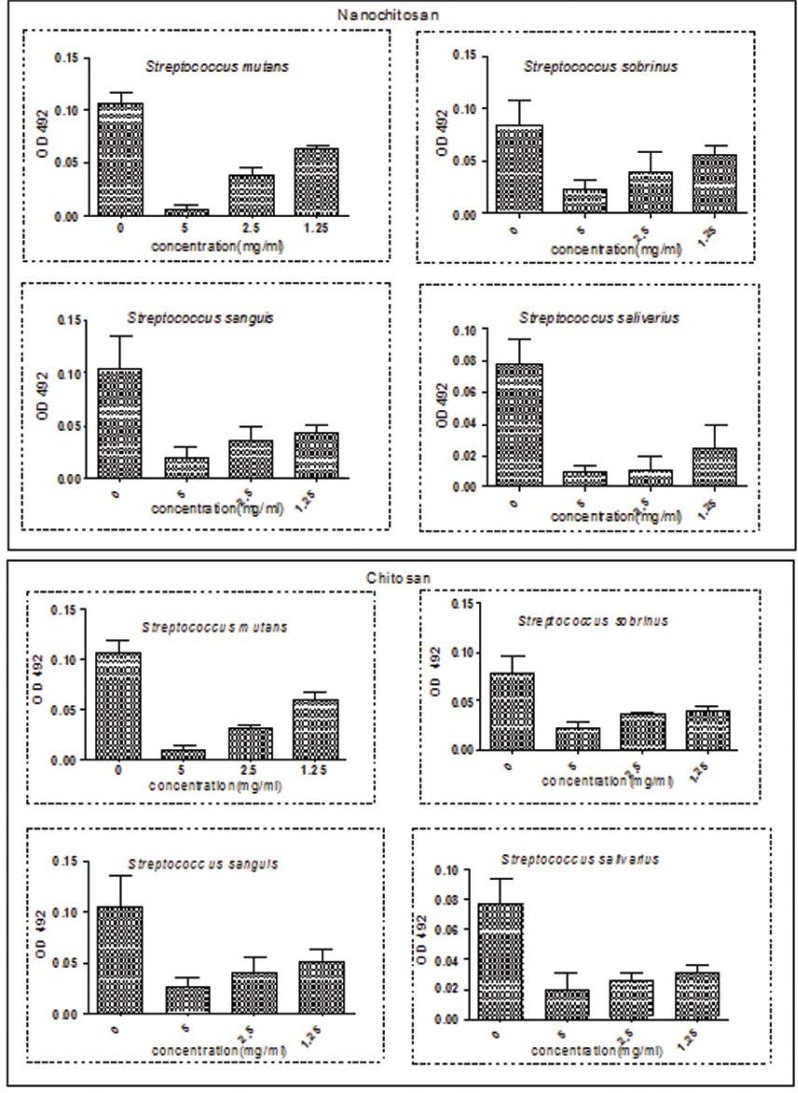
The MICs of chitosan for S. mutans, S. sanguis, S. salivarius and S. sobrinus were 1.25, 1.25, 0.625 and 0.625 mg/mL, respectively. The MIC of chitosan nanoparticle for S. mutans, S. salivarius and S. sobrinus was 0.625 mg/mL and for S. sanguis was 0.312 mg/mL. Chitosan and chitosan nanoparticles at a concentration of 5 mg/mL also reduced biofilm formation of S. mutans up to 92.5% and 93.4%, respectively.
The results of this study supported the use of chitosan and chitosan nanoparticles as antimicrobial agents against cariogenic Streptococci.
龋齿是全球最普遍的口腔疾病,影响着世界上很大一部分人口。对于这种病理状况,有一些经典的控制、预防和治疗方法;然而,结果仍未完全成功。因此,需要新的方法来更好地应对这一重大挑战。壳聚糖是一种天然无毒的多糖,有许多生物学应用,尤其是作为抗菌剂。壳聚糖纳米颗粒是一种具有生物活性且环境友好的材料,具有独特的物理化学性质。本研究的目的是调查壳聚糖和纳米壳聚糖对最重要的致龋链球菌的抗菌作用。
为评估壳聚糖和纳米壳聚糖对口腔链球菌的抗菌作用,采用肉汤微量稀释法对四种细菌进行了研究,即变形链球菌、远缘链球菌、血链球菌和唾液链球菌。此外,还评估了这些材料对上述细菌黏附的影响。采用单因素方差分析和事后 Tukey 检验进行统计分析。
壳聚糖对变形链球菌、血链球菌、唾液链球菌和远缘链球菌的最低抑菌浓度(MIC)分别为 1.25、1.25、0.625 和 0.625 mg/mL。壳聚糖纳米颗粒对变形链球菌、唾液链球菌和远缘链球菌的 MIC 为 0.625 mg/mL,对血链球菌的 MIC 为 0.312 mg/mL。浓度为 5 mg/mL 的壳聚糖和壳聚糖纳米颗粒分别使变形链球菌的生物膜形成减少了 92.5%和 93.4%。
本研究结果支持将壳聚糖和壳聚糖纳米颗粒用作抗致龋链球菌的抗菌剂。