Bessman Nicholas J, Sonnenberg Gregory F
Joan and Sanford I. Weill Department of Medicine, Division of Gastroenterology, Weill Cornell Medicine, New York, NY, USA.
Department of Microbiology and Immunology, Weill Cornell Medicine, New York, NY, USA.
Immunol Rev. 2016 Jul;272(1):139-50. doi: 10.1111/imr.12425.
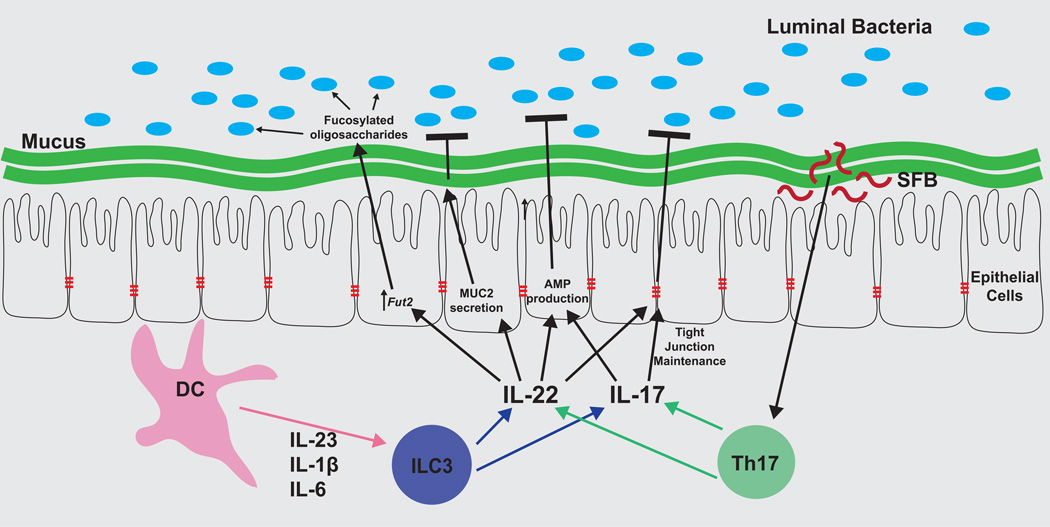
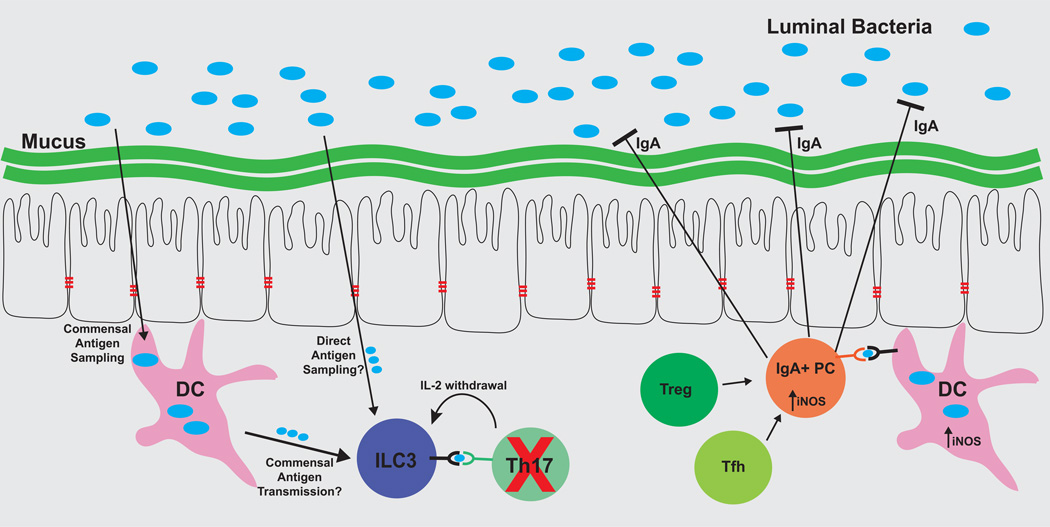
Trillions of beneficial bacteria inhabit the intestinal tract of healthy mammals from birth. Accordingly, mammalian hosts have evolved a series of complementary and redundant pathways to limit pathologic immune responses against these bacteria, while simultaneously protecting against enteric pathogen invasion. These pathways can be generically responsive to the presence of any commensal bacteria and innate in nature, as for IL-22-related pathways. Alternatively, specific bacterial antigens can drive a distinct set of adaptive immune cell responses, including IgA affinity maturation and secretion, and a recently described pathway of intestinal selection whereby MHCII(+) ILC3 deletes commensal bacteria-reactive CD4 T cells. These pathways can either promote or inhibit colonization by specific subsets of commensal bacteria, and cooperatively maintain intestinal homeostasis. In this review, we will highlight recent developments in understanding how these diverse pathways complement each other to cooperatively shape the symbiotic relationship between commensal bacteria and mammalian hosts.
从出生起,数万亿有益细菌就栖息在健康哺乳动物的肠道中。因此,哺乳动物宿主进化出了一系列互补且冗余的途径,以限制针对这些细菌的病理性免疫反应,同时抵御肠道病原体的入侵。这些途径通常可对任何共生细菌的存在产生反应,本质上是先天性的,比如与白细胞介素-22相关的途径。另外,特定的细菌抗原可驱动一组独特的适应性免疫细胞反应,包括免疫球蛋白A亲和力成熟和分泌,以及最近描述的一种肠道选择途径,即主要组织相容性复合体II类(MHCII)阳性的3型固有淋巴细胞(ILC3)清除对共生细菌有反应的CD4 T细胞。这些途径既可以促进也可以抑制特定共生细菌亚群的定殖,并协同维持肠道内环境稳定。在这篇综述中,我们将重点介绍在理解这些不同途径如何相互补充以协同塑造共生细菌与哺乳动物宿主之间的共生关系方面的最新进展。