Keitel Anne, Gross Joachim
Centre for Cognitive Neuroimaging, Institute of Neuroscience and Psychology, University of Glasgow, Glasgow, United Kingdom.
PLoS Biol. 2016 Jun 29;14(6):e1002498. doi: 10.1371/journal.pbio.1002498. eCollection 2016 Jun.
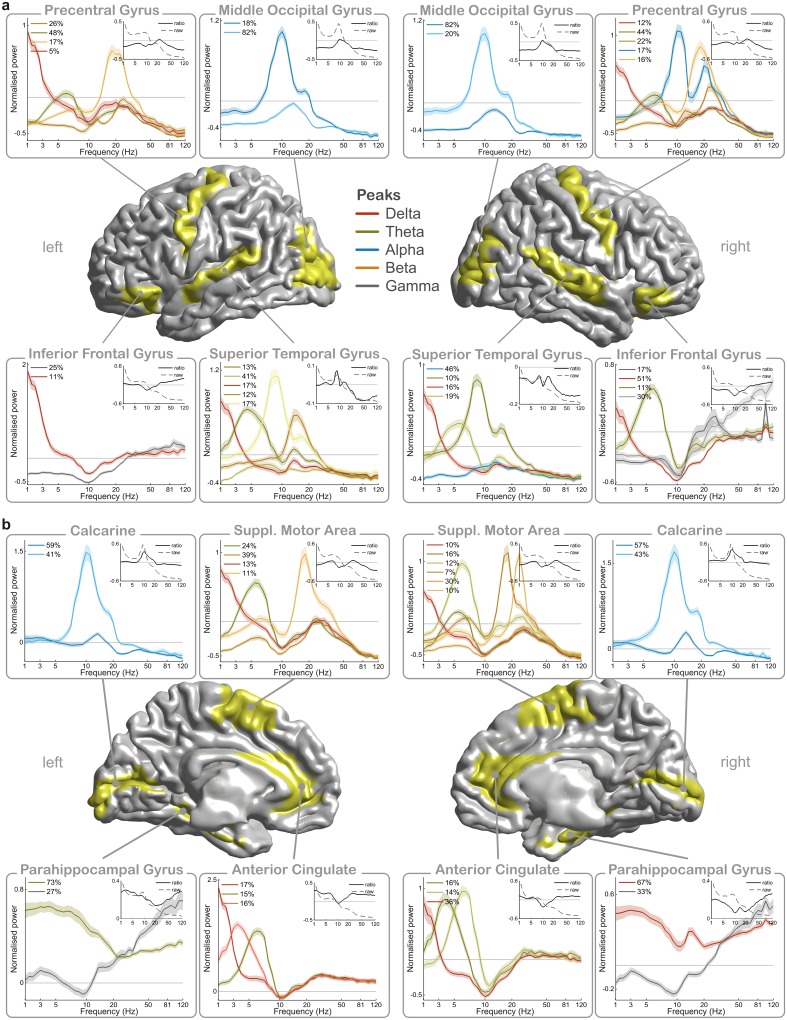
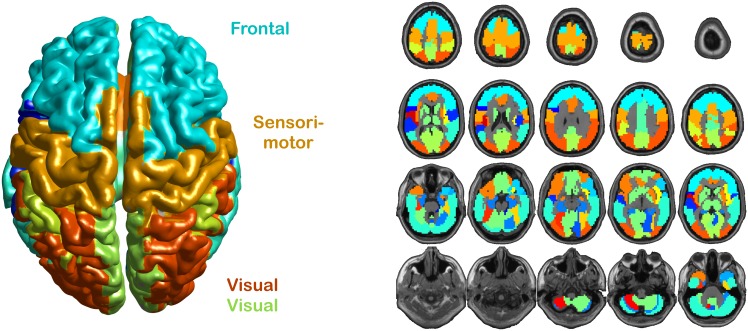
The human brain can be parcellated into diverse anatomical areas. We investigated whether rhythmic brain activity in these areas is characteristic and can be used for automatic classification. To this end, resting-state MEG data of 22 healthy adults was analysed. Power spectra of 1-s long data segments for atlas-defined brain areas were clustered into spectral profiles ("fingerprints"), using k-means and Gaussian mixture (GM) modelling. We demonstrate that individual areas can be identified from these spectral profiles with high accuracy. Our results suggest that each brain area engages in different spectral modes that are characteristic for individual areas. Clustering of brain areas according to similarity of spectral profiles reveals well-known brain networks. Furthermore, we demonstrate task-specific modulations of auditory spectral profiles during auditory processing. These findings have important implications for the classification of regional spectral activity and allow for novel approaches in neuroimaging and neurostimulation in health and disease.
人类大脑可被划分为不同的解剖区域。我们研究了这些区域的节律性脑活动是否具有特征性,以及能否用于自动分类。为此,我们分析了22名健康成年人的静息态脑磁图(MEG)数据。使用k均值和高斯混合(GM)模型,将图谱定义的脑区1秒长数据段的功率谱聚类为频谱轮廓(“指纹”)。我们证明,从这些频谱轮廓中可以高精度地识别各个区域。我们的结果表明,每个脑区参与不同的频谱模式,这些模式是各个区域所特有的。根据频谱轮廓的相似性对脑区进行聚类,可揭示出众所周知的脑网络。此外,我们还证明了在听觉处理过程中听觉频谱轮廓的任务特异性调制。这些发现对区域频谱活动的分类具有重要意义,并为健康和疾病状态下的神经成像和神经刺激提供了新方法。