Alemu Taddese, Umeta Melaku
Center of Food Science and Nutrition, College of Natural Sciences, Addis Ababa University, Ethiopia; Dilla University, College of Health and Medicine, and Referal Hospital. P.O.Box, 419, Dilla, Ethiopia.
Department of Medical Biochemistry, College of Health Sciences, Addis Ababa University, Ethiopia.
Ethiop J Health Sci. 2016 May;26(3):243-50. doi: 10.4314/ejhs.v26i3.7.
Low Birth Weight (LBW) babies account for nearly 80% of neonatal deaths globally. In Ethiopia, only 5% of them are weighed at birth. This study analyzes the prevalence and key proximate determinants of reported infant size, and its validity to use as a proxy indicator for low birth weight inthe Ethiopian context.
In-depth analysis of the Ethiopian Demographic and Health Survey dataset was conducted using representative data collected from all regions in the country. Considering reported fetal size at birth as an outcome variable, key predicting variables from socio-demographic, household, child and obstetric characteristics were employed for analyses. Chi-square test and multivariate logistic regression model were used to determine predictors at p value < 0.05.
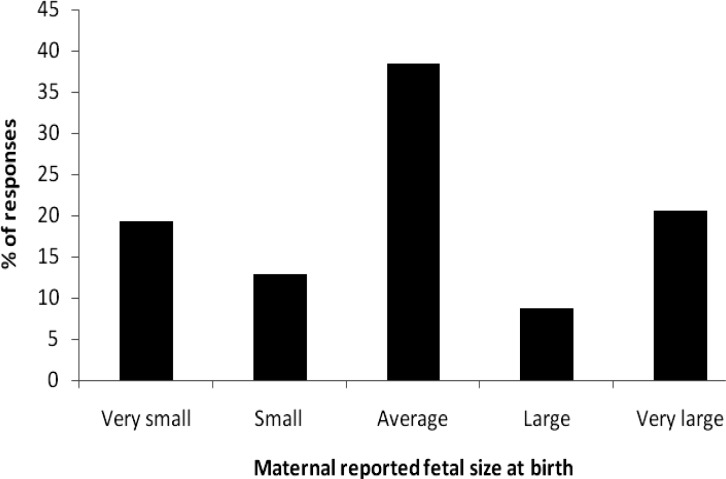
An average of 29.1% of Ethiopian babies were reported "small" at birth in 2011. various variables from socio-demographic, household, child and maternal reproductive characteristics were identified as key predictors. Women who develop anemia and not attending antenatal care during pregnancy had 15% and 41% more risk of giving birth to the reported "small size" babies than their counterparts (AoR = 1.15, and 1.41, 95% CI (1.02, 1.64 and 1.06, 1.88) respectively. Maternal age at delivery, maternal literacy level, paternal educational status and presence of radio or television in the household and other factors were also other key predictors identified.
The prevalence of small size babies in Ethiopia is high but comparable to regional estimates of LBW. It is recommend that improving maternal nutritional and socio-economic status is a timely intervention to tackle the problem.
低体重儿占全球新生儿死亡人数的近80%。在埃塞俄比亚,只有5%的低体重儿在出生时称过重。本研究分析了所报告的婴儿体型的患病率及其主要的直接决定因素,以及在埃塞俄比亚背景下将其用作低体重替代指标的有效性。
利用从该国所有地区收集的代表性数据,对埃塞俄比亚人口与健康调查数据集进行了深入分析。将所报告的出生时胎儿体型作为结果变量,采用社会人口学、家庭、儿童和产科特征等关键预测变量进行分析。使用卡方检验和多因素逻辑回归模型确定p值<0.05的预测因素。
2011年,平均29.1%的埃塞俄比亚婴儿在出生时被报告为“体型小”。社会人口学、家庭、儿童和母亲生殖特征等各种变量被确定为关键预测因素。孕期患贫血且未接受产前护理的妇女,生出所报告的“体型小”婴儿的风险分别比其对应人群高15%和41%(调整后比值比分别为1.15和1.41,95%置信区间分别为(1.02, 1.64)和(1.06, 1.88))。分娩时的母亲年龄、母亲识字水平、父亲教育状况以及家庭中是否有收音机或电视机等其他因素也是确定的关键预测因素。
埃塞俄比亚体型小的婴儿患病率很高,但与低体重的区域估计数相当。建议改善母亲的营养和社会经济状况是解决该问题的及时干预措施。