Jaradat Nidal Amin, Zaid Abdel Naser, Abuzant Aladdin, Shawahna Ramzi
Department of Pharmacy, Faculty of Medicine and Health Sciences, An-Najah National University, Nablus, State of Palestine.
Department of Biomedical Sciences, Faculty of Medicine and Health Sciences, An-Najah National University, Nablus, State of Palestine.
J Intercult Ethnopharmacol. 2016 May 4;5(3):250-6. doi: 10.5455/jice.20160421065949. eCollection 2016 Jun-Aug.
Currently, there is an increasing interest in developing more efficient techniques for the extraction of phytochemicals. Microwaves and ultrasonic extraction methods are promising techniques that can be used for this purpose.
The purpose of this study was to investigate the impact of different extraction methods on yield, antioxidant and antimicrobial activities of volatile oil extracted from Trichodesma africanum.
Volatile oil was extracted using microwave, ultrasonic, microwave-ultrasonic, and conventional hydrodistillation methods. The extracted oil was evaluated for antioxidant and antimicrobial activities. The antioxidant activity was assessed by 2,2-Diphenyl-1-picrylhydrazyl scavenging assay, whereas the antimicrobial activity was assessed by broth microdilution method. The antimicrobial activity of the volatile oils was examined against Staphylococcus aureus, Escherichia coli, and Pseudomonas aeruginosa American type culture collection reference strains, as well as against methicillin-resistant S. aureus (MRSA) and Candida albicans clinical isolates.
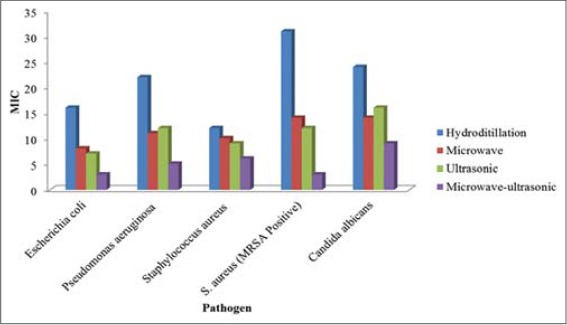
The volatile oil obtained by the four extraction methods in this study exhibited both antioxidant and antimicrobial activities. Among the four extraction methods used, the microwave-ultrasonic method yielded the largest amount (1.8% v/w) and the yield exhibited the highest antioxidant activity in terms of inhibition (91.83% ± 1.1). The minimum inhibitory concentrations for E. coli, P. aeruginosa, S. aureus, MRSA, and C. albicans were 3, 5, 6, 3, and 9, respectively.
Among the extraction techniques used in this study, the microwave-ultrasonic method showed the best results. Moreover, this study suggests that T. africanum volatile oils contain active substances that could potentially be used both as natural preservatives in food and pharmaceutical industries as well as in developing new antimicrobial and antioxidant agents.
目前,人们对开发更高效的植物化学物质提取技术的兴趣日益浓厚。微波和超声提取方法是可用于此目的的有前景的技术。
本研究的目的是调查不同提取方法对从非洲刺苞果中提取的挥发油的产量、抗氧化和抗菌活性的影响。
采用微波、超声、微波 - 超声和传统水蒸馏法提取挥发油。对提取的油进行抗氧化和抗菌活性评估。通过2,2 - 二苯基 - 1 - 苦基肼自由基清除试验评估抗氧化活性,而通过肉汤微量稀释法评估抗菌活性。针对金黄色葡萄球菌、大肠杆菌、铜绿假单胞菌美国典型培养物保藏中心参考菌株以及耐甲氧西林金黄色葡萄球菌(MRSA)和白色念珠菌临床分离株检测挥发油的抗菌活性。
本研究中采用的四种提取方法获得的挥发油均表现出抗氧化和抗菌活性。在所使用的四种提取方法中,微波 - 超声法产量最高(1.8% v/w),且就抑制率而言,该产量表现出最高的抗氧化活性(91.83% ± 1.1)。对大肠杆菌、铜绿假单胞菌、金黄色葡萄球菌、MRSA和白色念珠菌的最低抑菌浓度分别为3、5、6、3和9。
在本研究使用的提取技术中,微波 - 超声法显示出最佳结果。此外,本研究表明非洲刺苞果挥发油含有活性物质,这些物质有可能在食品和制药行业用作天然防腐剂,以及用于开发新的抗菌和抗氧化剂。