Department of Medicine, Faculty of Medicine and Health Sciences, An-Najah National University, P.O. Box 7, Nablus, Palestine.
Department of Pharmacy, Faculty of Medicine and Health Sciences, An-Najah National University, P.O. Box 7, Nablus, Palestine.
BMC Complement Med Ther. 2024 Feb 28;24(1):106. doi: 10.1186/s12906-024-04395-4.
Origanum punonense Danin is one of the old traditional medicinal plants Bedouins utilize in the Dead Sea region to treat a variety of illnesses, those caused by infections. The current study aimed to identify the phytochemical components of O. punonense essential oil (EO) and determine its antiproliferative and antimicrobial effects.
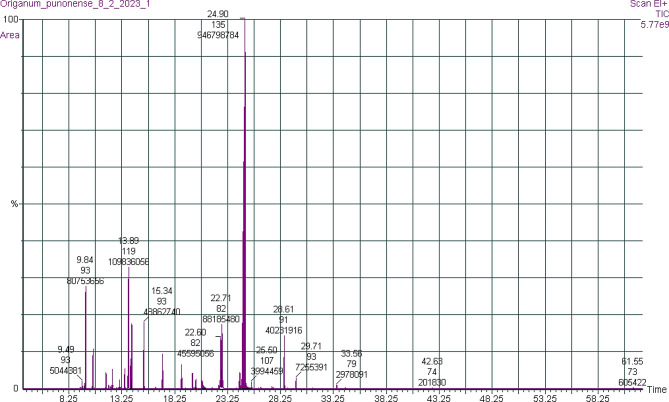
Gas chromatography and mass spectrometry were employed to detect the phytochemical constituents of O. punonense EO. Broth microdilution assay was utilized to determine the antimicrobial effects against various microbial species, including those causing diabetic foot infections.
This study revealed that O. punonense EO contains 44 phytochemical compounds, of which 41 compounds were detectable and amounted to 99.78% of the total oil. The main chemical components of the oil were carvacrol (57.4%), p-cymene (6.66%), carvone (5.35%), pinene (4.9%), and terpinene (2.96%). The antiproliferative activity of different concentrations of O. punonense EO was noted in all of the investigated cell lines, with the best activity at the concentration of 500 µg/mL. The greatest antibacterial activity was against Staphylococcus aureus, Escherichia coli, Klebsiella pneumoniae, and Proteus vulgaris, with MIC values of 1.56 µL/mL. In addition, and the O. punonense EO showed strong antifungal activity against Candida albicans with a MIC value of 0.8 µL/mL. In addition, the O. punonense EO showed potent antibacterial activity against all MRSA samples obtained from the diabetic foot with a MIC value of 3.13 µL/mL. The O. punonense EO demonstrated potent activity against Carbapenem-resistant Enterobacterales, Citrobacter freundii, and K. pneumoniae, with MICs value of 6.25 µL/mL.
The potent antiproliferative and broad antimicrobial activity of O. punonense EO makes it an effective strategy for treating infections, especially in immunocompromised patients with chronic comorbidities such as cancer and diabetes mellitus.
牛至属植物(Origanum punonense Danin)是贝都因人在死海地区使用的一种古老传统药用植物,可用于治疗多种疾病,包括由感染引起的疾病。本研究旨在鉴定牛至属植物精油(EO)的植物化学成分,并确定其抗增殖和抗菌作用。
采用气相色谱-质谱联用技术检测牛至属植物 EO 的植物化学成分。肉汤微量稀释法测定其对各种微生物的抗菌作用,包括引起糖尿病足感染的微生物。
本研究表明,牛至属植物 EO 含有 44 种植物化学成分,其中 41 种可检测到,占总油量的 99.78%。油的主要化学成分是香芹酚(57.4%)、对伞花烃(6.66%)、柠檬烯(5.35%)、蒎烯(4.9%)和萜品烯(2.96%)。不同浓度的牛至属植物 EO 在所有研究的细胞系中均表现出抗增殖活性,在 500µg/mL 浓度下活性最佳。该精油对金黄色葡萄球菌、大肠杆菌、肺炎克雷伯菌和普通变形杆菌的抗菌活性最强,MIC 值为 1.56µL/mL。此外,该精油对白色念珠菌具有很强的抗真菌活性,MIC 值为 0.8µL/mL。此外,该精油对从糖尿病足中获得的所有耐甲氧西林金黄色葡萄球菌(MRSA)样本均具有很强的抗菌活性,MIC 值为 3.13µL/mL。该精油对耐碳青霉烯类肠杆菌科、弗氏柠檬酸杆菌和肺炎克雷伯菌具有很强的抗菌活性,MIC 值为 6.25µL/mL。
牛至属植物 EO 具有很强的抗增殖和广谱抗菌活性,是治疗感染的有效策略,特别是在患有癌症和糖尿病等慢性合并症的免疫功能低下患者中。