Aakre Inger, Strand Tor A, Bjøro Trine, Norheim Ingrid, Barikmo Ingrid, Ares Susana, Alcorta Marta Duque, Henjum Sigrun
Department of Nursing and Health Promotion, Faculty of Health Sciences, Oslo and Akershus University College, 0130 Oslo, Norway.
Department of Global Public Health and Primary Care, Faculty of Medicine and Dentistry, University of Bergen, 5018 Bergen, Norway.
Nutrients. 2016 Jun 28;8(7):398. doi: 10.3390/nu8070398.
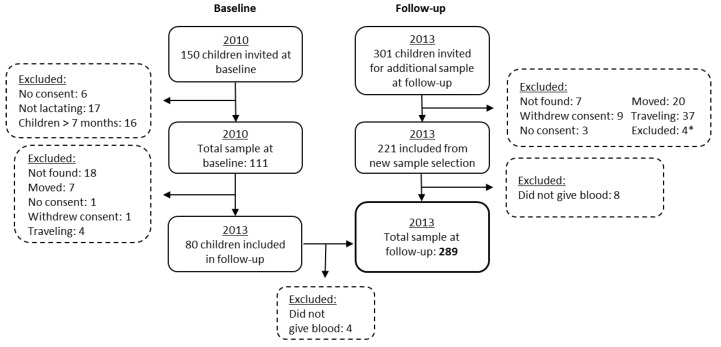
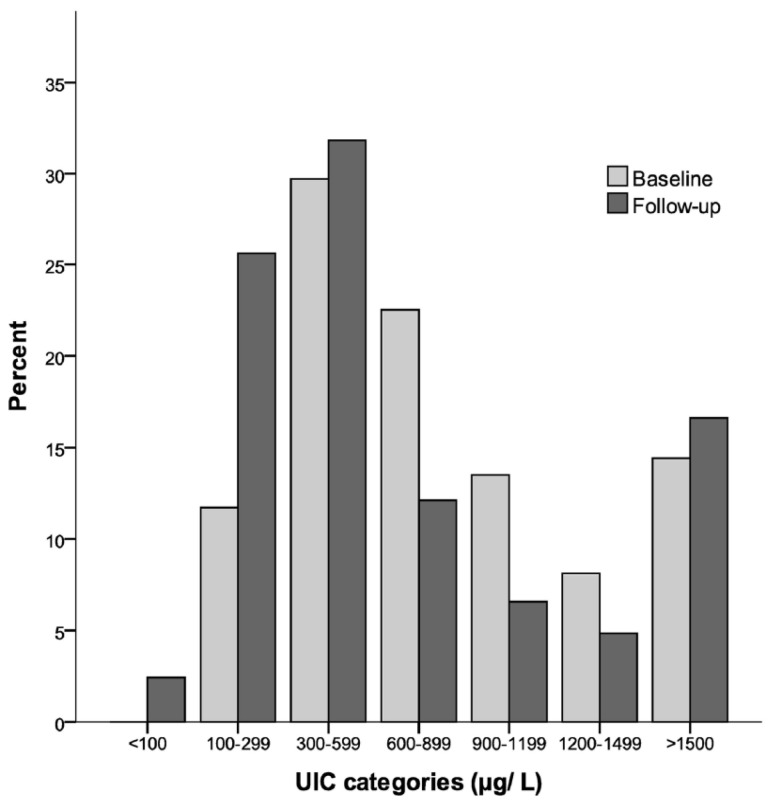
Iodine excess may impair thyroid function and trigger adverse health consequences for children. This study aims to describe iodine status among breastfed infants with high iodine exposure in the Saharawi refugee camps Algeria, and further assess thyroid function and iodine status among the children three years later. In 2010, a cross-sectional study among 111 breastfed children aged 0-6 months was performed (baseline study). In 2013, a second cross-sectional study (follow-up study) was conducted among 289 children; 213 newly selected and 76 children retrieved from baseline. Urinary iodine concentration (UIC) and breast milk iodine concentration (BMIC) were measured at baseline. UIC, thyroid hormones and serum thyroglobulin (Tg) were measured at follow-up. At baseline and follow-up, 88% and 72% had excessive iodine intakes (UIC ≥ 300 µg/L), respectively. At follow-up, 24% had a thyroid hormone disturbance and/or elevated serum Tg, including 9% with subclinical hypothyroidism (SCH), 4% with elevated fT3 and 14% with elevated Tg. Children with SCH had poorer linear growth and were more likely to be underweight than the children without SCH. Excessive iodine intakes and thyroid disturbances were common among children below four years of age in our study. Further, SCH seemed to be associated with poor growth and weight.
碘摄入过量可能会损害甲状腺功能,并给儿童带来不良健康后果。本研究旨在描述阿尔及利亚撒哈拉难民营中碘暴露量高的母乳喂养婴儿的碘状况,并在三年后进一步评估这些儿童的甲状腺功能和碘状况。2010年,对111名0至6个月大的母乳喂养儿童进行了一项横断面研究(基线研究)。2013年,对289名儿童进行了第二项横断面研究(随访研究);新选取213名儿童,76名儿童来自基线研究。在基线时测量了尿碘浓度(UIC)和母乳碘浓度(BMIC)。在随访时测量了UIC、甲状腺激素和血清甲状腺球蛋白(Tg)。在基线和随访时,分别有88%和72%的儿童碘摄入量过高(UIC≥300µg/L)。在随访时,24%的儿童存在甲状腺激素紊乱和/或血清Tg升高,其中9%患有亚临床甲状腺功能减退(SCH),4%的儿童fT3升高,14%的儿童Tg升高。与没有SCH的儿童相比,患有SCH的儿童线性生长较差,体重不足的可能性更大。在我们的研究中,四岁以下儿童碘摄入过量和甲状腺紊乱情况较为常见。此外,SCH似乎与生长发育不良和体重有关。