Yale Center for Analytical Sciences, Yale University, New Haven, CT, USA.
BMC Bioinformatics. 2014 Aug 13;15(1):276. doi: 10.1186/1471-2105-15-276.
Time series models can play an important role in disease prediction. Incidence data can be used to predict the future occurrence of disease events. Developments in modeling approaches provide an opportunity to compare different time series models for predictive power.
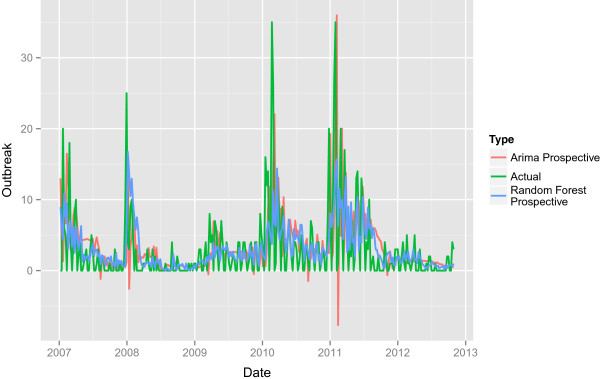
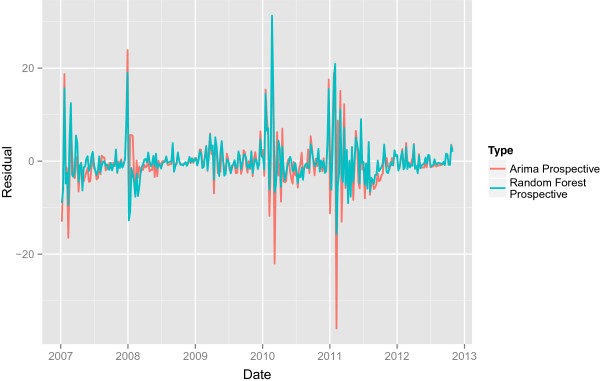
We applied ARIMA and Random Forest time series models to incidence data of outbreaks of highly pathogenic avian influenza (H5N1) in Egypt, available through the online EMPRES-I system. We found that the Random Forest model outperformed the ARIMA model in predictive ability. Furthermore, we found that the Random Forest model is effective for predicting outbreaks of H5N1 in Egypt.
Random Forest time series modeling provides enhanced predictive ability over existing time series models for the prediction of infectious disease outbreaks. This result, along with those showing the concordance between bird and human outbreaks (Rabinowitz et al. 2012), provides a new approach to predicting these dangerous outbreaks in bird populations based on existing, freely available data. Our analysis uncovers the time-series structure of outbreak severity for highly pathogenic avain influenza (H5N1) in Egypt.
时间序列模型在疾病预测中可以发挥重要作用。发病率数据可用于预测疾病事件的未来发生情况。建模方法的发展为比较不同时间序列模型的预测能力提供了机会。
我们应用 ARIMA 和随机森林时间序列模型对埃及高致病性禽流感(H5N1)爆发的发病率数据进行了分析,这些数据可通过在线 EMPRES-I 系统获得。我们发现,随机森林模型在预测能力方面优于 ARIMA 模型。此外,我们发现随机森林模型可有效预测埃及 H5N1 的爆发。
随机森林时间序列建模在预测传染病爆发方面提供了比现有时间序列模型更高的预测能力。这一结果,以及表明鸟类和人类爆发之间一致性的结果(Rabinowitz 等人,2012 年),为基于现有、免费获得的数据预测鸟类种群中这些危险的爆发提供了一种新方法。我们的分析揭示了埃及高致病性禽流感(H5N1)爆发严重程度的时间序列结构。