Goswami Ipsita, Rochow Niels, Fusch Gerhard, Liu Kai, Marrin Michael L, Heckmann Matthias, Nelle Mathias, Fusch Christoph
Division of Neonatology, Department of Pediatrics, University of Calgary, 780C, Foothills Medical Centre, 1403, 29th Street NW, Calgary, AB T2N 2T9, Canada.
Division of Neonatology, Department of Pediatrics, McMaster University, 1280 Main Street West, Room HSC-4F5, Hamilton, ON L8S 4K1, Canada.
Nutrients. 2016 Jul 8;8(7):417. doi: 10.3390/nu8070417.
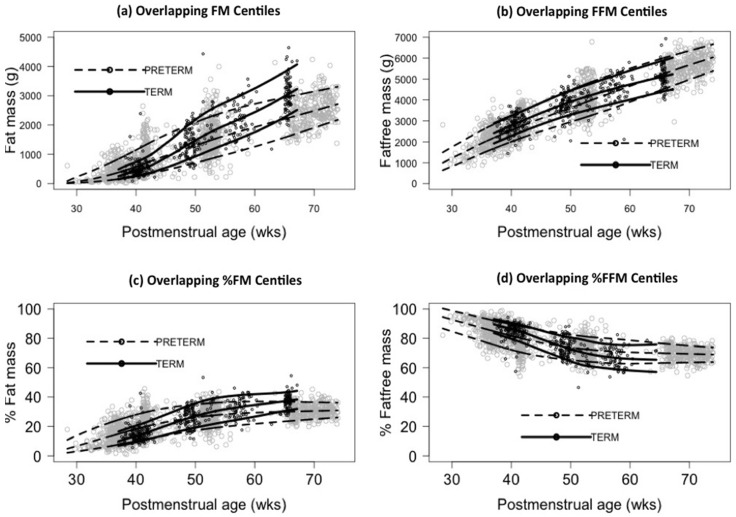
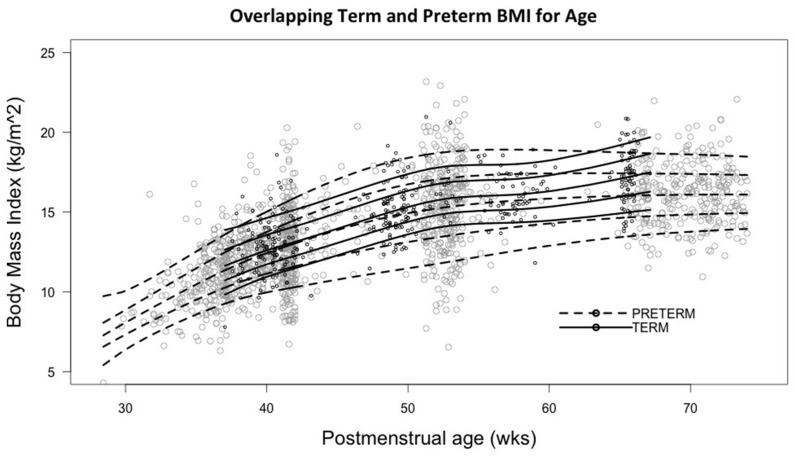
Postnatal tissue accretion in preterm infants differs from those in utero, affecting body composition (BC) and lifelong morbidity. Length normalized BC data allows infants with different body lengths to be compared and followed longitudinally. This study aims to analyze BC of preterm and term infants during the first six months of life.
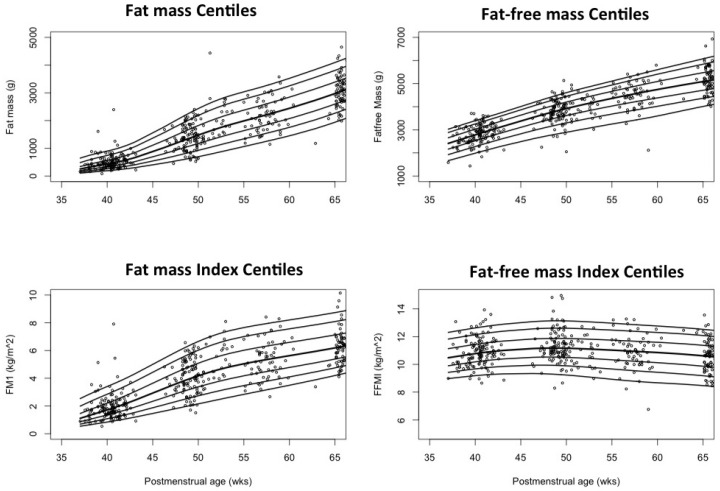
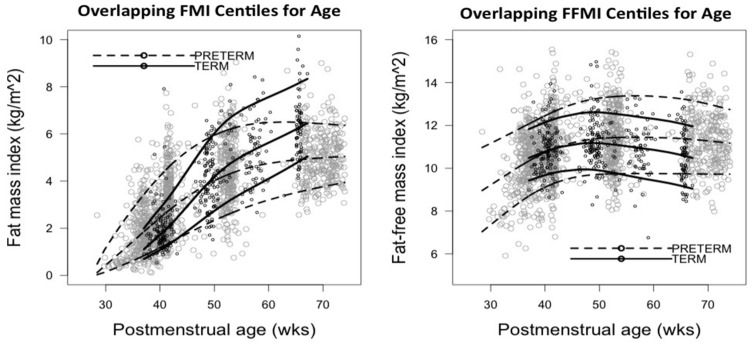
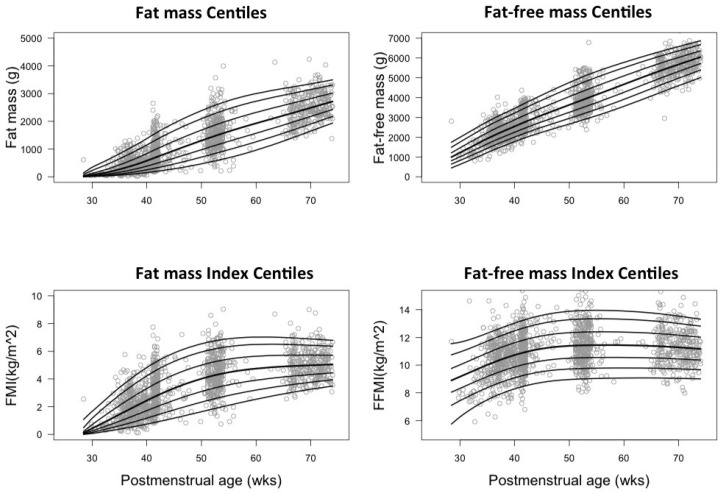
The BC data, measured using dual energy X-ray absorptiometry, of 389 preterm and 132 term infants from four longitudinal studies were combined. Fat-mass/length² (FMI) and fat-free mass/length² (FFMI) for postmenstrual age were calculated after reaching full enteral feeding, at term and two further time points up to six months corrected age.
Median FMI (preterm) increased from 0.4 kg/m² at 30 weeks to 2.5, 4.3, and 4.8 kg/m² compared to 1.7, 4.7, and 6 kg/m² in term infants at 40, 52, and 64 weeks, respectively. Median FFMI (preterm) increased from 8.5 kg/m² (30 weeks) to 11.4 kg/m² (45 weeks) and remained constant thereafter, whereas term FFMI remained constant at 11 kg/m² throughout the tested time points.
The study provides a large dataset of length normalized BC indices. Followed longitudinally, term and preterm infants differ considerably during early infancy in the pattern of change in FMI and FFMI for age.
早产儿出生后的组织增长与子宫内不同,会影响身体成分(BC)和终身发病率。长度标准化的BC数据可使不同身长的婴儿进行比较并纵向跟踪。本研究旨在分析早产和足月婴儿出生后前六个月的身体成分。
合并了来自四项纵向研究的389名早产儿和132名足月儿使用双能X线吸收法测量的BC数据。在达到完全经口喂养后、足月时以及校正年龄达六个月的另外两个时间点,计算月经龄的脂肪量/身长²(FMI)和去脂体重/身长²(FFMI)。
早产儿的FMI中位数从30周时的0.4kg/m²增加到2.5kg/m²、4.3kg/m²和4.8kg/m²,而足月儿在40周、52周和64周时分别为1.7kg/m²、4.7kg/m²和6kg/m²。早产儿的FFMI中位数从8.5kg/m²(30周)增加到11.4kg/m²(45周),此后保持不变,而足月儿的FFMI在整个测试时间点均保持在11kg/m²不变。
该研究提供了一个长度标准化的BC指数的大型数据集。纵向跟踪发现,足月儿和早产儿在婴儿早期FMI和FFMI随年龄变化的模式有很大差异。