Blumberg Dana M, De Moraes Carlos Gustavo, Liebmann Jeffrey M, Garg Reena, Chen Cynthia, Theventhiran Alex, Hood Donald C
Bernard and Shirlee Brown Glaucoma Research Laboratory, Department of Ophthalmology, Edward S. Harkness Eye Institute, Columbia University Medical Center, New York, New York, United States.
Department of Ophthalmology, New York Eye and Ear Infirmary of Mount Sinai Department of Ophthalmology, New York, New York, United States.
Invest Ophthalmol Vis Sci. 2016 Jul 1;57(9):OCT80-5. doi: 10.1167/iovs.15-18931.
To determine and compare the diagnostic performance of spectral-domain optical coherence tomography (SD-OCT), stereoscopic disc photographs, and automated perimetry as assessed by a group of glaucoma specialists in differentiating individuals with early glaucoma from suspects.
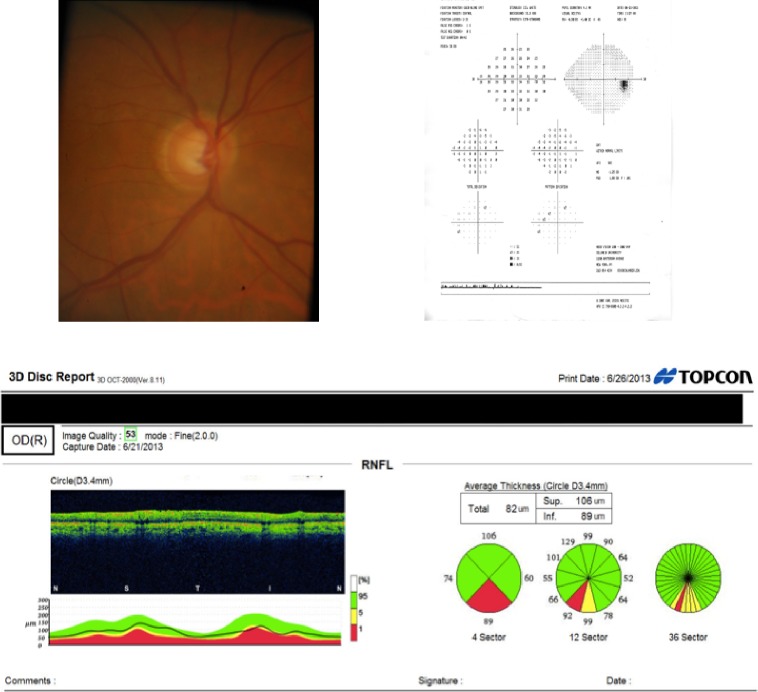
Forty-six eyes (46 patients) with suspicious optic nerves had previously undergone SD-OCT scans, 24-2 visual fields (VFs), and optic disc photographs. The average VF mean deviation was -1.97 ± 2.09 (SD) dB. Four glaucoma specialists examined the 138 individual diagnostic tests and classified the patient as likely glaucomatous or nonglaucomatous based on the results of a single test. The diagnostic performances of each of the three tests were compared to a previously determined reference standard, based on the consensus of a separate panel of four glaucoma specialists who examined all three tests together.
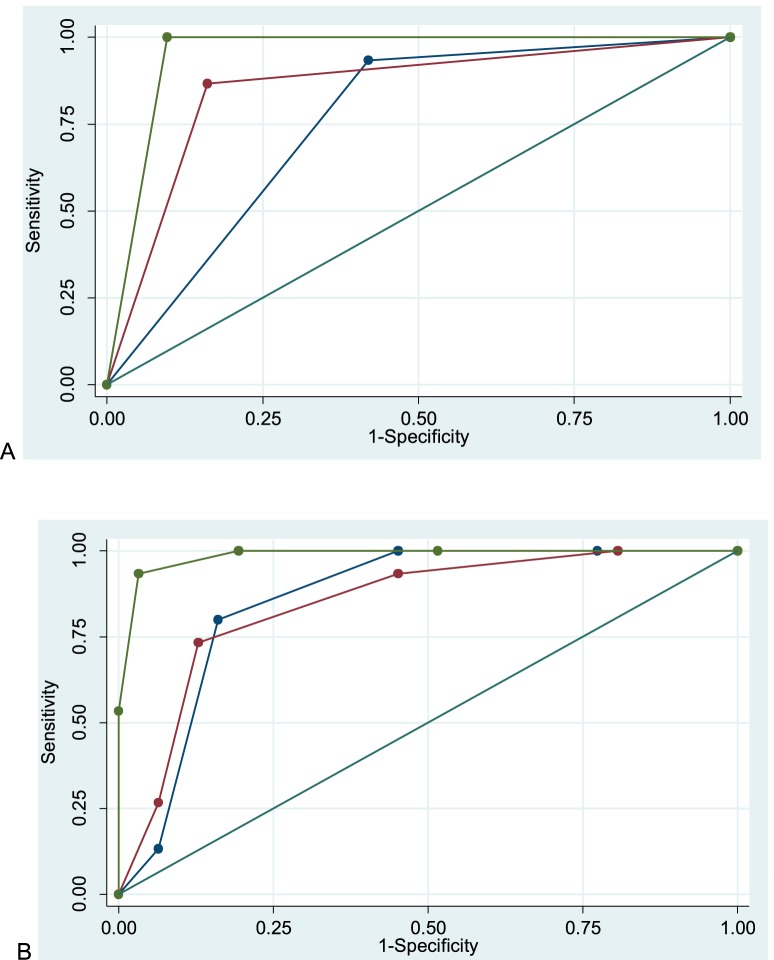
Among the four specialists, the interobserver agreement across the three diagnostic tests was poor for VF and photos, with kappa (κ) values of 0.13 and 0.16, respectively, and moderate for OCT, with κ value of 0.40. Using panel consensus as reference standard, OCT had the highest discriminative ability, with an area under the curve (AUC) of 0.99 (95% 0.96-1.0) compared to photograph AUC 0.85 (95% 0.73-0.96) and VF AUC 0.86 (95% 0.76-0.96), suggestive of closer performance to that of a group of glaucoma specialists.
Compared to VF and disc photography, SD-OCT, when used alone, had better internal agreement as well as better agreement with the consensus of clinicians using all available data. Future studies should evaluate best practices for SD-OCT interpretation.
由一组青光眼专家评估,以确定并比较频域光学相干断层扫描(SD - OCT)、立体视盘照片和自动视野计在鉴别早期青光眼患者与可疑青光眼患者时的诊断性能。
46只患有可疑视神经病变的眼睛(46例患者)此前已接受SD - OCT扫描、24 - 2视野(VF)检查和视盘照片拍摄。平均VF平均偏差为-1.97±2.09(标准差)dB。四位青光眼专家检查了这138项个体诊断测试,并根据单一测试结果将患者分类为可能患有青光眼或非青光眼。基于由四位共同检查所有三项测试的青光眼专家组成的独立小组的共识,将这三项测试各自的诊断性能与先前确定的参考标准进行比较。
在这四位专家中,对于VF和照片,三项诊断测试的观察者间一致性较差,kappa(κ)值分别为0.13和0.16,而对于OCT,一致性为中等,κ值为0.40。以小组共识作为参考标准,OCT具有最高的鉴别能力,曲线下面积(AUC)为0.99(95% 0.96 - 1.0),相比之下,照片AUC为0.85(95% 0.73 - 0.96),VF AUC为0.86(95% 0.76 - 0.96),这表明其性能更接近一组青光眼专家的表现。
与VF和视盘摄影相比,单独使用SD - OCT时具有更好的内部一致性,并且与使用所有可用数据的临床医生共识的一致性更好。未来的研究应评估SD - OCT解读的最佳实践。