Meydani Simin N, Das Sai K, Pieper Carl F, Lewis Michael R, Klein Sam, Dixit Vishwa D, Gupta Alok K, Villareal Dennis T, Bhapkar Manjushri, Huang Megan, Fuss Paul J, Roberts Susan B, Holloszy John O, Fontana Luigi
The Jean Mayer USDA Human Nutrition Research Center on Aging at Tufts University, Boston, MA 02111, USA.
Duke University Medical Center, Durham, NC 27705, USA.
Aging (Albany NY). 2016 Jul;8(7):1416-31. doi: 10.18632/aging.100994.
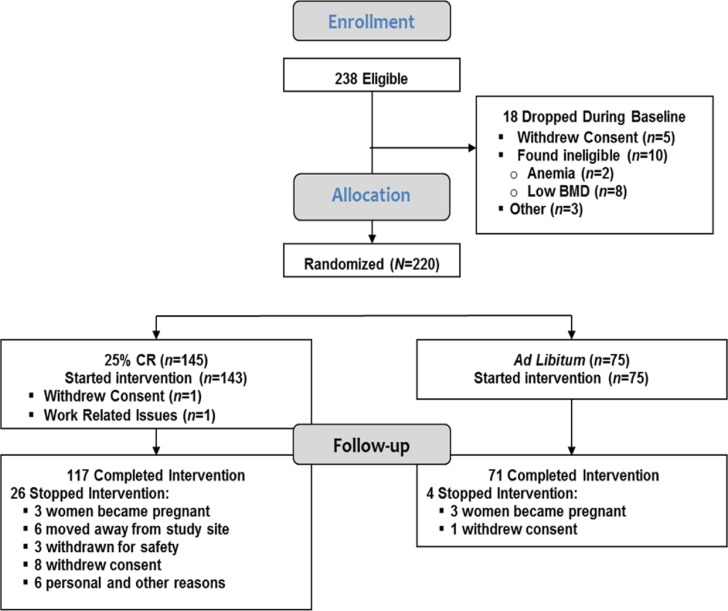
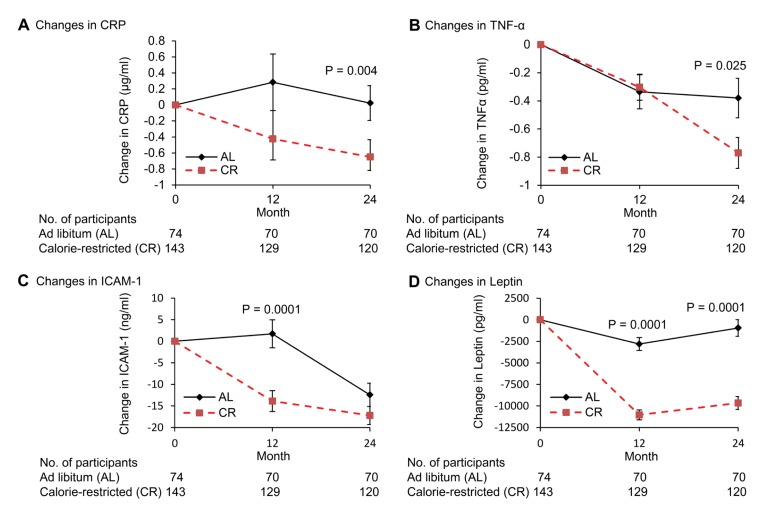
Calorie restriction (CR) inhibits inflammation and slows aging in many animal species, but in rodents housed in pathogen-free facilities, CR impairs immunity against certain pathogens. However, little is known about the effects of long-term moderate CR on immune function in humans. In this multi-center, randomized clinical trial to determine CR's effect on inflammation and cell-mediated immunity, 218 healthy non-obese adults (20-50 y), were assigned 25% CR (n=143) or an ad-libitum (AL) diet (n=75), and outcomes tested at baseline, 12, and 24 months of CR. CR induced a 10.4% weight loss over the 2-y period. Relative to AL group, CR reduced circulating inflammatory markers, including total WBC and lymphocyte counts, ICAM-1 and leptin. Serum CRP and TNF-α concentrations were about 40% and 50% lower in CR group, respectively. CR had no effect on the delayed-type hypersensitivity skin response or antibody response to vaccines, nor did it cause difference in clinically significant infections. In conclusion, long-term moderate CR without malnutrition induces a significant and persistent inhibition of inflammation without impairing key in vivo indicators of cell-mediated immunity. Given the established role of these pro-inflammatory molecules in the pathogenesis of multiple chronic diseases, these CR-induced adaptations suggest a shift toward a healthy phenotype.
热量限制(CR)可抑制多种动物的炎症反应并延缓衰老,但在无病原体设施中饲养的啮齿动物中,CR会损害其对某些病原体的免疫力。然而,关于长期适度热量限制对人类免疫功能的影响,人们知之甚少。在这项多中心随机临床试验中,为了确定热量限制对炎症和细胞介导免疫的影响,218名健康的非肥胖成年人(20 - 50岁)被分配到25%热量限制组(n = 143)或自由饮食(AL)组(n = 75),并在热量限制的基线、12个月和24个月时对结果进行测试。在两年期间,热量限制导致体重减轻了10.4%。相对于自由饮食组,热量限制降低了循环炎症标志物水平,包括白细胞总数、淋巴细胞计数、细胞间黏附分子-1(ICAM - 1)和瘦素。热量限制组的血清C反应蛋白(CRP)和肿瘤坏死因子-α(TNF - α)浓度分别降低了约40%和50%。热量限制对迟发型超敏皮肤反应或疫苗抗体反应没有影响,也未导致临床上显著感染的差异。总之,长期适度热量限制且无营养不良会显著且持续地抑制炎症,同时不会损害细胞介导免疫的关键体内指标。鉴于这些促炎分子在多种慢性疾病发病机制中的既定作用,热量限制诱导的这些适应性变化表明向健康表型的转变。