Ma Le, Liu Rong, Du Jun Hui, Liu Tao, Wu Shan Shan, Liu Xiao Hong
The First Affiliated Hospital, Xi'an Jiaotong University College of Medicine, 277 Yanta West Road, Xi'an 710061, Shaanxi, China.
School of Public Health, Xi'an Jiaotong University Health Science Center, 76 Yanta West Road, Xi'an 710061, Shaanxi, China.
Nutrients. 2016 Jul 12;8(7):426. doi: 10.3390/nu8070426.
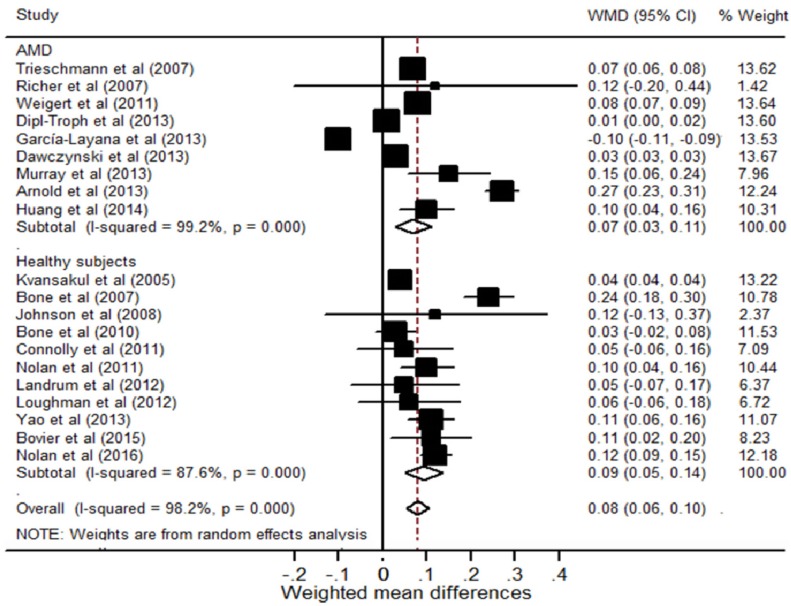
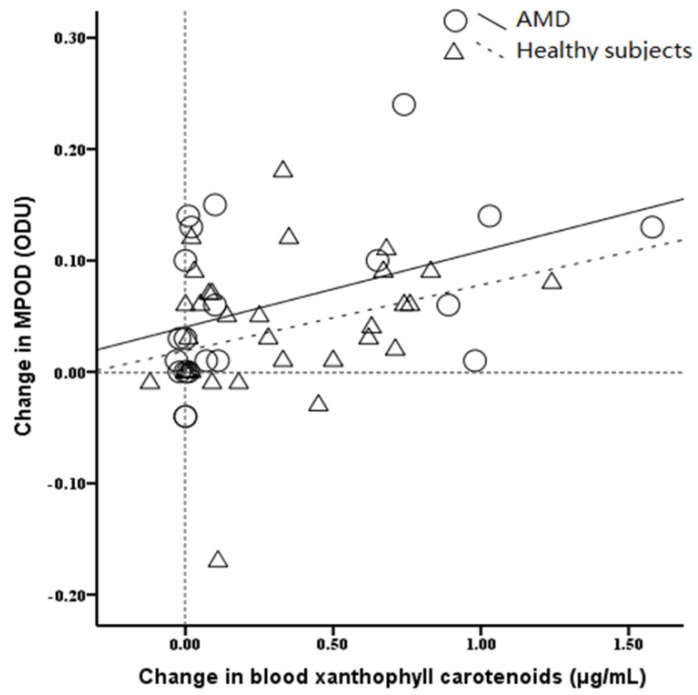
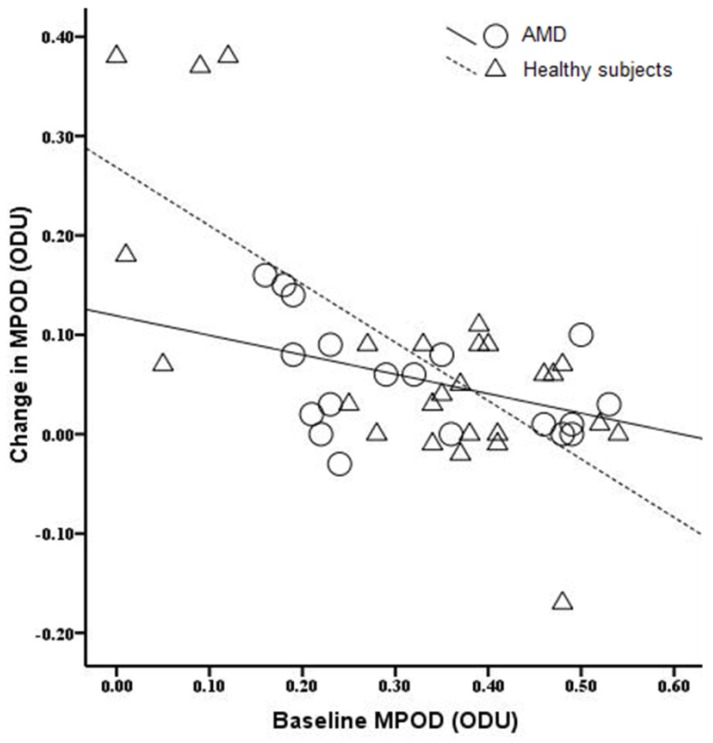
The purpose of this study was to evaluate the effects of lutein, zeaxanthin and meso-zeaxanthin on macular pigment optical density (MPOD) in randomized controlled trials (RCTs) among patients with age-related macular degeneration (AMD) and healthy subjects. Medline, Embase, Web of Science and Cochrane Library databases was searched through May 2016. Meta-analysis was conducted to obtain adjusted weighted mean differences (WMD) for intervention-versus-placebo group about the change of MPOD between baseline and terminal point. Pearson correlation analysis was used to determine the relationship between the changes in MPOD and blood xanthophyll carotenoids or baseline MPOD levels. Twenty RCTs involving 938 AMD patients and 826 healthy subjects were identified. Xanthophyll carotenoids supplementation was associated with significant increase in MPOD in AMD patients (WMD, 0.07; 95% CI, 0.03 to 0.11) and healthy subjects (WMD, 0.09; 95% CI, 0.05 to 0.14). Stratified analysis showed a greater increase in MPOD among trials supplemented and combined with meso-zeaxanthin. Additionally, the changes in MPOD were related with baseline MPOD levels (rAMD = -0.43, p = 0.06; rhealthy subjects = -0.71, p < 0.001) and blood xanthophyll carotenoids concentration (rAMD = 0.40, p = 0.07; rhealthy subjects = 0.33, p = 0.05). This meta-analysis revealed that lutein, zeaxanthin and meso-zeaxanthin supplementation improved MPOD both in AMD patients and healthy subjects with a dose-response relationship.
本研究旨在评估叶黄素、玉米黄质和内消旋玉米黄质对年龄相关性黄斑变性(AMD)患者和健康受试者在随机对照试验(RCT)中的黄斑色素光密度(MPOD)的影响。检索了截至2016年5月的Medline、Embase、科学引文索引和考克兰图书馆数据库。进行荟萃分析以获得干预组与安慰剂组在基线和终点之间MPOD变化的调整加权平均差(WMD)。采用Pearson相关分析确定MPOD变化与血液中叶黄素类胡萝卜素或基线MPOD水平之间的关系。确定了20项涉及938例AMD患者和826例健康受试者的RCT。补充叶黄素类胡萝卜素与AMD患者(WMD,0.07;95%CI,0.03至0.11)和健康受试者(WMD,0.09;95%CI,0.05至0.14)的MPOD显著增加相关。分层分析显示,在补充并联合内消旋玉米黄质的试验中MPOD增加更大。此外,MPOD的变化与基线MPOD水平(rAMD = -0.43,p = 0.06;r健康受试者 = -0.71,p < 0.001)和血液中叶黄素类胡萝卜素浓度(rAMD = 0.40,p = 0.07;r健康受试者 = 0.33,p = 0.05)有关。这项荟萃分析表明,补充叶黄素、玉米黄质和内消旋玉米黄质可改善AMD患者和健康受试者的MPOD,且存在剂量反应关系。