Son Yeonghoon, Jeong Ye Ji, Kwon Jong Hwa, Choi Hyung-Do, Pack Jeong-Ki, Kim Nam, Lee Yun-Sil, Lee Hae-June
Division of Radiation Effects, Korea Institute of Radiological and Medical Sciences, Seoul, Korea.
Radio and Broadcasting Technology Laboratory, Department of EMF Research Team, Daejon, Korea.
Bioelectromagnetics. 2016 Sep;37(6):391-9. doi: 10.1002/bem.21992. Epub 2016 Jul 19.
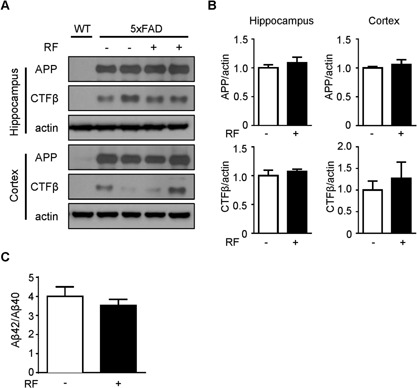
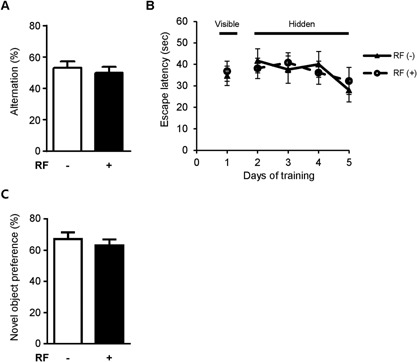
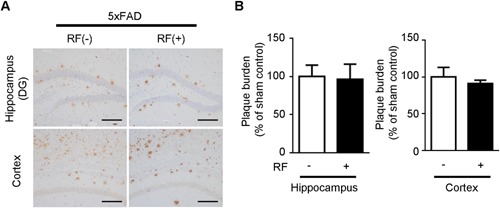
The increased use of mobile phones has generated public concern about the impact of radiofrequency electromagnetic fields (RF-EMF) on health. In the present study, we investigated whether RF-EMFs induce molecular changes in amyloid precursor protein (APP) processing and amyloid beta (Aβ)-related memory impairment in the 5xFAD mouse, which is a widely used amyloid animal model. The 5xFAD mice at the age of 1.5 months were assigned to two groups (RF-EMF- and sham-exposed groups, eight mice per group). The RF-EMF group was placed in a reverberation chamber and exposed to 1950 MHz electromagnetic fields for 3 months (SAR 5 W/kg, 2 h/day, 5 days/week). The Y-maze, Morris water maze, and novel object recognition memory test were used to evaluate spatial and non-spatial memory following 3-month RF-EMF exposure. Furthermore, Aβ deposition and APP and carboxyl-terminal fragment β (CTFβ) levels were evaluated in the hippocampus and cortex of 5xFAD mice, and plasma levels of Aβ peptides were also investigated. In behavioral tests, mice that were exposed to RF-EMF for 3 months did not exhibit differences in spatial and non-spatial memory compared to the sham-exposed group, and no apparent change was evident in locomotor activity. Consistent with behavioral data, RF-EMF did not alter APP and CTFβ levels or Aβ deposition in the brains of the 5xFAD mice. These findings indicate that 3-month RF-EMF exposure did not affect Aβ-related memory impairment or Aβ accumulation in the 5xFAD Alzheimer's disease model. Bioelectromagnetics. 37:391-399, 2016. © 2016 The Authors Bioelectromagnetics published by Wiley Periodicals, Inc. on behalf of Bioelectromagnetics Society.
手机使用的增加引发了公众对射频电磁场(RF-EMF)对健康影响的关注。在本研究中,我们调查了RF-EMF是否会在5xFAD小鼠(一种广泛使用的淀粉样蛋白动物模型)中诱导淀粉样前体蛋白(APP)加工和β淀粉样蛋白(Aβ)相关记忆障碍的分子变化。将1.5月龄的5xFAD小鼠分为两组(RF-EMF暴露组和假暴露组,每组8只小鼠)。RF-EMF组置于混响室中,暴露于1950 MHz电磁场3个月(比吸收率5 W/kg,每天2小时,每周5天)。在3个月的RF-EMF暴露后,使用Y迷宫、莫里斯水迷宫和新物体识别记忆测试来评估空间和非空间记忆。此外,评估了5xFAD小鼠海马体和皮质中的Aβ沉积以及APP和羧基末端片段β(CTFβ)水平,还研究了Aβ肽的血浆水平。在行为测试中,与假暴露组相比,暴露于RF-EMF 3个月的小鼠在空间和非空间记忆方面没有表现出差异,并且运动活动也没有明显变化。与行为数据一致,RF-EMF没有改变5xFAD小鼠大脑中的APP和CTFβ水平或Aβ沉积。这些发现表明,3个月的RF-EMF暴露不会影响5xFAD阿尔茨海默病模型中与Aβ相关的记忆障碍或Aβ积累。《生物电磁学》。37:391-399,2016年。©2016作者。《生物电磁学》由威利期刊公司代表生物电磁学协会出版。