Utiyama Daniela Mitiyo Odagiri, Yoshida Carolina Tieko, Goto Danielle Miyuki, de Santana Carvalho Tômas, de Paula Santos Ubiratan, Koczulla Andreas Rembert, Saldiva Paulo Hilário Nascimento, Nakagawa Naomi Kondo
Faculdade de Medicina da Universidade de São Paulo, Departamento de Fisioterapia, Fonoaudiologia e Terapia Ocupacional, LIM-34, São Paulo/SP, Brazil.
Faculdade de Medicina da Universidade de São Paulo, Departamento de Patologia, LIM-5, São Paulo/SP, Brazil.
Clinics (Sao Paulo). 2016 Jul;71(6):344-50. doi: 10.6061/clinics/2016(06)10.
The aim of the present study was to assess nasal mucociliary clearance, mucus properties and inflammation in smokers and subjects enrolled in a Smoking Cessation Program (referred to as quitters).
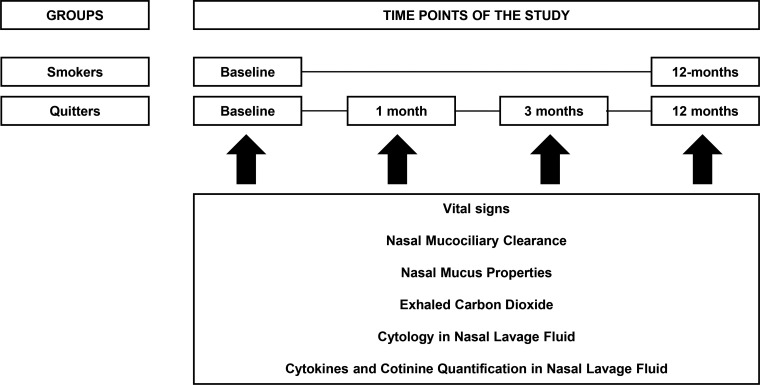
A total of 33 subjects with a median (IQR) smoking history of 34 (20-58) pack years were examined for nasal mucociliary clearance using a saccharine transit test, mucus properties using contact angle and sneeze clearability tests, and quantification of inflammatory and epithelial cells, IL-6 and IL-8 concentrations in nasal lavage fluid. Twenty quitters (mean age: 51 years, 9 male) were assessed at baseline, 1 month, 3 months and 12 months after smoking cessation, and 13 smokers (mean age: 52 years, 6 male) were assessed at baseline and after 12 months. Clinicaltrials.gov: NCT02136550.
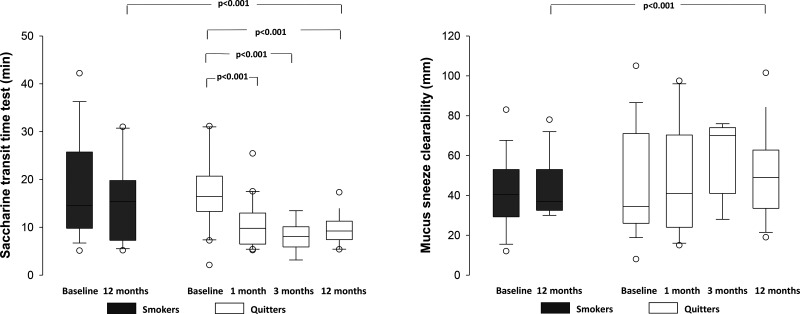
Smokers and quitters showed similar demographic characteristics and morbidities. At baseline, all subjects showed impaired nasal mucociliary clearance (mean 17.6 min), although 63% and 85% of the quitters demonstrated significant nasal mucociliary clearance improvement at 1 month and 12 months, respectively. At 12 months, quitters also showed mucus sneeze clearability improvement (∼26%), an increased number of macrophages (2-fold) and no changes in mucus contact angle or cytokine concentrations.
This study showed that smoking cessation induced early improvements in nasal mucociliary clearance independent of mucus properties and inflammation. Changes in mucus properties were observed after only 12 months of smoking cessation.
本研究旨在评估吸烟者以及参加戒烟计划者(以下简称戒烟者)的鼻黏液纤毛清除功能、黏液特性和炎症情况。
共有33名吸烟史中位数(四分位间距)为34(20 - 58)包年的受试者接受了检查,通过糖精转运试验评估鼻黏液纤毛清除功能,通过接触角和喷嚏清除能力试验评估黏液特性,并对鼻灌洗液中的炎症细胞、上皮细胞、白细胞介素-6(IL-6)和白细胞介素-8(IL-8)浓度进行定量分析。20名戒烟者(平均年龄:51岁,9名男性)在戒烟后基线、1个月、3个月和12个月时接受评估,13名吸烟者(平均年龄:52岁,6名男性)在基线和12个月后接受评估。Clinicaltrials.gov注册号:NCT02136550。
吸烟者和戒烟者具有相似的人口统计学特征和发病率。在基线时,所有受试者的鼻黏液纤毛清除功能均受损(平均17.6分钟),尽管分别有63%和85%的戒烟者在1个月和12个月时鼻黏液纤毛清除功能有显著改善。在12个月时,戒烟者的黏液喷嚏清除能力也有所改善(约26%),巨噬细胞数量增加(2倍),黏液接触角或细胞因子浓度无变化。
本研究表明,戒烟可使鼻黏液纤毛清除功能早期得到改善,且与黏液特性和炎症无关。仅在戒烟12个月后观察到黏液特性的变化。