• 文献检索
  • 文档翻译
  • 深度研究
  • 学术资讯
  • Suppr Zotero 插件Zotero 插件
  • 邀请有礼
  • 套餐&价格
  • 历史记录
应用&插件
Suppr Zotero 插件Zotero 插件浏览器插件Mac 客户端Windows 客户端微信小程序
定价
高级版会员购买积分包购买API积分包
服务
文献检索文档翻译深度研究API 文档MCP 服务
关于我们
关于 Suppr公司介绍联系我们用户协议隐私条款
关注我们

Suppr 超能文献

核心技术专利:CN118964589B侵权必究
粤ICP备2023148730 号-1Suppr @ 2026

文献检索

告别复杂PubMed语法,用中文像聊天一样搜索,搜遍4000万医学文献。AI智能推荐,让科研检索更轻松。

立即免费搜索

文件翻译

保留排版,准确专业,支持PDF/Word/PPT等文件格式,支持 12+语言互译。

免费翻译文档

深度研究

AI帮你快速写综述,25分钟生成高质量综述,智能提取关键信息,辅助科研写作。

立即免费体验

利用客观的受助者因素预测辅助技术在痴呆症患者生活中的作用。

Predicting the role of assistive technologies in the lives of people with dementia using objective care recipient factors.

作者信息

Czarnuch Stephen, Ricciardelli Rose, Mihailidis Alex

机构信息

Department of Electrical and Computer Engineering and Discipline of Emergency Medicine, Memorial University, S.J. Carew Building, St. John's, NL, A1B 3X5, Canada.

Department of Sociology, Memorial University, Arts and Administration Building, St. John's, NL, A1C 5S7, Canada.

出版信息

BMC Geriatr. 2016 Jul 20;16:143. doi: 10.1186/s12877-016-0314-2.

DOI:10.1186/s12877-016-0314-2
PMID:27440237
原文链接:https://pmc.ncbi.nlm.nih.gov/articles/PMC4955267/
Abstract

BACKGROUND

The population of people with dementia is not homogeneous. People with dementia exhibit a wide range of needs, each characterized by diverse factors including age, sex, ethnicity, and place of residence. These needs and characterizing factors may influence the applicability, and ultimately the acceptance, of assistive technologies developed to support the independence of people with dementia. Accordingly, predicting the needs of users before developing the technologies may increase the applicability and acceptance of assistive technologies. Current methods of prediction rely on the difficult collection of subjective, potentially invasive information. We propose a method of prediction that uses objective, unobtrusive, easy to collect information to help inform the development of assistive technologies.

METHODS

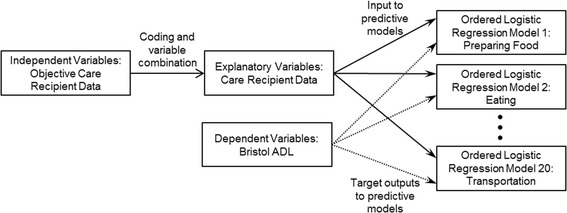
We develop a set of models that can predict the level of independence of people with dementia during 20 activities of daily living using simple, objective information. Using data collected from a Canadian survey conducted with caregivers of people with dementia, we create an ordered logistic regression model for each of the twenty daily tasks in the Bristol ADL scale.

RESULTS

Data collected from 430 Canadian caregivers of people with dementia were analyzed to reveal: most care recipients were mothers or husbands, married, living in private housing with their caregivers, English-speaking, Canadian born, clinically diagnosed with dementia 1 to 6 years prior to the study, and were dependent on their caregiver. Next, we developed models that use 13 factors to predict a person with dementia's ability to complete the 20 Bristol activities of daily living independently. The 13 factors include caregiver relation, age, marital status, place of residence, language, housing type, proximity to caregiver, service use, informal primary caregiver, diagnosis of Alzheimer's disease or dementia, time since diagnosis, and level of dependence on caregiver. The resulting models predicted the aggregate level of independence correctly for 88 of 100 total responses categories, marginally for nine, and incorrectly for three.

CONCLUSIONS

Objective, easy to collect information can predict caregiver-reported level of task independence for a person with dementia. Knowledge of task independence can then inform the development of assistive technologies for people with dementia, improving their applicability and acceptance.

摘要

背景

痴呆症患者群体并非同质化。痴呆症患者表现出广泛的需求,每种需求都由包括年龄、性别、种族和居住地点等多种因素所决定。这些需求和特征因素可能会影响为支持痴呆症患者独立生活而开发的辅助技术的适用性,最终影响其接受度。因此,在开发技术之前预测用户需求可能会提高辅助技术的适用性和接受度。目前的预测方法依赖于收集主观的、可能具有侵入性的信息,这很困难。我们提出一种预测方法,该方法使用客观的、不引人注意的、易于收集的信息来为辅助技术的开发提供参考。

方法

我们开发了一组模型,这些模型可以使用简单的客观信息预测痴呆症患者在20项日常生活活动中的独立程度。利用从加拿大对痴呆症患者护理人员进行的一项调查中收集的数据,我们为布里斯托尔日常生活活动量表中的20项日常任务分别创建了一个有序逻辑回归模型。

结果

对从430名加拿大痴呆症患者护理人员那里收集的数据进行分析后发现:大多数受照顾者是母亲或丈夫,已婚,与他们的护理人员住在私人住宅中,说英语,出生在加拿大,在研究前1至6年被临床诊断为痴呆症,并且依赖于他们的护理人员。接下来,我们开发了一些模型,这些模型使用13个因素来预测痴呆症患者独立完成布里斯托尔20项日常生活活动的能力。这13个因素包括护理人员关系、年龄、婚姻状况、居住地点、语言、住房类型、与护理人员的距离、服务使用情况、非正式主要护理人员、阿尔茨海默病或痴呆症的诊断、诊断后的时间以及对护理人员的依赖程度。最终得到的模型在总共100个反应类别中,有88个正确预测了独立程度的总体水平,9个预测接近正确,3个预测错误。

结论

客观的、易于收集的信息可以预测护理人员报告的痴呆症患者的任务独立程度。了解任务独立程度随后可为痴呆症患者辅助技术的开发提供参考,提高其适用性和接受度。
https://cdn.ncbi.nlm.nih.gov/pmc/blobs/765d/4955267/99d214557e7f/12877_2016_314_Fig2_HTML.jpg
https://cdn.ncbi.nlm.nih.gov/pmc/blobs/765d/4955267/083ca59eaca0/12877_2016_314_Fig1_HTML.jpg
https://cdn.ncbi.nlm.nih.gov/pmc/blobs/765d/4955267/99d214557e7f/12877_2016_314_Fig2_HTML.jpg
https://cdn.ncbi.nlm.nih.gov/pmc/blobs/765d/4955267/083ca59eaca0/12877_2016_314_Fig1_HTML.jpg
https://cdn.ncbi.nlm.nih.gov/pmc/blobs/765d/4955267/99d214557e7f/12877_2016_314_Fig2_HTML.jpg

相似文献

1
Predicting the role of assistive technologies in the lives of people with dementia using objective care recipient factors.利用客观的受助者因素预测辅助技术在痴呆症患者生活中的作用。
BMC Geriatr. 2016 Jul 20;16:143. doi: 10.1186/s12877-016-0314-2.
2
Caregiver perspectives on a smart home-based socially assistive robot for individuals with Alzheimer's disease and related dementia.照顾者对智能家居社交辅助机器人在阿尔茨海默病及相关痴呆患者中的应用的看法。
Disabil Rehabil Assist Technol. 2020 Oct;15(7):789-798. doi: 10.1080/17483107.2020.1753831. Epub 2020 Apr 17.
3
Care recipients' physical frailty is independently associated with subjective burden in informal caregivers in the community setting: a cross-sectional study.在社区环境中,受照护者的身体虚弱与非正式照护者的主观负担独立相关:一项横断面研究。
BMC Geriatr. 2016 Nov 17;16(1):186. doi: 10.1186/s12877-016-0355-6.
4
Keeping In Touch Everyday (KITE) project: developing assistive technologies with people with dementia and their carers to promote independence.每日保持联系(KITE)项目:与痴呆症患者及其护理人员共同开发辅助技术以促进独立生活。
Int Psychogeriatr. 2009 Jun;21(3):494-502. doi: 10.1017/S1041610209008448. Epub 2009 Feb 5.
5
Measurement of informal care time in a study of patients with dementia.在一项痴呆症患者研究中对非正式护理时间的测量。
Int Psychogeriatr. 2008 Dec;20(6):1160-76. doi: 10.1017/S1041610208007564. Epub 2008 Jul 8.
6
Optimizing Technology-Based Prompts for Supporting People Living With Dementia in Completing Activities of Daily Living at Home: Experimental Approach to Prompt Modality, Task Breakdown, and Attentional Support.优化基于技术的提示,以支持在家中完成日常生活活动的痴呆症患者:提示方式、任务分解和注意力支持的实验方法。
JMIR Aging. 2024 Aug 23;7:e56055. doi: 10.2196/56055.
7
The use of assistive technology in the everyday lives of young people living with dementia and their caregivers. Can a simple remote control make a difference?辅助技术在患有痴呆症的年轻人及其照顾者日常生活中的应用。一个简单的遥控器能产生影响吗?
Int Psychogeriatr. 2014 Dec;26(12):2011-21. doi: 10.1017/S1041610214001069. Epub 2014 Jun 16.
8
Differences in assistive technology installed for people with dementia living at home who have wandering and safety risks.居家痴呆症患者中,存在走失和安全风险的人群所使用的辅助技术的差异。
BMC Geriatr. 2021 Oct 30;21(1):613. doi: 10.1186/s12877-021-02546-7.
9
Toward user-centered assistive technologies for aging in place with cognitive impairment: a survey.面向以用户为中心的认知障碍老年人就地养老辅助技术:一项调查。
Disabil Rehabil Assist Technol. 2024 May;19(4):1561-1567. doi: 10.1080/17483107.2023.2217848. Epub 2023 Jun 2.
10
Assistive technologies in reducing caregiver burden among informal caregivers of older adults: a systematic review.辅助技术减轻老年人非正式照料者的照料负担:一项系统综述
Disabil Rehabil Assist Technol. 2016;11(5):353-60. doi: 10.3109/17483107.2015.1087061. Epub 2015 Sep 15.

引用本文的文献

1
Dissecting Alzheimer's Disease Risk in Asian American Elders: A Classification and Regression Tree Approach.剖析美国亚裔老年人患阿尔茨海默病的风险:一种分类与回归树方法。
J Alzheimers Dis Rep. 2024 Mar 19;8(1):517-530. doi: 10.3233/ADR-230162. eCollection 2024.
2
Tele-Medicine Based and Self-Administered Interactive Exercise Program (Tele-Exergame) to Improve Cognition in Older Adults with Mild Cognitive Impairment or Dementia: A Feasibility, Acceptability, and Proof-of-Concept Study.基于远程医疗和自我管理的互动式运动游戏(远程健智游戏)改善轻度认知障碍或痴呆老年人认知功能:一项可行性、可接受性和概念验证研究。
Int J Environ Res Public Health. 2022 Dec 6;19(23):16361. doi: 10.3390/ijerph192316361.
3

本文引用的文献

1
A predictive model for assistive technology adoption for people with dementia.用于痴呆症患者的辅助技术采用的预测模型。
IEEE J Biomed Health Inform. 2014 Jan;18(1):375-83. doi: 10.1109/JBHI.2013.2267549.
2
Living alone with dementia.独居与痴呆症
Dementia (London). 2013 Jan;12(1):123-36. doi: 10.1177/1471301211420331. Epub 2011 Oct 16.
3
Are there sensitive time periods for dementia caregivers? The occurrence of behavioral and psychological symptoms in the early stages of dementia.痴呆症照顾者是否存在敏感时期?痴呆症早期出现行为和心理症状。
Carers' experiences of assistive technology use in dementia care: a cross sectional survey.
照顾者在痴呆症护理中使用辅助技术的体验:一项横断面调查。
BMC Geriatr. 2021 Aug 25;21(1):471. doi: 10.1186/s12877-021-02417-1.
4
Literature review: technological interventions and their impact on quality of life for people living with dementia.文献综述:技术干预及其对痴呆症患者生活质量的影响。
BMJ Health Care Inform. 2020 Jan;27(1). doi: 10.1136/bmjhci-2019-100064.
5
Smartphone-Based Interventions to Foster Simple Activity and Personal Satisfaction in People With Advanced Alzheimer's Disease.基于智能手机的干预措施,以促进晚期阿尔茨海默病患者的简单活动和个人满足感。
Am J Alzheimers Dis Other Demen. 2019 Nov-Dec;34(7-8):478-485. doi: 10.1177/1533317519844144. Epub 2019 Apr 23.
6
Exploring assistive technology as a potential beneficial intervention tool for people with Alzheimer's disease - a systematic review.探索辅助技术作为阿尔茨海默病患者潜在有益干预工具的系统评价。
Neuropsychiatr Dis Treat. 2018 Nov 16;14:3151-3158. doi: 10.2147/NDT.S181849. eCollection 2018.
7
Supporting Simple Activity Engagement in Persons With Moderate to Severe Alzheimer's Disease Through a Technology-Aided Program.通过一项技术辅助计划支持中重度阿尔茨海默病患者进行简单活动参与。
Am J Alzheimers Dis Other Demen. 2017 May;32(3):137-144. doi: 10.1177/1533317517698793. Epub 2017 Mar 21.
Int Psychogeriatr. 2013 Sep;25(9):1453-62. doi: 10.1017/S1041610213000768. Epub 2013 Jun 3.
4
The identification of assistive technologies being used to support the daily occupations of community-dwelling older adults with dementia: a cross-sectional pilot study.用于支持社区居住的老年痴呆症患者日常活动的辅助技术识别:一项横断面试点研究。
Disabil Rehabil Assist Technol. 2014 Jan;9(1):17-30. doi: 10.3109/17483107.2013.785035. Epub 2013 Apr 22.
5
How do family carers respond to behavioral and psychological symptoms of dementia?家庭照顾者如何应对痴呆症的行为和心理症状?
Int Psychogeriatr. 2013 May;25(5):743-53. doi: 10.1017/S1041610213000070. Epub 2013 Feb 21.
6
Behavioral and psychological symptoms of dementia.痴呆的行为和心理症状
Front Neurol. 2012 May 7;3:73. doi: 10.3389/fneur.2012.00073. eCollection 2012.
7
2012 Alzheimer's disease facts and figures.2012 年阿尔茨海默病事实和数据。
Alzheimers Dement. 2012;8(2):131-68. doi: 10.1016/j.jalz.2012.02.001.
8
The meaning of "aging in place" to older people.“原地老化”对老年人的意义。
Gerontologist. 2012 Jun;52(3):357-66. doi: 10.1093/geront/gnr098. Epub 2011 Oct 7.
9
Living alone with dementia: lack of awareness adds to functional and cognitive vulnerabilities.独居痴呆症患者:缺乏意识增加了功能和认知方面的脆弱性。
Int Psychogeriatr. 2010 Aug;22(5):778-84. doi: 10.1017/S1041610209991529. Epub 2010 May 18.
10
Short-form Zarit Caregiver Burden Interviews were valid in advanced conditions.简短版 ZBI 照顾者负担量表在晚期情况下是有效的。
J Clin Epidemiol. 2010 May;63(5):535-42. doi: 10.1016/j.jclinepi.2009.06.014.