Department of Chemistry, University of Cambridge, Lensfield Road, Cambridge, CB2 1EW, UK.
Cancer Research, UK, Cambridge Institute, Li Ka Shing Centre, University of Cambridge, Robinson Way, Cambridge, CB2 0RE, UK.
Angew Chem Int Ed Engl. 2016 Sep 5;55(37):11144-8. doi: 10.1002/anie.201605531. Epub 2016 Jul 21.
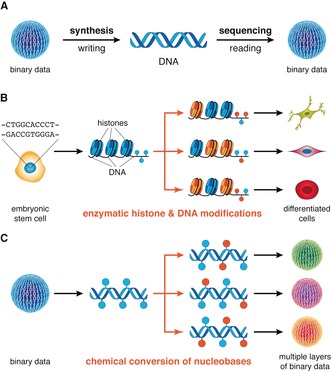
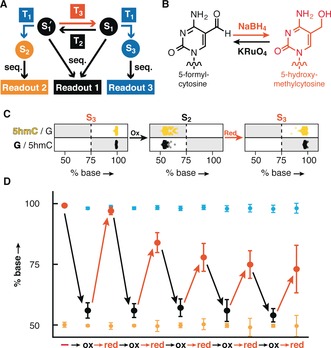
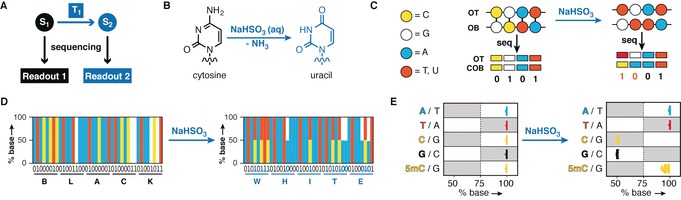
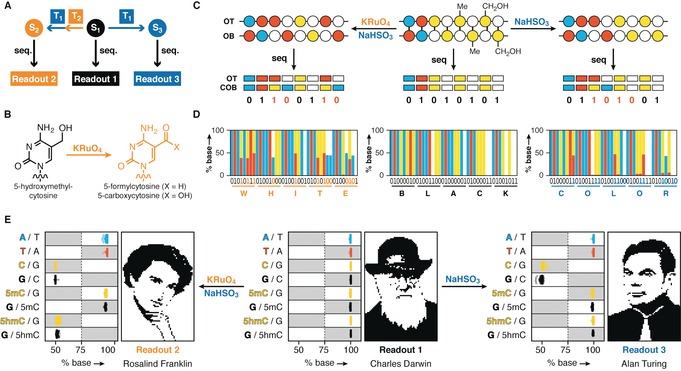
Biopolymers are an attractive alternative to store and circulate information. DNA, for example, combines remarkable longevity with high data storage densities and has been demonstrated as a means for preserving digital information. Inspired by the dynamic, biological regulation of (epi)genetic information, we herein present how binary data can undergo controlled changes when encoded in synthetic DNA strands. By exploiting differential kinetics of hydrolytic deamination reactions of cytosine and its naturally occurring derivatives, we demonstrate how multiple layers of information can be stored in a single DNA template. Moreover, we show that controlled redox reactions allow for interconversion of these DNA-encoded layers of information. Overall, such interlacing of multiple messages on synthetic DNA libraries showcases the potential of chemical reactions to manipulate digital information on (bio)polymers.
生物聚合物是存储和传播信息的一种有吸引力的选择。例如,DNA 具有出色的耐久性、高数据存储密度,并已被证明是保存数字信息的一种手段。受(表观)遗传信息动态生物调控的启发,本文展示了如何在合成 DNA 链中对二进制数据进行编码,以实现受控变化。通过利用胞嘧啶及其天然衍生物的水解脱氨反应的差异动力学,我们证明了如何在单个 DNA 模板中存储多层信息。此外,我们还表明,受控的氧化还原反应允许这些 DNA 编码的信息层之间的相互转换。总的来说,这种在合成 DNA 文库上交织的多个信息展示了化学反应在(生物)聚合物上操纵数字信息的潜力。