Vandeweghe Laura, Vervoort Leentje, Verbeken Sandra, Moens Ellen, Braet Caroline
Department of Developmental, Personality and Social Psychology, Ghent University Ghent, Belgium.
Front Psychol. 2016 Jun 24;7:928. doi: 10.3389/fpsyg.2016.00928. eCollection 2016.
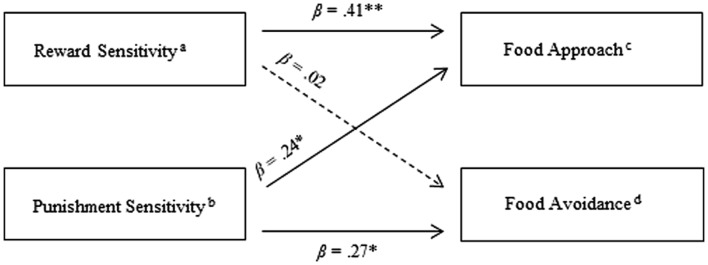
It has recently been suggested that individual differences in Reward Sensitivity and Punishment Sensitivity may determine how children respond to food. These temperamental traits reflect activity in two basic brain systems that respond to rewarding and punishing stimuli, respectively, with approach and avoidance. Via parent-report questionnaires, we investigate the associations of the general motivational temperamental traits Reward Sensitivity and Punishment Sensitivity with Food Approach and Food Avoidance in 98 preschool children. Consistent with the conceptualization of Reward Sensitivity in terms of approach behavior and Punishment Sensitivity in terms of avoidance behavior, Reward Sensitivity was positively related to Food Approach, while Punishment Sensitivity was positively related to Food Avoidance. Future research should integrate these perspectives (i.e., general temperamental traits Reward Sensitivity and Punishment Sensitivity, and Food Approach and Avoidance) to get a better understanding of eating behavior and related body weight.
最近有人提出,奖励敏感性和惩罚敏感性的个体差异可能决定儿童对食物的反应方式。这些气质特征分别反映了两个基本脑系统的活动,这两个系统通过趋近和回避对奖励性和惩罚性刺激做出反应。通过家长报告问卷,我们调查了98名学龄前儿童的一般动机性气质特征奖励敏感性和惩罚敏感性与食物趋近和食物回避之间的关联。与奖励敏感性在趋近行为方面的概念化以及惩罚敏感性在回避行为方面的概念化一致,奖励敏感性与食物趋近呈正相关,而惩罚敏感性与食物回避呈正相关。未来的研究应整合这些观点(即一般气质特征奖励敏感性和惩罚敏感性,以及食物趋近和回避),以更好地理解饮食行为和相关体重。