Deziel Nicole C, Freeman Laura E Beane, Graubard Barry I, Jones Rena R, Hoppin Jane A, Thomas Kent, Hines Cynthia J, Blair Aaron, Sandler Dale P, Chen Honglei, Lubin Jay H, Andreotti Gabriella, Alavanja Michael C R, Friesen Melissa C
Division of Cancer Epidemiology and Genetics, National Cancer Institute, National Institutes of Health, Department of Human Health and Services, Bethesda, Maryland, USA.
Environ Health Perspect. 2017 Mar;125(3):296-305. doi: 10.1289/EHP426. Epub 2016 Jul 26.
Increased pesticide concentrations in house dust in agricultural areas have been attributed to several exposure pathways, including agricultural drift, para-occupational, and residential use.
To guide future exposure assessment efforts, we quantified relative contributions of these pathways using meta-regression models of published data on dust pesticide concentrations.
From studies in North American agricultural areas published from 1995 to 2015, we abstracted dust pesticide concentrations reported as summary statistics [e.g., geometric means (GM)]. We analyzed these data using mixed-effects meta-regression models that weighted each summary statistic by its inverse variance. Dependent variables were either the log-transformed GM (drift) or the log-transformed ratio of GMs from two groups (para-occupational, residential use).
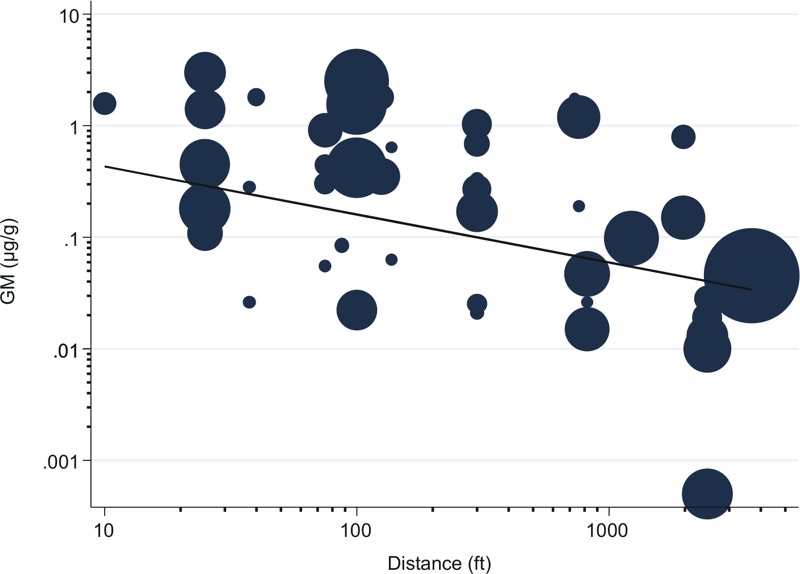
For the drift pathway, predicted GMs decreased sharply and nonlinearly, with GMs 64% lower in homes 250 m versus 23 m from fields (interquartile range of published data) based on 52 statistics from seven studies. For the para-occupational pathway, GMs were 2.3 times higher [95% confidence interval (CI): 1.5, 3.3; 15 statistics, five studies] in homes of farmers who applied pesticides more recently or frequently versus less recently or frequently. For the residential use pathway, GMs were 1.3 (95% CI: 1.1, 1.4) and 1.5 (95% CI: 1.2, 1.9) times higher in treated versus untreated homes, when the probability that a pesticide was used for the pest treatment was 1-19% and ≥ 20%, respectively (88 statistics, five studies).
Our quantification of the relative contributions of pesticide exposure pathways in agricultural populations could improve exposure assessments in epidemiologic studies. The meta-regression models can be updated when additional data become available. Citation: Deziel NC, Beane Freeman LE, Graubard BI, Jones RR, Hoppin JA, Thomas K, Hines CJ, Blair A, Sandler DP, Chen H, Lubin JH, Andreotti G, Alavanja MC, Friesen MC. 2017. Relative contributions of agricultural drift, para-occupational, and residential use exposure pathways to house dust pesticide concentrations: meta-regression of published data. Environ Health Perspect 125:296-305; http://dx.doi.org/10.1289/EHP426.
农业地区室内灰尘中农药浓度升高归因于多种暴露途径,包括农业漂移、准职业暴露和家庭使用。
为指导未来的暴露评估工作,我们使用已发表的灰尘农药浓度数据的meta回归模型量化了这些途径的相对贡献。
从1995年至2015年发表的北美农业地区研究中,我们提取了报告为汇总统计量(如几何均值(GM))的灰尘农药浓度。我们使用混合效应meta回归模型分析这些数据,该模型以每个汇总统计量的逆方差对其进行加权。因变量要么是对数转换后的GM(漂移),要么是两组GM的对数转换比值(准职业暴露、家庭使用)。
对于漂移途径,预测的GM急剧且非线性下降,基于七项研究的52个统计数据,距离田地250米处房屋的GM比距离23米处房屋低64%(已发表数据的四分位间距)。对于准职业暴露途径,最近或频繁使用农药的农民家庭中的GM比不那么频繁使用农药的农民家庭高2.3倍[95%置信区间(CI):1.5, 3.3;15个统计数据,五项研究]。对于家庭使用途径,当农药用于害虫防治的概率分别为1-19%和≥20%时,使用农药的家庭中的GM分别比未使用农药的家庭高1.3倍(95%CI:1.1, 1.4)和1.5倍(95%CI:1.2, 1.9)(88个统计数据,五项研究)。
我们对农业人群中农药暴露途径相对贡献的量化可以改善流行病学研究中的暴露评估。当有更多数据可用时,可以更新meta回归模型。引文:Deziel NC, Beane Freeman LE, Graubard BI, Jones RR, Hoppin JA, Thomas K, Hines CJ, Blair A, Sandler DP, Chen H, Lubin JH, Andreotti G, Alavanja MC, Friesen MC. 2017. 农业漂移、准职业暴露和家庭使用暴露途径对室内灰尘农药浓度的相对贡献:已发表数据的meta回归。环境健康展望125:296-305;http://dx.doi.org/10.1289/EHP426。